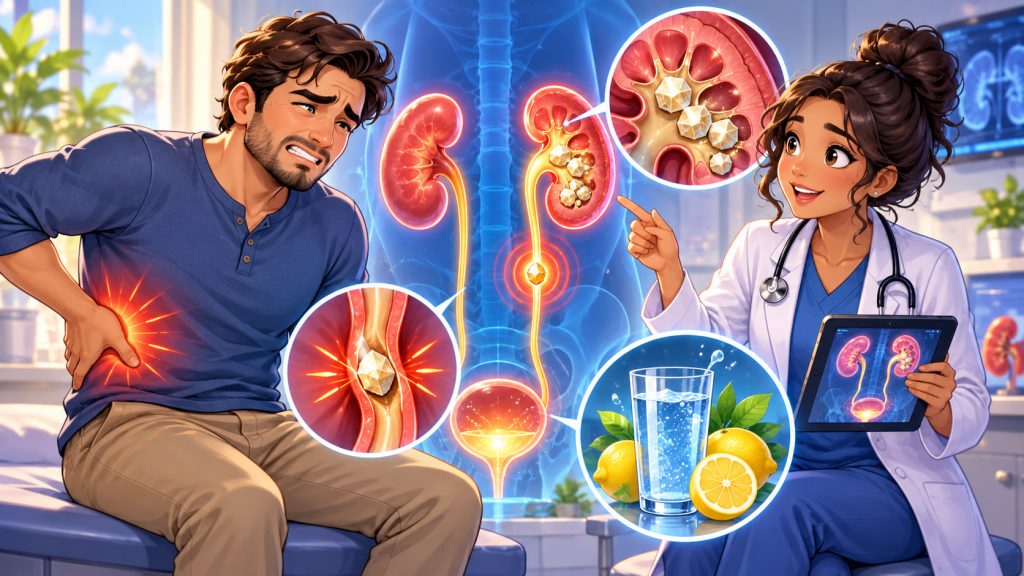
Kidney stones can cause some of the most intense pain a person will ever experience. What begins as a tiny collection of crystals inside the kidney can develop into a hard deposit capable of blocking urine flow and triggering severe discomfort.
Millions of people worldwide experience kidney stones, and many develop them more than once.
But why do these stones form? Is the problem caused by drinking too little water, eating the wrong foods, inherited characteristics, or something happening inside the kidneys?
The answer often involves several factors working together.
Understanding what causes kidney stones, recognizing the warning signs, and making targeted lifestyle changes can significantly reduce the risk of future episodes.
What Are Kidney Stones?
Kidney stones are solid deposits formed from minerals and other substances normally dissolved in urine.
Under ordinary conditions, urine contains compounds that help prevent these substances from forming large crystals.
However, when certain minerals become too concentrated, crystals can develop and gradually grow.
This process is called crystallization.
Stones may remain inside the kidneys without causing noticeable symptoms.
Problems often begin when a stone moves into the ureter, the narrow tube connecting a kidney to the bladder.
A stone that obstructs this passage can cause intense pain and interfere with normal urine drainage.
The Main Types of Kidney Stones
Kidney stones are not all made from the same materials.
Their composition influences both treatment and prevention.
The most common varieties include:
- Calcium oxalate stones — The most common type, formed primarily from calcium and oxalate.
- Uric acid stones — Develop when urine chemistry favors the formation of uric acid crystals, particularly in acidic urine.
- Struvite stones — Often associated with urinary infections caused by certain bacteria.
- Cystine stones — Rare stones linked to an inherited disorder affecting how the kidneys process cystine.
Calcium phosphate stones are another important category.
Identifying the stone’s composition helps doctors recommend the most appropriate prevention strategy.
Dehydration: One of the Biggest Risk Factors
Insufficient fluid intake is a major contributor to kidney stone formation.
When the body loses more water than it receives, urine becomes more concentrated.
This increases the likelihood that dissolved minerals will form crystals.
People who work in hot environments, exercise intensely, or sweat heavily may face additional risks if they do not replace lost fluids.
For many adults prone to kidney stones, specialists recommend drinking enough fluid to produce at least 2–2.5 liters of urine daily.
Achieving this may require approximately 2.5–3 liters or more of fluid intake, depending on individual circumstances.
Adequate hydration is one of the most effective general measures for preventing kidney stones.
People with medical conditions requiring fluid restrictions should follow individualized medical advice.
Can Your Diet Cause Kidney Stones?
Diet can significantly influence the chemical composition of urine.
One important factor is excessive sodium consumption.
High sodium intake can increase urinary calcium excretion, potentially encouraging calcium-containing stones.
Large amounts of animal protein may also increase certain stone-forming substances and reduce protective urinary compounds.
Another dietary consideration is oxalate, a naturally occurring substance found in foods such as spinach, rhubarb, almonds, and chocolate.
However, eliminating all oxalate-containing foods is generally unnecessary.
The appropriate dietary approach depends on stone composition and individual metabolic risk factors.
The Surprising Truth About Calcium
Because many kidney stones contain calcium, people sometimes assume they should avoid calcium-rich foods.
This is a common misunderstanding.
Normal dietary calcium actually helps reduce the absorption of oxalate in the digestive tract.
When calcium binds oxalate in the intestines, less oxalate may enter the bloodstream and eventually reach the urine.
For many adults with calcium stones, recommended dietary calcium intake remains approximately 1,000–1,200 milligrams daily.
Food sources are generally preferred over unnecessary supplements.
Reducing dietary calcium too much can increase the risk of certain kidney stones rather than prevent them.
Calcium supplements should be discussed with a healthcare professional when kidney stones are a recurring problem.
Who Is Most Likely to Develop Kidney Stones?
Several factors increase the likelihood of developing stones.
These include:
- Family history of kidney stones
- Previous stone episodes
- Low fluid intake
- High sodium consumption
- Obesity and certain metabolic disorders
- Some digestive diseases and intestinal surgeries
- Recurrent urinary infections
- Certain medications and supplements
Genetics can influence how the kidneys process calcium, oxalate, and other substances.
Environmental conditions also matter.
People living in hot climates may experience greater fluid losses, increasing the risk of concentrated urine.
What Does Kidney Stone Pain Feel Like?
Kidney stone pain often begins suddenly.
A typical episode may involve severe pain in the side or back, beneath the ribs.
The pain can radiate toward the lower abdomen or groin as the stone moves.
Other symptoms may include nausea, vomiting, frequent urination, and blood in the urine.
Pain caused by a stone traveling through the ureter is called renal colic.
Unlike ordinary muscle pain, renal colic may come in waves and make it difficult to find a comfortable position.
Some stones cause little discomfort, particularly when they remain inside the kidney without obstructing urine flow.
When Kidney Stones Become Dangerous
Most kidney stones are not immediately life-threatening, but certain complications require urgent medical care.
A stone can block urine drainage, causing swelling of the kidney called hydronephrosis.
Obstruction becomes especially dangerous when combined with infection.
Severe flank pain accompanied by fever or chills requires emergency medical assessment because an infected, obstructed kidney can lead to sepsis.
Inability to urinate, uncontrolled pain, persistent vomiting, or symptoms in someone with a single functioning kidney also require urgent assessment.
Delaying treatment in these situations can threaten kidney function.
How Doctors Diagnose Kidney Stones
Doctors evaluate symptoms, medical history, urine tests, and imaging findings.
Urine testing may identify blood or evidence of infection.
Ultrasound can detect many kidney stones and signs of urinary obstruction.
A noncontrast CT scan is highly effective for detecting stones and determining their size and location.
However, ultrasound is often preferred initially in pregnancy and children because it avoids ionizing radiation.
Blood tests may assess kidney function, calcium levels, and other relevant measurements.
Whenever possible, a passed or surgically removed stone should be analyzed to determine its composition.
Can Kidney Stones Pass Naturally?
Small stones sometimes pass through the urinary tract without surgery.
The likelihood depends on stone size, location, anatomy, and the degree of obstruction.
Stones smaller than approximately 5 millimeters have a relatively favorable chance of passing spontaneously, although this is not guaranteed.
Doctors may recommend pain relief, observation, and appropriate fluid intake.
In selected cases, medications such as alpha blockers may help certain ureteral stones pass.
However, forcing excessive amounts of water during severe renal colic does not reliably accelerate stone passage and may worsen discomfort.
A stone should be monitored until passage or resolution of obstruction is confirmed.
Modern Treatments for Kidney Stones
Stones that cannot pass naturally may require medical procedures.
Shock wave lithotripsy uses externally generated shock waves to fragment suitable stones into smaller pieces.
Another technique, ureteroscopy, involves passing a thin instrument through the urinary tract to locate and remove or break up a stone.
Large or complex kidney stones may require other minimally invasive surgical approaches.
An infected, obstructed kidney generally requires urgent drainage and antibiotics before definitive stone removal.
Treatment selection depends on the stone’s characteristics, infection status, kidney function, and patient circumstances.
Expert Perspective: Prevention Must Be Personalized
Urologists following established clinical guidelines emphasize that recurrent kidney stone prevention should be tailored to the individual.
Stone composition, medical history, dietary habits, and urine chemistry all provide important information.
For recurrent stone formers, a 24-hour urine test can measure substances such as calcium, oxalate, citrate, uric acid, and sodium.
The results help identify specific abnormalities.
Doctors may recommend dietary adjustments or preventive medications, including selected treatments that alter urine chemistry.
The best prevention plan is based on the cause of stone formation, not a universal list of forbidden foods.
How to Reduce the Risk of Future Kidney Stones
Several practical habits can help protect kidney health.
Drink water regularly throughout the day, particularly during hot weather or physical activity.
Limit excessive salt intake and avoid unnecessarily high consumption of animal protein.
Maintain normal dietary calcium intake and eat a balanced diet containing vegetables and fruit.
Some citrus fruits provide citrate, a substance that can help inhibit certain types of stone formation.
Avoid high-dose vitamin C supplements unless medically indicated, since excessive supplementation may increase urinary oxalate in susceptible individuals.
For people with previous stones, follow-up testing and individualized prevention are especially valuable.
Interesting Facts
- Kidney stones can range from microscopic crystals to deposits several centimeters across.
- Calcium oxalate stones account for the majority of kidney stone cases.
- Some kidney stones remain inside the kidneys for years without producing noticeable symptoms.
- Hot weather can increase kidney stone risk by promoting dehydration.
- Kidney stones can occur in children as well as adults.
- Certain infection-related stones can grow into branching structures that occupy large portions of the kidney’s collecting system.
- A normal amount of calcium in the diet can help protect against calcium oxalate stones.
- Not every kidney stone is visible on a conventional abdominal X-ray.
- Kidney stone recurrence is common, making preventive care particularly important.
Glossary
- Crystallization — The process by which dissolved substances form solid crystals.
- Calcium Oxalate Stones — Kidney stones composed primarily of calcium combined with oxalate.
- Uric Acid Stones — Stones formed from uric acid, often associated with persistently acidic urine.
- Struvite Stones — Stones associated with certain bacterial urinary tract infections.
- Cystine Stones — Rare stones caused by an inherited disorder affecting cystine transport.
- Oxalate — A naturally occurring substance found in many foods that can contribute to calcium oxalate stone formation.
- Renal Colic — Severe pain commonly caused by a kidney stone obstructing the ureter.
- Hydronephrosis — Swelling of a kidney caused by impaired urine drainage.
- Noncontrast CT Scan — A computed tomography examination performed without intravenous contrast material, frequently used to detect urinary stones.
- Shock Wave Lithotripsy — A treatment that uses shock waves to break suitable kidney stones into smaller fragments.
- Ureteroscopy — A procedure using a thin instrument inserted through the urinary tract to examine or treat stones.
- 24-Hour Urine Test — A laboratory analysis of urine collected over an entire day to evaluate substances involved in kidney stone formation.