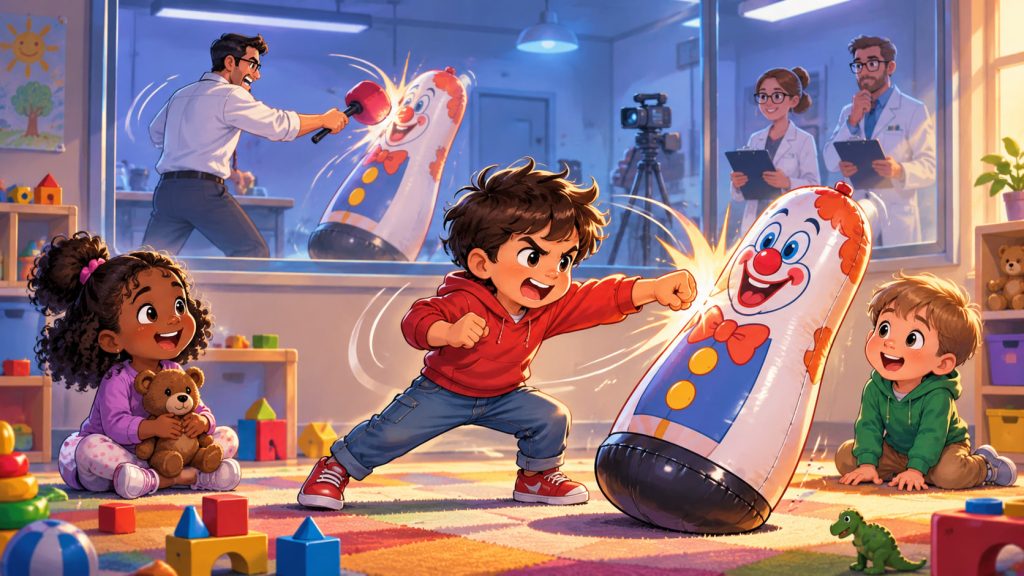
Can children learn aggressive behavior simply by watching adults?
In 1961, psychologist Albert Bandura conducted a groundbreaking experiment that transformed our understanding of how human behavior develops.
Known as the Bobo Doll Experiment, this famous psychological study demonstrated that children can acquire new behaviors by observing other people, even without receiving direct rewards or instructions.
The experiment challenged traditional explanations of learning and helped establish one of the most influential ideas in modern psychology: people learn not only through personal experience but also by watching others.
Its findings remain relevant to parenting, education, social behavior, and discussions about the influence of media.
Who Was Albert Bandura?
Albert Bandura was a Canadian-American psychologist who became one of the most influential researchers in behavioral and social psychology.
During the mid-20th century, many psychologists focused on behaviorism, which emphasized learning through rewards, punishments, and direct experience.
Bandura believed this explanation was incomplete.
He proposed that people could acquire behaviors simply by observing what others did.
This process became known as observational learning.
His research helped develop social learning theory, which explains how behavior is influenced by observing other people and the consequences of their actions.
To test these ideas, Bandura designed an experiment involving preschool children and an unusual inflatable toy.
What Was the Bobo Doll Experiment?
The Bobo Doll Experiment was conducted in 1961 at Stanford University by Albert Bandura and his colleagues Dorothea Ross and Sheila A. Ross.
The study involved 72 preschool children, including 36 boys and 36 girls.
The children were approximately three to five years old.
Researchers wanted to determine whether children would reproduce aggressive actions after watching an adult behave aggressively toward a toy.
The toy was a Bobo doll, a large inflatable figure with a weighted base.
When struck or pushed, the doll would fall backward and then return to an upright position.
This made it particularly suitable for observing repeated physical actions.
The central question was straightforward:
Would children imitate aggressive behavior they had witnessed, even when nobody instructed them to do so?
How the Experiment Was Conducted
Researchers divided the children into three main conditions.
One group observed an adult behaving aggressively toward the Bobo doll.
Another group watched an adult behaving calmly and playing with other toys.
A third group served as the control group and did not observe an adult model before the testing phase.
In the aggressive condition, the adult performed several distinctive actions:
- Striking the Bobo doll with a mallet
- Punching the doll
- Kicking it
- Throwing it around
- Making aggressive verbal statements
The children observed these actions without being instructed to copy them.
In the non-aggressive condition, the adult played quietly and ignored the Bobo doll.
Afterward, the children experienced a mild frustration procedure in which attractive toys were made temporarily unavailable.
They were then taken into another room containing various toys, including a Bobo doll.
Researchers observed their behavior for approximately 20 minutes.
What Did the Children Do?
The results were striking.
Children who watched an aggressive adult were significantly more likely to reproduce aggressive actions than children in the other conditions.
Some copied the adult’s specific movements.
Others repeated aggressive phrases they had heard.
Several children performed distinctive behaviors that were unlikely to have occurred in exactly the same form without exposure to the adult model.
This provided evidence of imitation, the reproduction of behavior previously observed in another individual.
The children did not need direct instructions or rewards to demonstrate what they had learned.
The researchers also found differences associated with the sex of the child and the adult model.
Boys generally displayed more imitative physical aggression than girls, particularly after observing a male aggressive model.
However, both boys and girls demonstrated the ability to learn through observation.
Why the Experiment Changed Psychology
Before Bandura’s research, learning was often explained primarily through direct reinforcement.
According to this perspective, behavior became more or less likely depending on whether it produced rewards or punishments.
Bandura demonstrated that another important mechanism was involved.
Children could acquire unfamiliar behavior simply by watching another person perform it.
This process is called modeling.
A model can be a parent, teacher, sibling, friend, or another individual whose behavior attracts attention.
Bandura’s findings showed that learning can occur without immediately performing the learned behavior.
This distinction became essential to understanding human development.
People may observe and remember a behavior without necessarily choosing to reproduce it.
Did Rewards and Punishments Influence Imitation?
Bandura continued investigating observational learning after the original experiment.
In a notable 1965 study, children watched filmed models whose aggressive actions were rewarded, punished, or followed by no visible consequences.
Children were less likely to spontaneously imitate behavior when they had seen the model punished.
However, when offered incentives to demonstrate what they remembered, children across the conditions could reproduce many of the observed actions.
This illustrated an important distinction between acquiring knowledge and deciding to act on it.
The concept of vicarious reinforcement describes how observing rewards received by another person can influence an observer’s willingness to perform similar behavior.
Children may learn a behavior without displaying it immediately, and the consequences they observe can influence whether they perform it.
What Does the Experiment Tell Us About Children?
The Bobo Doll Experiment revealed that adults can influence children’s behavior through everyday actions.
Children observe much more than explicit instructions.
They notice how adults respond to frustration, disagreement, success, and disappointment.
For example, a child who frequently observes adults shouting during arguments may learn that shouting is one possible response to conflict.
Alternatively, children who observe calm discussion, cooperation, and constructive problem-solving can acquire those behavioral patterns.
Observational learning is therefore not limited to aggression.
It also contributes to the development of communication skills, cooperation, emotional responses, and everyday habits.
Expert Perspective: Bandura’s Broader Theory
Albert Bandura later expanded his research into social cognitive theory.
His work emphasized that human behavior develops through interactions between personal characteristics, behavior, and the surrounding environment.
Bandura recognized that individuals are not simply passive recipients of outside influences.
Attention, memory, motivation, expectations, and personal decisions all influence whether observed behavior is reproduced.
This helps explain why two children exposed to similar situations may respond differently.
Observing aggression can teach a child an aggressive response, but it does not mean the child will inevitably become aggressive.
That distinction is essential when applying the experiment to real-world behavior.
Limitations of the Bobo Doll Experiment
Although highly influential, the experiment had important limitations.
It took place in a controlled laboratory rather than a natural home or school environment.
The participants were also a relatively small group of children recruited from a Stanford nursery school.
Furthermore, hitting an inflatable doll is not necessarily equivalent to deliberately hurting another person.
The researchers measured behavior shortly after the children observed an adult.
The original experiment therefore did not establish whether these behaviors would persist for months or years.
These limitations do not erase the study’s contribution.
They help clarify what it demonstrated: children can reproduce newly observed aggressive actions under controlled experimental conditions.
Why the Bobo Doll Experiment Still Matters Today
The findings have influenced research into childhood development, education, parenting, and social behavior.
They also contributed to scientific discussions about the possible effects of television, online videos, and other media.
Modern research recognizes that responses to observed behavior depend on multiple factors, including age, context, family environment, and individual characteristics.
The Bobo Doll Experiment remains particularly valuable for understanding how examples can shape behavior.
Parents and educators can apply its central insight by demonstrating patience, cooperation, respect, and constructive ways to handle disagreements.
Positive behavior can also be learned through observation.
Interesting Facts
- The original Bobo Doll Experiment was published in 1961 and involved 72 preschool children.
- The Bobo doll’s weighted base allowed it to return upright after being knocked over.
- The aggressive adult model used both physical actions and verbal expressions.
- Children were observed through a one-way mirror during the final experimental phase.
- Bandura and his colleagues studied differences in children’s responses to male and female adult models.
- Later experiments used filmed models to investigate whether behavior could also be learned through recorded demonstrations.
- Albert Bandura became one of the most influential psychologists of the 20th century, and his research extended far beyond childhood aggression.
Glossary
- Observational Learning — Learning new behaviors, skills, or responses by watching other individuals.
- Social Learning Theory — A psychological theory explaining how people acquire behaviors through observation and social experience.
- Control Group — A group of participants used as a comparison in an experiment without receiving the main experimental treatment.
- Imitation — Reproducing actions or behaviors previously observed in another person.
- Modeling — The process through which an individual’s behavior serves as an example that others may learn from.
- Vicarious Reinforcement — A process in which observing another person’s rewards influences the observer’s motivation to perform similar behavior.