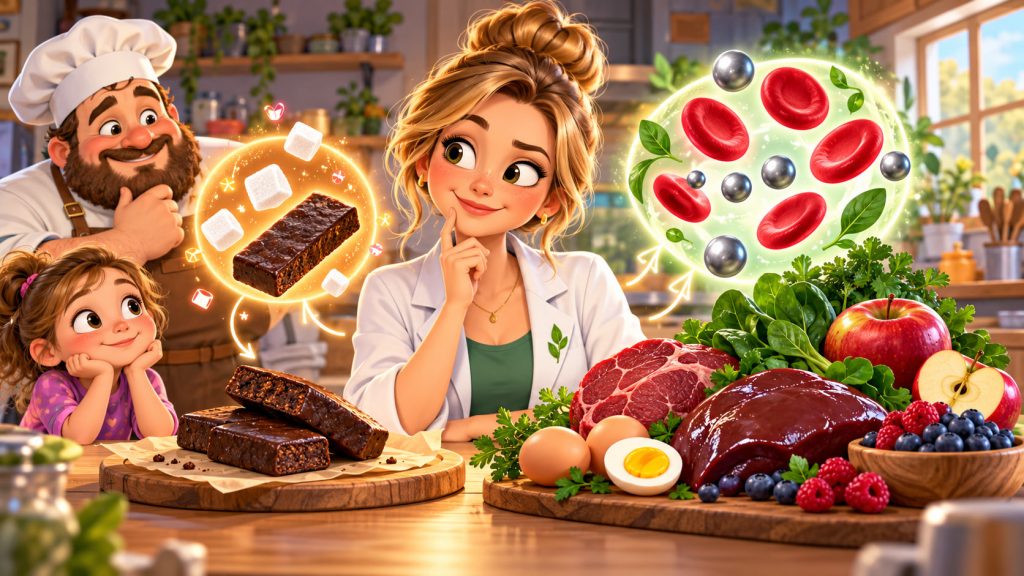
Hematogen is a sweet bar familiar to generations of people across Russia and other post-Soviet countries. It is often associated with childhood, pharmacies, and the idea that eating one can quickly “raise iron” or improve blood health.
Its reputation has a real historical basis. Traditional hematogen contains processed animal blood proteins, usually in the form of black food albumin, combined with ingredients such as sugar, condensed milk, syrup, or flavorings.
But modern hematogen sits somewhere between a nutritional supplement and a confectionery product. It can provide iron and protein, but it is not automatically a treatment for iron deficiency, and eating more is not necessarily better.
What Is Hematogen Actually Made From?
Traditional hematogen contains black food albumin produced from processed cattle blood.
Blood naturally contains hemoglobin and iron, which explains why hematogen became associated with supporting blood formation.
Modern recipes vary considerably. A typical product may also contain:
- Sugar
- Glucose syrup
- Condensed milk
- Honey
- Nuts or seeds
- Coconut
- Chocolate coatings
- Vitamins or additional minerals
Some products contain additional iron compounds, while others rely mainly on ingredients derived from blood.
This variation is important because two bars called “hematogen” may have very different nutritional compositions.
Why Iron Is Important
Iron is required for the production of hemoglobin, the protein inside red blood cells that carries oxygen from the lungs to tissues.
Without enough iron, the body gradually loses its ability to produce normal amounts of healthy red blood cells.
This can eventually lead to iron-deficiency anemia.
Symptoms may include fatigue, weakness, pale skin, shortness of breath during activity, headaches, reduced exercise capacity, and difficulty concentrating.
However, fatigue alone does not prove that someone has iron deficiency.
Many different conditions can cause similar symptoms.
Does Hematogen Really Contain Useful Iron?
Yes, traditional hematogen can provide iron.
Some of that iron originates from blood-derived ingredients and may be biologically available. Animal tissues contain heme iron, which the human body generally absorbs more efficiently than many forms of non-heme iron found in plants.
However, the exact iron content of hematogen depends heavily on the formulation.
Some bars contain relatively modest amounts, while others are fortified with additional iron.
This is why the label matters.
Hematogen should not be judged by its name alone. The amount and form of iron in the actual product determine its nutritional value.
Hematogen Is Not a Reliable Treatment for Anemia
One of the biggest misconceptions is that someone diagnosed with anemia can simply eat hematogen instead of taking prescribed iron.
That is usually not appropriate.
Medical treatment of iron deficiency typically uses controlled doses of iron designed to provide a known amount of elemental iron.
Hematogen may contain some iron, but the dose can be too low or unpredictable to correct significant deficiency efficiently.
Doctors also need to determine why iron deficiency developed.
Possible causes include heavy menstrual bleeding, gastrointestinal blood loss, pregnancy, poor dietary intake, malabsorption, or other medical conditions.
Treating the symptom without identifying the cause can delay proper care.
Ferritin Matters More Than Guessing
One of the most useful markers for evaluating the body’s iron stores is ferritin.
Low ferritin often indicates depleted iron reserves, although inflammation and some diseases can complicate interpretation.
Hemoglobin can remain normal during the early stages of iron depletion.
This means a person may already have low iron stores before classic anemia appears.
For this reason, healthcare professionals usually rely on symptoms together with blood tests rather than recommending iron-containing foods based purely on tiredness.
The Sugar Problem
Many hematogen bars are sweet because they contain substantial amounts of sugar, syrup, condensed milk, or similar ingredients.
That makes them easy to eat, especially for children.
But nutritionally, this also means hematogen can behave more like a sweet snack than a medicine.
Eating several bars to obtain more iron also means consuming more sugar and calories.
The iron does not cancel out the sugar.
For someone with a balanced diet and normal iron status, routinely eating hematogen simply because it is considered “healthy” may provide little additional benefit.
Can Too Much Iron Be Harmful?
Yes.
The body needs iron, but excessive iron can also cause problems.
Iron participates in chemical reactions capable of generating damaging reactive molecules when present in excess.
Very high iron intake can cause gastrointestinal symptoms such as nausea, abdominal pain, vomiting, or constipation.
People with hemochromatosis and certain other conditions can accumulate excessive iron in the body and generally should not casually use iron-containing supplements.
This is another reason why taking extra iron “just in case” is not ideal.
What About Children?
Hematogen has traditionally been marketed heavily toward children.
A small portion can fit into a normal diet, provided the product is appropriate for the child’s age and the manufacturer’s instructions are followed.
But parents should not treat it as an unlimited healthy sweet.
Children can also consume too much iron, particularly if hematogen is combined with iron-containing vitamins or supplements.
Products containing nuts, milk, or other ingredients may also trigger allergic reactions in susceptible children.
The safest approach is to treat hematogen as a controlled food or supplement rather than ordinary candy.
Is Hematogen Better Than Meat or Liver?
If the goal is simply to obtain dietary iron, hematogen is not the only option.
Meat, liver, shellfish, eggs, legumes, fortified cereals, and other foods can contribute iron.
Liver is particularly rich in iron and vitamin B12, although it should also be eaten in moderation because of its high vitamin A content.
Red meat provides heme iron without the large amount of added sugar found in many hematogen bars.
Plant foods provide non-heme iron, which is generally absorbed less efficiently but can still contribute substantially to iron intake.
Eating vitamin C-rich foods alongside plant sources can improve non-heme iron absorption.
Can Hematogen Prevent Iron Deficiency?
It may contribute some iron to the diet, but prevention depends on much more than one product.
Adequate nutrition, blood loss, absorption, age, pregnancy, and health conditions all affect iron status.
Someone who regularly loses more iron than they absorb can become deficient even while eating hematogen.
Likewise, a person with normal iron stores may gain no meaningful health advantage from adding extra iron.
Hematogen is best viewed as one possible dietary source of iron, not as universal protection against anemia.
Who Should Be More Careful?
People with diabetes or those limiting added sugar should examine the carbohydrate content carefully.
Anyone taking iron supplements should consider the combined amount of iron from all sources.
People with known iron-overload disorders should avoid unnecessary iron unless specifically advised otherwise.
Pregnant people should discuss suspected iron deficiency with a healthcare professional because iron requirements increase substantially during pregnancy, and treatment should provide a predictable dose.
Expert Perspective: Diagnose Before Treating
Hematologists and nutrition professionals generally emphasize that suspected iron deficiency should be confirmed rather than assumed.
Blood tests can distinguish iron deficiency from many other causes of fatigue or anemia.
Once deficiency is confirmed, treatment can be matched to its severity and cause.
Food can support healthy iron intake, but significant iron-deficiency anemia often requires a controlled therapeutic approach rather than relying on hematogen bars.
How to Choose a Hematogen
If you enjoy hematogen and want to buy it, read the ingredient and nutrition label rather than choosing by packaging.
Look for information about:
- Iron content per serving
- Serving size
- Black food albumin or another iron source
- Added sugar
- Additional vitamins or minerals
- Allergens
Products marketed as hematogen can differ dramatically.
If the main ingredients are sugar and syrup and the iron content is very low, the product is nutritionally much closer to confectionery.
A product containing a clearly stated amount of iron is easier to evaluate.
Interesting Facts
- Hematogen became popular long before modern iron tablets were widely available.
- Traditional versions use processed proteins derived from animal blood.
- Iron is essential not only for blood formation but also for enzymes, energy metabolism, and nervous-system function.
- The body has no simple mechanism for actively eliminating large amounts of excess iron.
- Iron deficiency can exist before hemoglobin falls below the normal range.
- Vitamin C can increase absorption of non-heme iron from plant foods.
- Tea and coffee consumed with meals can reduce absorption of some forms of iron.
- Hematogen formulas vary significantly between manufacturers.
- A sweet taste does not mean a product is nutritionally equivalent to ordinary candy, but neither does added iron automatically make it a health food.
Glossary
- Hemoglobin — The iron-containing protein in red blood cells that transports oxygen around the body.
- Iron-Deficiency Anemia — A condition in which insufficient iron reduces the body’s ability to produce normal amounts of hemoglobin.
- Heme Iron — A highly absorbable form of iron naturally found in animal tissues.
- Elemental Iron — The actual quantity of usable iron supplied by an iron-containing compound or supplement.
- Ferritin — A protein that stores iron and is commonly measured to estimate the body’s iron reserves.
- Hemochromatosis — A disorder in which excessive iron accumulates in the body and can damage organs.
- Non-Heme Iron — The form of dietary iron found mainly in plant foods and fortified products, generally absorbed less efficiently than heme iron.