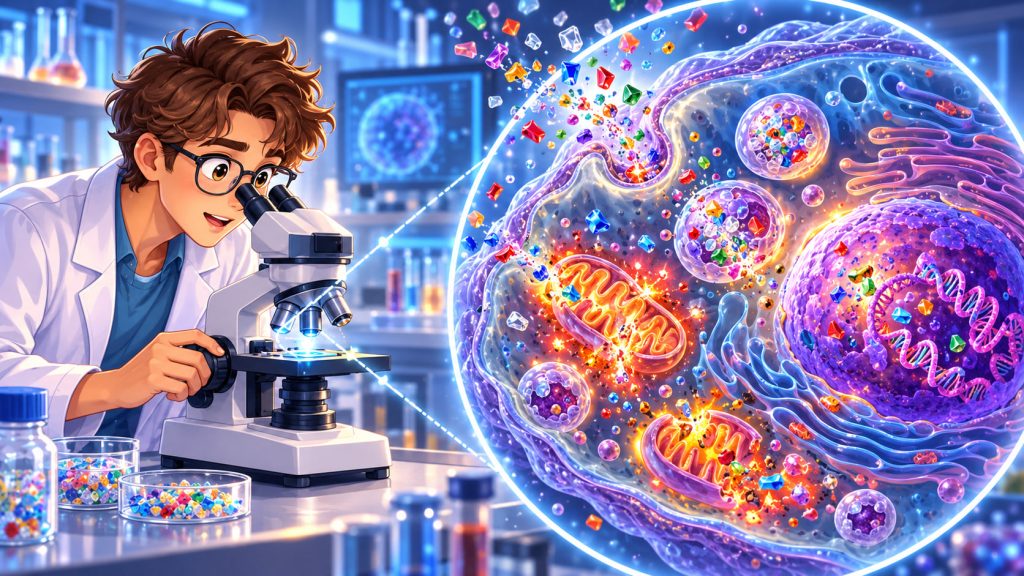
Plastic pollution is no longer only an environmental problem floating in oceans or accumulating in landfills. Scientists are increasingly studying particles so small that they can interact directly with tissues and individual cells.
These particles are known as nanoplastics. Unlike larger fragments, they can reach biological barriers, enter cells, interact with proteins and organelles, and potentially disturb normal cellular processes.
Recent research has reported microplastic and nanoplastic particles in human blood, lungs, placenta, arteries, liver, reproductive tissues, and even brain samples. The most important question is no longer simply whether tiny plastic particles can enter the body, but what happens after they reach the cellular level.
What Exactly Is Nanoplastic?
Nanoplastics are extremely small plastic particles generally measured on the nanometer scale, although scientific definitions are still not perfectly standardized.
They can form when larger plastic products gradually break apart under sunlight, heat, mechanical stress, and chemical degradation.
They can also originate from industrial processes, synthetic textiles, packaging, coatings, tires, and other plastic-containing materials.
Their tiny size gives them unusual biological properties. A particle that is too large to cross a cell membrane may become biologically accessible once it breaks into nanoscale fragments.
Smaller particles generally have a larger surface area relative to their mass, allowing them to interact more intensely with surrounding molecules.
How Nanoplastics Enter Cells
Cells do not simply have open doors that allow particles to drift inside.
One important uptake mechanism is endocytosis, in which the cell membrane folds around material and encloses it inside a small internal compartment.
Different forms of endocytosis can transport nanoscale particles into cells.
Extremely small particles may also interact directly with cell membranes, depending on their size, shape, electrical charge, and surface chemistry.
Once inside, nanoplastics may travel through cellular compartments rather than remaining at the membrane.
This is where potential biological effects become especially important.
Nanoplastics Can Accumulate in Lysosomes
After entering a cell, many particles are transported toward lysosomes.
Lysosomes act as cellular recycling centers. They contain enzymes capable of breaking down damaged proteins, worn-out cellular components, and biological waste.
Plastic, however, is not normal biological material.
Some experimental studies suggest that nanoplastic particles can accumulate inside lysosomes because cells may be unable to degrade them efficiently.
Long-term accumulation could interfere with normal recycling functions, alter lysosomal acidity, or damage lysosomal membranes.
A cellular recycling system designed to destroy biological waste may therefore become a storage site for material it cannot easily eliminate.
Oxidative Stress Is One of the Biggest Concerns
One of the most frequently observed cellular effects in laboratory studies is oxidative stress.
Cells naturally produce chemically reactive molecules called reactive oxygen species during metabolism.
Normally, antioxidant systems keep these molecules under control.
Nanoplastic exposure has been associated in experimental systems with increased production of reactive oxygen species or reduced ability to neutralize them.
When the balance is disturbed, oxidative stress can damage:
- Cell membranes
- Proteins
- DNA
- Mitochondria
- Other cellular structures
The severity depends strongly on particle concentration, polymer type, surface properties, exposure duration, and the type of cell being studied.
Mitochondria May Be Especially Vulnerable
Mitochondria produce much of the usable energy needed by cells.
They are also sensitive to oxidative damage.
Laboratory research has linked nanoplastic exposure with changes in mitochondrial membrane function, energy production, and reactive oxygen species generation.
If mitochondria become severely disrupted, cells may produce less energy and activate stress-response pathways.
In some experimental conditions, prolonged damage can contribute to programmed cell death.
This is especially important because tissues with high energy demands — including the brain, heart, muscles, and kidneys — depend heavily on healthy mitochondrial function.
Nanoplastics Can Disturb Cell Membranes
The cell membrane is a highly organized structure containing fats, proteins, receptors, and channels.
Nanoplastic particles can interact with this membrane before they even enter the cell.
Their surfaces may attach to membrane molecules, alter membrane fluidity, or influence signaling.
Particles with certain electrical charges may interact particularly strongly with biological membranes.
Some experimental studies suggest that high nanoplastic exposure can increase membrane permeability or physically disturb membrane structures.
This may influence the movement of ions and other molecules between the cell and its environment.
The Protein Corona Changes the Particle
A nanoplastic particle entering blood or another biological fluid does not remain chemically “naked.”
Proteins and other molecules quickly attach to its surface, creating a protein corona.
This coating can completely change how cells recognize the particle.
Instead of interacting with bare plastic, immune cells and other tissues encounter a plastic particle covered in biological molecules.
The protein corona can influence:
- Which cells absorb the particle
- How long it remains in circulation
- How the immune system responds
- Where the particle eventually accumulates
Inside the body, the biological identity of a nanoplastic particle may be determined as much by its coating as by the original plastic itself.
Can Nanoplastics Damage DNA?
Experimental studies have raised concerns about genotoxicity, meaning damage to genetic material.
Nanoplastics may not always interact with DNA directly.
Instead, oxidative stress, inflammation, or disrupted cellular metabolism may generate conditions that increase DNA damage.
Some laboratory studies have reported DNA strand breaks, changes in gene expression, or disruption of mechanisms involved in cell division after substantial nanoplastic exposure.
However, the real-world significance depends strongly on exposure levels.
Evidence from laboratory cells cannot automatically tell us the long-term effect of everyday human exposure.
Autophagy May Become Disrupted
Cells use a process called autophagy to remove damaged internal components and recycle useful material.
Autophagy is essential for cellular housekeeping.
Nanoplastic exposure has been shown in experimental systems to alter this process.
Cells may increase autophagy as a defensive response to stress. But if exposure becomes excessive or persistent, the recycling system may become inefficient or overloaded.
This creates a potentially damaging cycle: particles generate stress, cells activate cleanup systems, and those same cleanup systems may struggle to process persistent plastic material.
Inflammation Can Spread Beyond One Cell
Nanoplastics may also activate immune responses.
Immune cells can recognize unusual particles as foreign material and release inflammatory signals.
This process is known as inflammation.
Short-term inflammation is a normal defense mechanism, but persistent inflammation can damage healthy tissue.
Researchers studying nanoplastic toxicity are particularly interested in whether chronic exposure could maintain low-level inflammatory responses in organs where particles accumulate.
This does not mean nanoplastics have been proven to cause specific human diseases directly, but it identifies a biologically plausible pathway that scientists are actively investigating.
Human Arteries Have Produced a Major Warning Sign
One of the most striking recent findings involved plastic particles detected in atherosclerotic plaques removed from human arteries.
Researchers reported that patients whose plaques contained microplastic or nanoplastic material experienced a higher rate of serious cardiovascular events during follow-up than patients whose samples did not show detectable particles.
The study did not prove that plastic caused those events.
However, it provided important human evidence connecting the presence of microscopic plastic particles with tissues already involved in cardiovascular disease.
Researchers also found signs consistent with increased inflammatory activity.
This moved the discussion beyond laboratory dishes by showing that plastic particles can be present inside clinically important human tissue.
Nanoplastics and the Brain
Another rapidly developing area concerns whether very small plastic particles can reach the nervous system.
Experimental work suggests that sufficiently small particles may cross biological barriers under some conditions.
Recent analyses of human tissues have also reported plastic particles in brain samples.
Researchers are now investigating how these particles might interact with neurons, supporting brain cells, blood vessels, and immune cells within the nervous system.
The blood-brain barrier normally restricts many substances from entering brain tissue, so evidence that nanoscale particles may reach this compartment has attracted considerable scientific attention.
Why Size and Chemistry Matter So Much
Not all nanoplastics behave the same way.
A 50-nanometer polystyrene particle may behave differently from a larger polyethylene fragment.
Shape, electrical charge, additives, aging, and surface contamination can all change biological effects.
Researchers in nanotoxicology emphasize that “nanoplastic” is not one single substance.
Real-world particles are extraordinarily diverse.
This is one reason estimating the health effects of environmental nanoplastic exposure remains difficult.
What Experts Are Focusing On Now
Toxicologists studying nanoplastics increasingly focus on realistic exposure rather than simply exposing cells to extremely high experimental concentrations.
The central questions include how much nanoplastic humans actually absorb, which particles enter the bloodstream, where they accumulate, how long they remain, and whether the body can remove them.
Scientists are also developing better analytical techniques because detecting nanoplastics in biological tissue is technically challenging.
The emerging picture is clear in one respect: plastic particles can interact with biological systems at scales that were largely overlooked only a few decades ago.
The next major challenge is determining exactly when those interactions become harmful in real human life.
P.S. This is one of humanity’s global challenges—one that we can solve only by working together. If ordinary people begin to speak out about the challenges facing our civilization and the need to unite all human potential for the sake of our collective future, the world will change for the better very quickly.
Interesting Facts
- One nanometer is one billionth of a meter.
- Nanoplastic particles can have dramatically more surface area relative to their mass than larger plastic fragments.
- Cells may transport nanoplastics using some of the same mechanisms used to absorb biological material.
- Proteins can rapidly coat plastic particles after they enter biological fluids.
- Experimental studies have linked nanoplastic exposure with oxidative stress, mitochondrial dysfunction, inflammation, and altered cellular recycling.
- Plastic particles have been detected in several types of human tissue.
- Some nanoplastic particles are small enough to interact with structures much smaller than an entire cell.
- Researchers increasingly study particle shape and surface chemistry, not simply particle size.
- Detecting environmental nanoplastics is more difficult than detecting larger microplastics because the particles approach the scale of biological molecules and cellular structures.
Glossary
- Endocytosis — A process in which a cell surrounds material with its membrane and transports it inside.
- Lysosomes — Cellular compartments containing enzymes that break down waste and damaged biological material.
- Oxidative Stress — A harmful imbalance between reactive molecules and the cell’s ability to neutralize them.
- Reactive Oxygen Species — Highly reactive oxygen-containing molecules produced naturally in cells but capable of causing damage when present in excess.
- Mitochondria — Cellular structures responsible for producing much of the energy used by cells.
- Protein Corona — A layer of proteins and other biological molecules that forms around a nanoparticle in biological fluids.
- Genotoxicity — The ability of a substance or process to damage genetic material.
- Autophagy — A cellular recycling process that removes damaged internal structures and reuses their components.
- Inflammation — An immune response involving signaling molecules and cells that react to injury, infection, or foreign material.
- Blood-Brain Barrier — A selective biological barrier that controls which substances can move from the bloodstream into brain tissue.