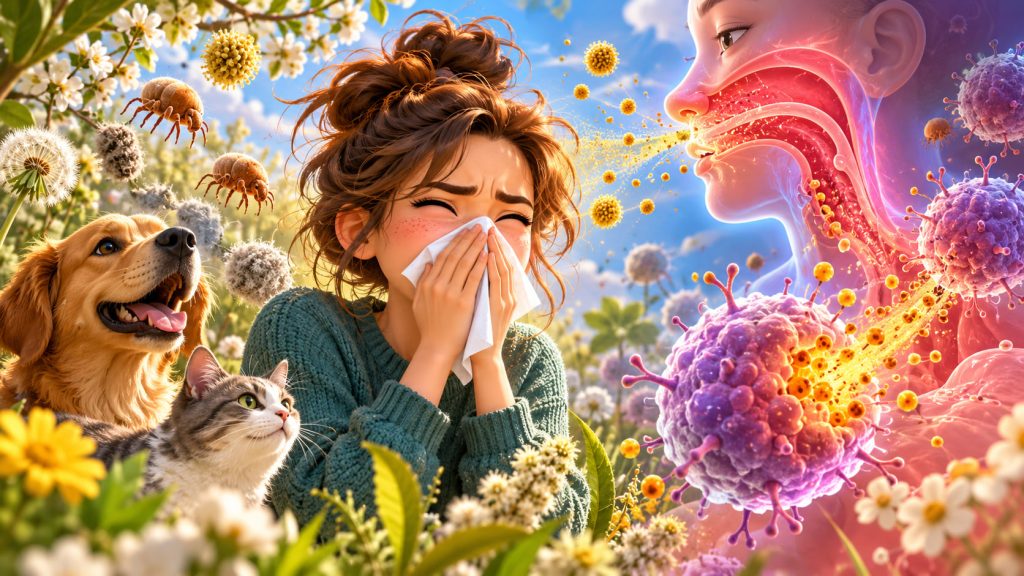
Allergies happen when the immune system reacts too strongly to substances that are normally harmless. Pollen, dust mites, certain foods, pet dander, insect venom, and some medications can all trigger allergic reactions.
For someone without an allergy, these substances may cause no problem at all. For someone who is allergic, the immune system can treat them as dangerous invaders.
An allergy is not simply “sensitivity.” It is an immune reaction involving specific cells, antibodies, and chemical messengers.
Understanding how allergies work helps explain why symptoms can range from mild sneezing to a life-threatening emergency.
What Is an Allergy?
An allergy begins when the immune system identifies a normally harmless substance as a threat.
That substance is called an allergen.
Common allergens include:
- Pollen
- Dust mites
- Mold spores
- Animal dander
- Peanuts and tree nuts
- Milk, eggs, wheat, and shellfish
- Insect venom
- Certain medications
The first contact with an allergen does not always cause obvious symptoms.
Instead, the immune system may become sensitized and prepare for future exposure.
How Sensitization Begins
During sensitization, the immune system mistakenly decides that an allergen is dangerous.
Specialized immune cells process the allergen and activate other cells involved in the immune response.
In many common allergies, the body produces a type of antibody called IgE.
These IgE antibodies attach to immune cells known as mast cells.
At this point, the person may not feel anything unusual.
The problem often appears during later exposure.
When the same allergen enters the body again, it can bind to IgE antibodies on mast cells and trigger them to release powerful chemicals.
Histamine: The Chemical Behind Many Symptoms
One of the most important chemicals released during an allergic reaction is histamine.
Histamine affects blood vessels, nerves, airways, skin, and other tissues.
It can cause blood vessels to widen and become more permeable, leading to redness and swelling.
It can also stimulate nerve endings, causing itching.
In the nose, histamine contributes to sneezing, congestion, and a runny nose.
In the eyes, it can cause watering, redness, and irritation.
Many familiar allergy symptoms are therefore not caused directly by pollen, food, or animal dander, but by the immune system’s response to them.
Why Some Allergies Affect the Nose and Others the Skin
The symptoms of an allergy depend partly on where the allergen enters the body and which tissues respond.
Airborne allergens such as pollen often affect the nose and eyes.
Food allergens may trigger symptoms in the digestive system, skin, respiratory tract, or throughout the body.
Contact with certain substances can cause localized skin reactions.
Allergic inflammation can also affect the lungs and contribute to asthma symptoms in susceptible people.
The same person may experience different types of allergic reactions at different times.
Hay Fever and Airborne Allergies
Seasonal allergic rhinitis, commonly called hay fever, is usually triggered by airborne pollen.
Trees, grasses, and weeds release enormous quantities of pollen into the air.
When pollen reaches the nose of a sensitized person, the immune system reacts.
Symptoms may include sneezing, nasal congestion, itchy eyes, watery eyes, and a runny nose.
Indoor allergies can occur year-round.
Dust mites, mold, and animal allergens are common triggers.
Reducing exposure can help, although completely eliminating many airborne allergens is difficult.
How Food Allergies Work
Food allergy is an immune reaction to specific proteins in food.
Even a small amount of the triggering food can sometimes cause a reaction.
Symptoms may include:
- Hives
- Swelling of the lips or face
- Vomiting
- Abdominal pain
- Wheezing
- Difficulty breathing
- Dizziness
Food allergy should not be confused with food intolerance.
An intolerance usually does not involve the same immune mechanisms.
For example, lactose intolerance occurs because the body has difficulty digesting lactose, not because the immune system mistakes lactose for a dangerous invader.
What Is Anaphylaxis?
The most severe allergic reaction is anaphylaxis.
Anaphylaxis is a rapid, systemic reaction that can affect several organs at once.
Symptoms may include severe difficulty breathing, swelling of the throat or tongue, a sudden drop in blood pressure, widespread hives, vomiting, dizziness, or loss of consciousness.
Anaphylaxis is a medical emergency.
The primary emergency treatment is epinephrine, also known as adrenaline.
People at known risk of severe allergic reactions may be prescribed an epinephrine auto-injector and should know how and when to use it.
Rapid treatment is critical because severe reactions can progress quickly.
Why Do Some People Develop Allergies?
There is no single cause.
Genetics plays an important role.
People with a family history of allergies, asthma, or eczema may have a higher likelihood of developing allergic disease.
Environmental factors also matter.
Exposure to allergens, air pollution, infections, diet, skin-barrier function, and microbial exposure may all influence immune development.
Scientists continue to study why allergic diseases have become common in many modern populations.
One idea involves changes in early-life exposure to microorganisms, but allergy development is too complex to be explained by a single theory.
The Role of the Skin Barrier
The skin is more than a covering. It is an important protective barrier.
When the skin barrier is damaged, allergens may enter more easily and interact with immune cells.
This is especially relevant in people with eczema.
Research into the connection between eczema and food allergy has changed how specialists think about early allergic disease.
A weakened skin barrier may contribute to sensitization in some people, particularly during infancy.
Allergy Testing
Doctors may use several methods to investigate suspected allergies.
A skin prick test introduces tiny amounts of suspected allergens into the surface of the skin.
If the person is sensitized, a small raised itchy bump may develop.
Blood tests can measure allergen-specific IgE antibodies.
However, a positive test does not automatically prove that a person will have symptoms during real-life exposure.
Allergy specialists interpret test results together with medical history and actual reactions.
In some cases, a carefully supervised challenge may be needed to confirm a diagnosis.
Can Allergies Be Treated?
Treatment depends on the type and severity of allergy.
Avoiding or reducing exposure to known triggers is often important.
Antihistamines can reduce symptoms caused by histamine.
Nasal corticosteroids are commonly used for allergic rhinitis because they reduce inflammation.
Some patients may benefit from allergen immunotherapy.
This treatment exposes the immune system to controlled amounts of an allergen over time, with the goal of reducing sensitivity.
It can be delivered through injections or, for certain allergens, tablets or drops placed under the tongue.
Allergy specialists generally consider immunotherapy particularly useful when symptoms are significant and difficult to control with standard measures.
Please do not self-medicate – consult a doctor.
Can Allergies Disappear?
Some allergies change over time.
Many children outgrow allergies to milk or eggs, while allergies to peanuts, tree nuts, fish, or shellfish are more likely to persist.
Seasonal allergies can also become stronger or weaker with age.
A person may develop a new allergy later in life even if the substance caused no problems before.
The immune system is constantly changing, which helps explain why allergic disease can evolve.
Why Allergy Management Matters
Mild allergies can be annoying, but severe allergies can affect sleep, school, work, exercise, and overall quality of life.
Good management starts with identifying the real trigger.
Unnecessary avoidance can be restrictive, while ignoring a serious allergy can be dangerous.
The most effective approach is accurate diagnosis, realistic trigger reduction, and treatment matched to the severity of the reaction.
Interesting Facts
- Allergy symptoms are caused mainly by the immune response, not by the allergen directly.
- Histamine plays a major role in itching, sneezing, swelling, and watery eyes.
- A person can become allergic to something after years of previous exposure without symptoms.
- Food intolerance and food allergy are biologically different conditions.
- Some allergic diseases are linked with asthma and eczema.
- Epinephrine is the first-line emergency treatment for anaphylaxis.
- Allergy tests must be interpreted together with symptoms and medical history.
- Some forms of immunotherapy can gradually reduce sensitivity to specific allergens.
Glossary
- Allergen — A normally harmless substance that triggers an allergic immune response.
- Sensitization — The process by which the immune system becomes prepared to react to a specific allergen.
- IgE — A type of antibody involved in many immediate allergic reactions.
- Mast Cells — Immune cells that release histamine and other chemicals during allergic reactions.
- Histamine — A chemical messenger that contributes to itching, swelling, sneezing, redness, and other allergy symptoms.
- Anaphylaxis — A severe, rapidly developing allergic reaction that can affect breathing and blood pressure.
- Epinephrine — A medication used as the first-line emergency treatment for anaphylaxis.
- Skin Prick Test — A diagnostic test in which tiny amounts of allergens are introduced into the skin to look for an allergic response.
- Allergen Immunotherapy — Treatment that gradually exposes the immune system to an allergen in controlled amounts to reduce sensitivity.