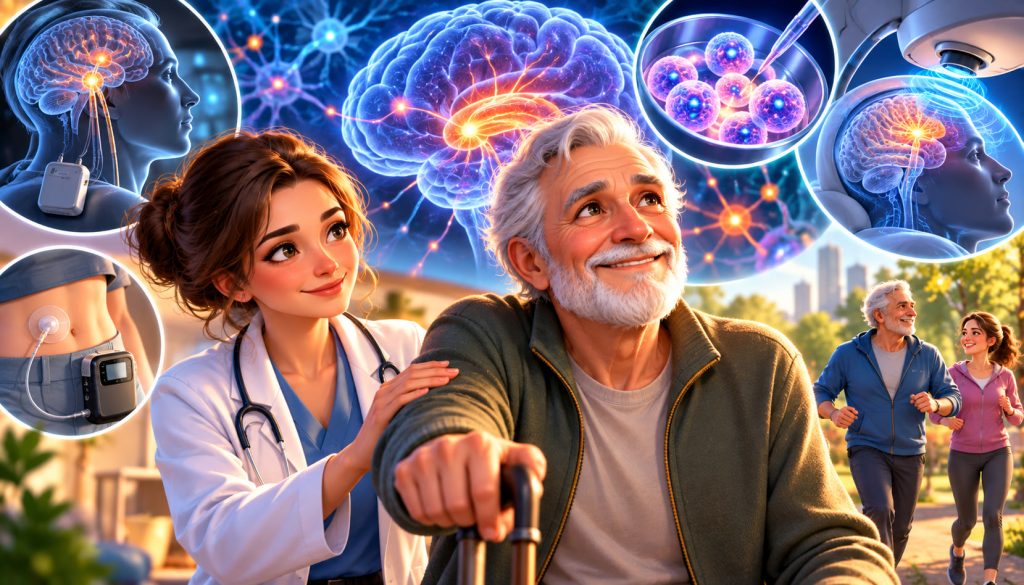
Parkinson’s disease treatment is entering a new era. Advances in neuroscience, regenerative medicine, and medical technology are creating possibilities that seemed almost impossible just a decade ago.
Scientists are developing treatments that deliver medication more consistently, stimulate the brain according to its activity, and potentially replace neurons damaged by the disease.
One particularly important development came in 2026, when Japan granted conditional approval to a Parkinson’s treatment derived from reprogrammed stem cells.
Although there is still no established cure for Parkinson’s disease, modern treatments are expanding the possibilities for symptom control, independence, and quality of life.
What Happens in the Brain During Parkinson’s Disease?
Parkinson’s disease is a progressive neurological disorder that primarily affects brain cells responsible for producing dopamine.
Dopamine is a neurotransmitter essential for coordinating movement.
As dopamine-producing neurons deteriorate, communication between different parts of the brain becomes less effective.
Common symptoms include tremors, muscular stiffness, slowed movement, and balance difficulties.
Parkinson’s can also cause sleep disturbances, constipation, depression, and changes in cognitive function.
Traditional treatments focus primarily on replacing dopamine or improving how the brain responds to it.
However, new Parkinson’s treatments are increasingly exploring ways to restore damaged neural circuits and address the biological processes behind the disease.
Continuous Levodopa Infusion: More Consistent Symptom Control
Levodopa remains one of the most effective medications for managing Parkinson’s movement symptoms.
However, as the disease progresses, individual doses may become less predictable.
Patients can experience periods when medication works effectively, alternating with episodes of stiffness, tremor, and difficulty moving.
New infusion systems aim to reduce these fluctuations.
In October 2024, the United States approved Vyalev, a treatment delivering foslevodopa and foscarbidopa continuously beneath the skin.
Unlike conventional tablets, this system uses a portable infusion pump to provide medication throughout the day and night.
Clinical trials demonstrated improvements in the time patients experienced good movement control without troublesome involuntary movements.
Apomorphine Pumps: Another Important Treatment
Another significant development is continuous apomorphine infusion.
Apomorphine stimulates dopamine receptors and can help patients experiencing unpredictable periods of impaired mobility.
In February 2025, the FDA approved Onapgo for adults with advanced Parkinson’s disease.
The medication is delivered through a small pump beneath the skin, providing continuous treatment during waking hours.
Unlike levodopa, apomorphine acts directly on dopamine receptors.
This approach can reduce periods when conventional medications become temporarily ineffective.
However, infusion therapies require careful medical supervision because they can cause adverse effects, including nausea, low blood pressure, excessive sleepiness, and infusion-site reactions.
Adaptive Deep Brain Stimulation: A Smarter Brain Implant
Deep brain stimulation has been used for years to help control severe Parkinson’s symptoms.
The procedure involves implanting electrodes into specific brain regions responsible for movement regulation.
Traditional systems deliver electrical stimulation according to settings programmed by a specialist.
Adaptive deep brain stimulation represents a major technological improvement.
These newer systems can monitor particular patterns of brain activity and automatically adjust electrical stimulation in response.
In February 2025, the FDA approved an adaptive stimulation feature for certain Medtronic devices.
Adaptive brain stimulation makes it possible to personalize treatment according to changing neural activity rather than relying exclusively on fixed stimulation settings.
Focused Ultrasound: Treating Symptoms Without Brain Incisions
Focused ultrasound offers another approach for selected patients whose movement symptoms are difficult to control.
The technology concentrates ultrasound energy on precisely targeted regions of the brain.
Magnetic resonance imaging helps doctors monitor the procedure and identify the appropriate treatment area.
Unlike conventional brain surgery, focused ultrasound does not require an incision through the skull.
It can reduce certain movement symptoms, particularly medication-resistant tremor.
However, the procedure deliberately creates a small, permanent lesion in brain tissue. It is not reversible and does not cure Parkinson’s disease.
In 2025, the FDA expanded approval for certain staged treatments involving both sides of the brain.
Stem Cell Therapy: A Historic Breakthrough in 2026
One of the most significant recent developments involves replacing damaged dopamine-producing neurons.
Scientists can transform specialized stem cells into immature neurons capable of developing into dopamine-producing brain cells.
These cells can then be transplanted into specific regions of the brain.
In March 2026, Japan granted conditional and time-limited approval to AMCHEPRY, a regenerative treatment derived from induced pluripotent stem cells.
The treatment is intended to improve movement symptoms in patients whose response to existing medications is inadequate.
The decision followed early clinical research conducted at Kyoto University.
This represents a historic advance in regenerative medicine, although further research is required to establish long-term safety and effectiveness.
Can Stem Cells Actually Restore Brain Function?
Stem cell therapy attempts to replace some of the neurons lost during Parkinson’s disease.
Early clinical studies have demonstrated that transplanted cells can survive and produce dopamine.
Researchers have also observed improvements in movement symptoms among some participants.
A separate European stem cell study published in July 2026 provided additional information about the feasibility and safety of this approach.
Nevertheless, transplantation involves significant challenges, including brain surgery and, for certain cell products, immunosuppressive medication.
Scientists must also determine whether transplanted neurons can function effectively over many years.
Replacing dopamine-producing cells may improve movement, but it does not necessarily prevent the underlying disease from affecting other parts of the brain.
New Drugs Targeting the Causes of Parkinson’s
Researchers are increasingly investigating treatments designed to influence Parkinson’s biological mechanisms rather than simply control its symptoms.
One important target is alpha-synuclein, a protein that can accumulate abnormally inside nerve cells.
Scientists are developing antibodies and other treatments intended to reduce harmful protein accumulation.
Other research focuses on mitochondrial dysfunction, chronic inflammation within the nervous system, and genetic abnormalities associated with Parkinson’s.
Experimental gene therapies are also being investigated.
These approaches could potentially influence disease progression, although their clinical benefits remain under investigation.
Expert Perspective: Toward Personalized Parkinson’s Treatment
Neurologist Robert A. Hauser, director of the Parkinson’s and Movement Disorder Center at the University of South Florida, has emphasized the importance of continuous medication delivery for patients with advanced Parkinson’s disease.
More consistent dopamine replacement can help address movement fluctuations that become increasingly difficult to manage with conventional tablets.
This principle is now being extended through adaptive brain stimulation and increasingly individualized treatment strategies.
The emerging direction of Parkinson’s care is toward treatments tailored to individual symptoms, disease stages, and physiological responses.
Exercise and Rehabilitation Remain Essential
Technological advances do not eliminate the importance of physical rehabilitation.
Regular exercise can improve mobility, balance, strength, and everyday functioning.
In February 2026, the Parkinson’s Foundation and the American College of Sports Medicine announced updated exercise recommendations.
Their guidance emphasizes aerobic activity, strength training, flexibility, and exercises involving balance and coordination.
Speech therapy, occupational therapy, and individualized rehabilitation can also help patients maintain independence.
Exercise programs should be adapted to disease severity, cardiovascular health, and fall risk.
Combining appropriate medical treatment with regular rehabilitation remains an important part of comprehensive Parkinson’s care.
Interesting Facts
- Parkinson’s disease affects dopamine-producing neurons in a brain region called the substantia nigra.
- Certain infusion systems can deliver Parkinson’s medication continuously throughout the day and night.
- Adaptive deep brain stimulation can adjust electrical stimulation according to monitored brain activity.
- In March 2026, Japan granted conditional approval to an innovative Parkinson’s treatment produced from reprogrammed stem cells.
- Parkinson’s disease can affect sleep, digestion, mood, and cognitive function years before pronounced movement symptoms appear.
- Focused ultrasound uses concentrated sound waves to create precisely targeted changes in brain tissue.
- Researchers are investigating antibodies, gene therapy, and regenerative medicine as potential approaches to modifying Parkinson’s disease.
Glossary
- Parkinson’s Disease — A progressive neurological disorder affecting movement and several other bodily functions.
- Dopamine — A neurotransmitter involved in controlling movement, motivation, and other neurological processes.
- Levodopa — A medication converted into dopamine in the brain to relieve Parkinson’s movement symptoms.
- Motor Fluctuations — Changes in movement control associated with variations in medication effectiveness.
- Apomorphine — A dopamine receptor agonist used to manage certain movement complications in Parkinson’s disease.
- Deep Brain Stimulation (DBS) — A treatment that uses surgically implanted electrodes to deliver electrical stimulation to selected brain regions.
- Adaptive DBS — A brain stimulation system capable of adjusting treatment according to monitored neural activity.
- Focused Ultrasound — A technology that concentrates ultrasound energy on precisely targeted tissue.
- Stem Cell Therapy — A medical approach using specialized cells capable of developing into other cell types to replace or repair damaged tissue.
- Induced Pluripotent Stem Cells (iPSCs) — Adult cells reprogrammed into a state that allows them to develop into many different cell types.
- Alpha-Synuclein — A protein that can accumulate abnormally in nerve cells affected by Parkinson’s disease.
- Neuroprotection — Strategies intended to protect nerve cells from damage or degeneration.