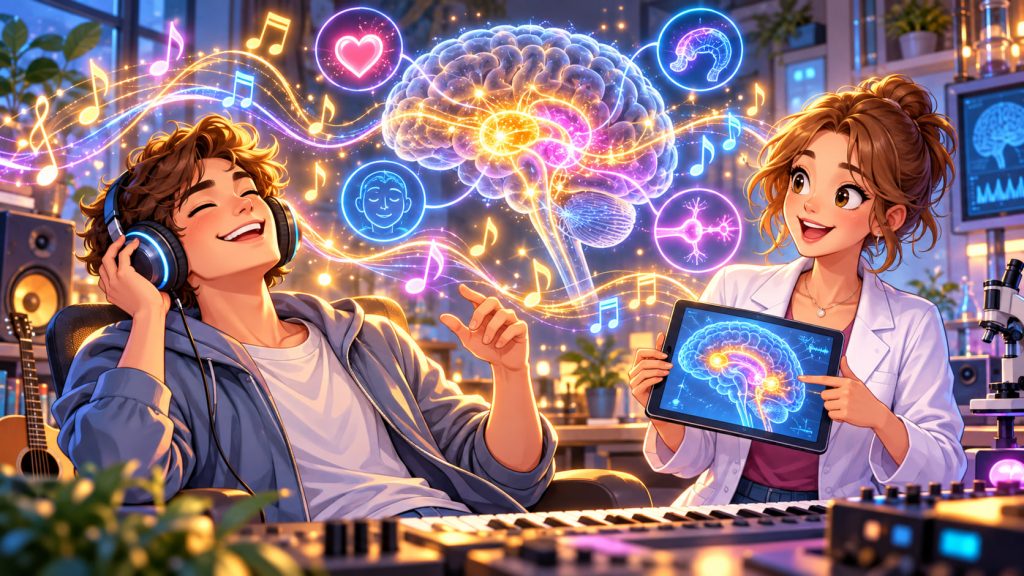
Imagine hearing your favorite song for the first time in years. Within seconds, memories come flooding back, your mood changes, and you might even feel goosebumps spreading across your skin.
Music has an extraordinary ability to influence human emotions. A simple melody can make us happy, nostalgic, excited, relaxed, or deeply moved.
But why does the human brain respond so powerfully to something as abstract as organized sound?
The answer lies in the fascinating relationship between music, dopamine, memory, and the brain’s reward system.
Neuroscience reveals that listening to music activates some of the same brain circuits involved in experiencing pleasure from food, social connection, and other rewarding activities.
What Happens in Your Brain When You Listen to Music?
Listening to music involves much more than simply processing sound.
When sound waves enter the ears, specialized sensory cells convert mechanical vibrations into electrical signals. These signals travel along the auditory pathways to the brain.
The auditory cortex analyzes important musical characteristics, including pitch, rhythm, timbre, and melody.
However, music also activates brain regions associated with emotion, attention, memory, movement, and reward.
This widespread activity helps explain why music can influence our thoughts, feelings, and even physical behavior.
Music is a whole-brain experience that connects sensory processing with some of our most sophisticated emotional and cognitive functions.
Dopamine: The Chemistry of Musical Pleasure
One of the most remarkable discoveries in music neuroscience involves dopamine.
Dopamine is a neurotransmitter that plays important roles in motivation, learning, anticipation, and reward.
When we experience something pleasurable, certain brain circuits use dopamine to reinforce behaviors and help us recognize rewarding experiences.
Research has demonstrated that intensely pleasurable musical experiences can also trigger dopamine release.
The nucleus accumbens, a central component of the brain’s reward system, is particularly important in this process.
Interestingly, dopamine is not simply a chemical responsible for happiness.
It also participates in the anticipation of rewarding experiences.
The excitement we feel while waiting for our favorite part of a song can involve some of the same reward mechanisms activated when that moment finally arrives.
Why Music Gives Us Goosebumps
Have you ever experienced a sudden wave of emotion when a singer reaches a powerful note or an orchestra builds toward a dramatic climax?
This sensation is often called musical frisson.
It may involve goosebumps, chills, a tingling sensation, or an intense emotional response.
These experiences are associated with activity in brain regions involved in reward and emotion.
Scientists have investigated how dopamine release changes during moments of intense musical pleasure.
Their findings suggest that anticipation and peak pleasure involve partially distinct patterns of activity within the brain’s reward circuitry.
However, not everyone experiences musical chills, and their intensity varies considerably between individuals.
Expert Perspective: Robert Zatorre and the Musical Brain
Neuroscientist Robert Zatorre of McGill University has made major contributions to understanding how the human brain processes and enjoys music.
In research conducted with neuroscientist Valorie Salimpoor and their colleagues, brain imaging revealed dopamine release associated with intensely pleasurable musical experiences.
The researchers also identified differences between brain activity during anticipation and activity during moments of peak musical pleasure.
Their findings demonstrate that an abstract experience such as music can engage powerful biological reward mechanisms.
This research helped establish an important connection between auditory processing, emotional responses, and the brain’s motivation and reward systems.
Why Does Your Brain Love Musical Surprises?
The human brain constantly attempts to predict what will happen next.
Music provides an ideal environment for this predictive ability.
When listening to a familiar melody, we develop expectations about which notes, rhythms, and harmonies should follow.
Composers can manipulate these expectations by introducing an unexpected chord, delaying a musical resolution, or changing the rhythm.
A carefully timed surprise may produce a particularly satisfying emotional response.
However, music that is completely unpredictable can become difficult to follow.
Musical pleasure often emerges from a balance between familiarity and surprise.
Our brains enjoy recognizing patterns while discovering something unexpected within them.
Why Do Certain Songs Bring Back Powerful Memories?
Music possesses an extraordinary ability to trigger autobiographical memories.
A song heard during childhood can suddenly transport someone back to a particular place, relationship, or important life event.
This happens because musical experiences can become strongly associated with emotional and personal memories.
The hippocampus plays an important role in memory formation and retrieval, while the amygdala contributes to processing emotional significance.
Music can engage these interconnected systems, helping retrieve memories associated with specific experiences.
Songs from adolescence and early adulthood are often particularly memorable because these periods involve substantial emotional and identity development.
Music can become a powerful emotional marker that connects our present experiences with our personal history.
Why Do We Enjoy Sad Music?
One of the most fascinating paradoxes in music psychology is that people frequently enjoy songs that make them feel sad.
Outside artistic experiences, sadness is usually considered an unpleasant emotion.
However, sad music creates a different emotional context.
Listeners can explore feelings of loss, longing, nostalgia, or melancholy without necessarily experiencing the real-life circumstances associated with those emotions.
Sad songs may also provide emotional validation, helping people feel that their experiences are understood.
For some listeners, this combination of emotional expression and psychological distance can make sad music deeply rewarding.
Individual personality, mood, and personal associations strongly influence these responses.
Why Does Music Make Us Want to Dance?
Rhythm connects auditory processing with the brain’s motor systems.
When we hear a strong beat, networks involving the auditory cortex, basal ganglia, and motor-related brain regions help us recognize and anticipate its timing.
This process contributes to our ability to synchronize movement with music.
It explains why people may instinctively tap their feet, nod their heads, or begin dancing when hearing a familiar rhythm.
Regular musical patterns allow the brain to predict upcoming beats and coordinate movements accordingly.
Dancing also combines musical enjoyment with physical activity and social interaction.
Rhythm transforms sound into an experience that connects perception, movement, and emotion.
Can Music Improve Mental Well-Being?
Music can influence mood, emotional regulation, and perceived stress.
Relaxing music may help some people reduce tension, while energetic songs can increase motivation during physical activity.
Music therapy also uses structured musical experiences to support specific therapeutic goals under the guidance of trained professionals.
Researchers continue to investigate its potential applications in rehabilitation, emotional well-being, and neurological care.
However, responses to music are highly individual.
A melody that relaxes one person might distract or irritate another.
Musical preferences, previous experiences, cultural background, and the listening environment all influence the emotional effects of music.
Why Do We Love Different Types of Music?
Musical preferences develop through a combination of biological, psychological, and cultural influences.
Repeated exposure can increase familiarity, making particular musical styles easier to recognize and enjoy.
Personal memories can create strong emotional associations with specific artists or songs.
Culture also shapes musical expectations, influencing which rhythms, scales, and harmonic patterns feel natural or satisfying.
Some individuals particularly enjoy complex musical structures, while others prefer simple melodies and predictable rhythms.
There is no single musical formula that produces pleasure in every human brain.
Our favorite music reflects a unique combination of neural processing, personal experiences, emotional associations, and cultural influences.
Interesting Facts
- Listening to intensely pleasurable music can trigger measurable dopamine release in the brain’s reward circuitry.
- Musical chills can involve goosebumps and changes in physiological arousal.
- The brain can anticipate musical beats even when a person is sitting completely still.
- Familiar songs can evoke vivid autobiographical memories after many years.
- Some people experience musical anhedonia, a condition in which they derive little pleasure from music despite having otherwise normal hearing and the ability to enjoy other rewarding experiences.
- Musical expectations are influenced by both previous listening experiences and cultural background.
- Listening to music and performing music engage overlapping but partly distinct networks responsible for auditory processing, movement, memory, and attention.
Glossary
- Neuroscience — The scientific study of the nervous system, including the brain and its relationship with behavior.
- Dopamine — A neurotransmitter involved in motivation, learning, reward, and movement.
- Reward System — A network of interconnected brain regions involved in motivation, reinforcement, and rewarding experiences.
- Nucleus Accumbens — A brain structure involved in reward processing, motivation, and pleasurable experiences.
- Auditory Cortex — The region of the cerebral cortex responsible for processing sounds, including speech and music.
- Musical Frisson — An intense emotional response to music that may produce chills, goosebumps, or tingling sensations.
- Hippocampus — A brain structure essential for forming and retrieving many types of memories.
- Amygdala — A group of brain structures involved in emotional processing and emotional learning.
- Musical Anhedonia — A reduced ability to experience pleasure from music despite preserved enjoyment of other rewarding activities.
- Music Therapy — The clinical use of music-based interventions to support individualized therapeutic goals.
- Neural Entrainment — The synchronization of neural activity with the timing of external rhythmic stimuli, including certain musical patterns.