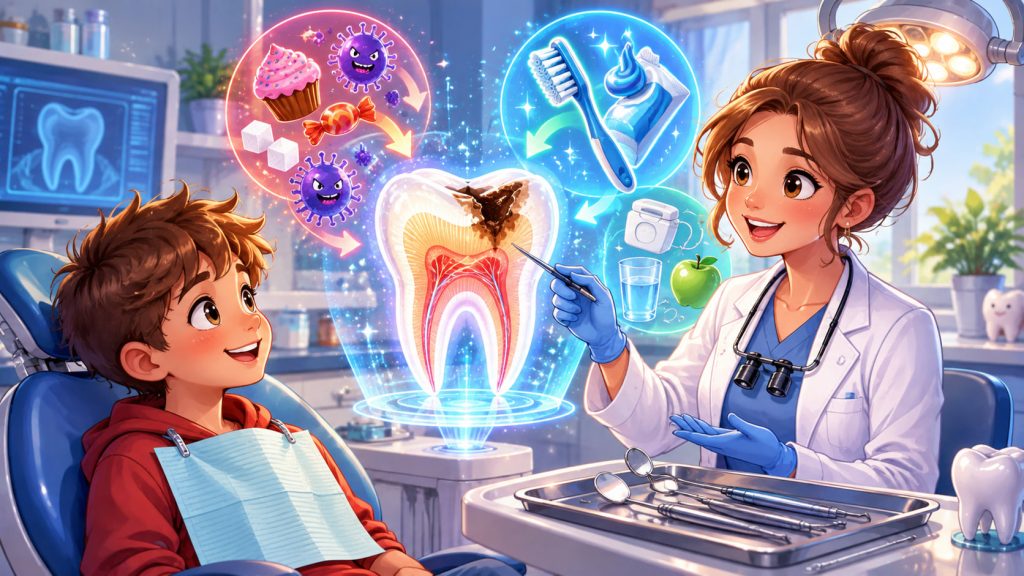
Dental caries, commonly known as tooth decay or cavities, is one of the most widespread oral health problems. It can affect children, teenagers, adults, and older people, and without treatment it may progress from minor enamel damage to severe pain, infection, and even tooth loss.
The good news is that tooth decay is often preventable.
Modern dentistry views caries not as a mysterious hole that suddenly appears, but as a gradual biological process involving oral bacteria, sugars, acids, saliva, tooth structure, and daily habits.
What Is Dental Caries?
Dental caries is the progressive destruction of the hard tissues of a tooth.
The outer surface of a tooth is covered by enamel, the hardest substance in the human body. Beneath it lies dentin, a softer tissue that surrounds the pulp containing nerves and blood vessels.
Cavities develop when acids repeatedly remove minerals from these structures faster than the body can replace them.
Early tooth decay can sometimes be stopped or partially reversed before a permanent cavity forms.
Once enough tooth structure has been destroyed and a physical hole develops, however, professional dental treatment is usually required.
How Cavities Actually Form
The mouth naturally contains hundreds of species of microorganisms.
Many are harmless or even useful, but some bacteria can metabolize sugars from food and drinks.
When these bacteria consume fermentable carbohydrates, they produce acids.
The acids temporarily lower the pH around the teeth and begin dissolving minerals such as calcium and phosphate from enamel.
This process is called demineralization.
Saliva later helps neutralize the acids and return minerals to the tooth surface through remineralization.
Problems develop when acid attacks happen too frequently.
If demineralization repeatedly exceeds remineralization, the enamel becomes weaker and decay progresses.
Dental Plaque Is More Than Dirt
Dental plaque is a sticky microbial biofilm that forms continuously on teeth.
It is not simply leftover food.
Inside this biofilm, bacteria live in organized communities where they can produce acids and interact with one another.
Plaque commonly accumulates around the gumline, between teeth, inside deep grooves of molars, and around dental appliances.
Regular brushing and interdental cleaning disrupt the biofilm before it has time to contribute significantly to tooth decay and gum disease.
Sugar Frequency Matters
Sugar plays an important role in dental caries, but the frequency of exposure can be just as important as the total amount.
Imagine eating a sweet dessert once with a meal.
Now compare that with sipping a sugary drink every 20 minutes for several hours.
In the second situation, oral bacteria receive repeated supplies of carbohydrate, causing repeated acid attacks.
This gives enamel less time to recover.
Frequent snacking and sipping on sugary drinks can therefore be particularly harmful to teeth.
Common sources include soft drinks, sweetened coffee, sports drinks, candy, biscuits, sweetened juices, and sticky snacks.
Can Healthy Foods Also Contribute?
Even foods that are generally considered nutritious can contain carbohydrates that oral bacteria can use.
Dried fruits, fruit juices, flavored yogurts, and some snack bars can expose teeth to significant amounts of sugar.
This does not mean fruit or dairy products should automatically be avoided.
The broader pattern matters.
Whole fruits, for example, provide fiber and require chewing, while sipping sweet fruit juice slowly throughout the day creates a very different environment for teeth.
Why Fluoride Is So Important
Fluoride is one of the most effective tools available for preventing tooth decay.
It helps enamel resist acid attack and supports remineralization.
Fluoride toothpaste provides regular low-level exposure directly to tooth surfaces.
For most people, brushing twice daily with an appropriate fluoride toothpaste is a basic part of cavity prevention.
After brushing, it is generally better to spit out excess toothpaste rather than immediately rinsing the mouth repeatedly with large amounts of water, because this allows more fluoride to remain on the teeth.
Dentists may recommend stronger fluoride products or professional fluoride treatments for people with a particularly high risk of decay.
Saliva Is a Natural Defense System
Saliva is extremely important for oral health.
It washes away food particles, dilutes acids, provides minerals for remineralization, and helps stabilize the chemical environment of the mouth.
People with dry mouth are therefore at increased risk of cavities.
Dry mouth may result from:
- Certain medications
- Some medical conditions
- Dehydration
- Radiation treatment involving the head and neck
- Reduced salivary gland function
Someone experiencing persistent dry mouth should discuss it with a dentist or healthcare professional.
Where Cavities Commonly Develop
Caries does not develop equally on every tooth surface.
The deep pits and grooves on chewing surfaces of back teeth can trap plaque and food.
Areas between teeth are also vulnerable because toothbrush bristles may not clean them completely.
Decay may also occur around old fillings, crowns, bridges, orthodontic appliances, or areas where gums have receded.
Exposed tooth roots are especially vulnerable because root surfaces are softer than enamel.
What Does a Cavity Feel Like?
Early tooth decay may cause no symptoms.
As the damage progresses, a person may experience:
- Sensitivity to cold
- Sensitivity to sweets
- Pain while chewing
- Toothache
- Visible discoloration
- A noticeable hole or rough area
- Food repeatedly becoming trapped
Severe or spontaneous pain may indicate that decay has reached deeper tissues.
Swelling, fever, facial swelling, or difficulty swallowing can indicate a spreading dental infection and requires prompt professional attention.
What Happens If Caries Is Not Treated?
A small lesion may gradually extend through enamel into dentin.
Once it approaches the pulp, bacteria and inflammation can cause significant pain.
At this stage, treatment may require more than a simple filling.
Depending on the severity, a dentist may need to perform root canal treatment, place a crown, or remove a tooth that cannot be restored.
An untreated dental infection can also spread into surrounding tissues.
Treating decay early is usually simpler, less invasive, and less expensive than treating advanced disease.
The Best Way to Prevent Cavities
Effective prevention combines several habits rather than relying on one product.
Brush thoroughly twice a day using fluoride toothpaste.
Clean between teeth with floss or another interdental cleaning method appropriate for you.
Reduce the frequency of sugary snacks and drinks.
Choose water frequently between meals.
Attend dental examinations at intervals recommended according to your individual risk.
Children and adults with deep grooves in molars may sometimes benefit from dental sealants.
People with high cavity risk may need additional fluoride, dietary changes, more frequent professional monitoring, or treatment for dry mouth.
Expert Perspective: Prevention Is a Balance
Dental professionals increasingly describe caries as a dynamic disease process rather than simply a hole in a tooth.
The balance between acid-producing factors and protective factors determines whether enamel loses or gains minerals over time.
This explains why prevention is so effective.
Fluoride, saliva, effective plaque control, and sensible eating patterns can move the balance toward remineralization.
Frequent sugar exposure, poor oral hygiene, and dry mouth move it in the opposite direction.
Are Cavities Contagious?
Caries itself is not contagious in the same way as influenza or measles.
However, bacteria associated with tooth decay can be transferred between people through saliva.
This can occur between family members or caregivers and children.
Whether disease develops still depends on many additional factors, including diet, fluoride exposure, oral hygiene, saliva, and tooth anatomy.
Dental Checkups Matter Even Without Pain
Waiting for a toothache is not an ideal dental strategy.
Early caries can often be detected before symptoms develop.
Dentists use visual examination and, when appropriate, dental X-rays to identify decay that may be hidden between teeth or beneath existing restorations.
Regular preventive care also provides an opportunity to assess gums, bite, dental restorations, and overall oral health.
Interesting Facts
- Tooth enamel is the hardest substance in the human body.
- Early enamel caries may appear as a chalky white spot before a physical cavity develops.
- Saliva helps repair microscopic mineral loss from teeth throughout the day.
- Cavities can develop between teeth where they may initially be invisible.
- Frequent sugar exposure can be more damaging than eating the same amount of sugar in fewer episodes.
- Dental sealants can protect deep grooves in molars from food and plaque accumulation.
- Root surfaces can decay faster than enamel because they are less heavily mineralized.
- People with dry mouth can develop cavities unusually quickly.
- Fluoride helps make tooth minerals more resistant to acid attack.
Glossary
- Dental Caries — The disease process that causes tooth decay and cavities.
- Cavity — A permanent area of damaged tooth structure caused by advanced caries.
- Enamel — The hard outer layer covering the crown of a tooth.
- Dentin — The mineralized tissue beneath enamel that surrounds the dental pulp.
- Pulp — The innermost part of a tooth containing nerves, blood vessels, and connective tissue.
- Dental Plaque — A sticky microbial biofilm that develops on tooth surfaces.
- Demineralization — Loss of minerals from enamel or dentin due to acid exposure.
- Remineralization — Restoration of minerals to weakened tooth structure.
- Fluoride — A mineral that strengthens teeth and helps prevent or slow tooth decay.
- Dental Sealant — A protective coating applied to grooves on chewing surfaces to reduce cavity risk.
- Dry Mouth — A condition in which insufficient saliva is produced.
- Root Canal Treatment — A dental procedure used to treat infection or inflammation inside the tooth.
- Biofilm — An organized community of microorganisms attached to a surface.