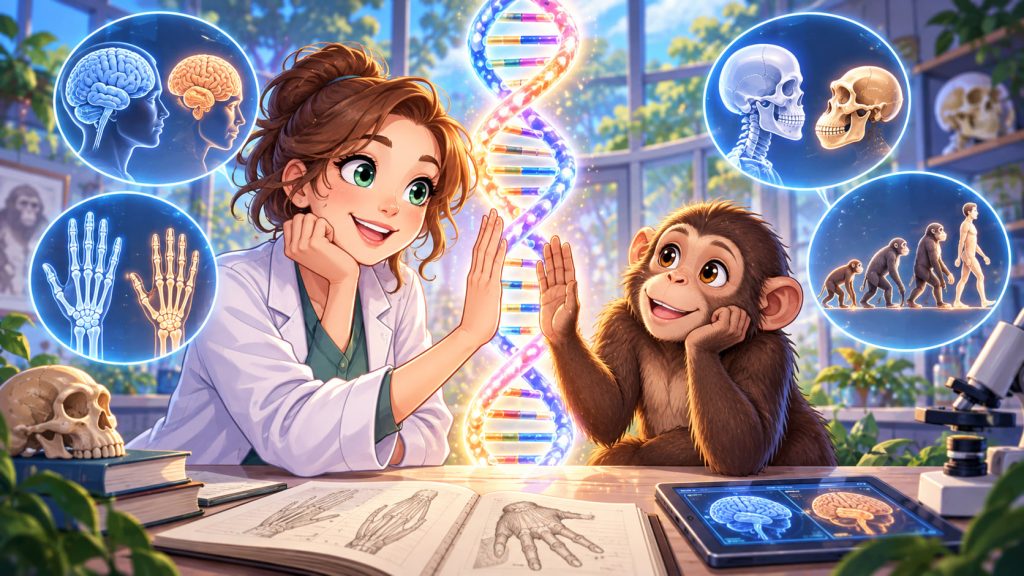
Humans often look surprisingly different from monkeys, yet biologically we belong to the same larger evolutionary family: the primates.
The comparison becomes even more interesting when we include apes. Humans are not descended from modern monkeys or chimpanzees. Instead, humans, apes, and monkeys share ancient common ancestors and then followed different evolutionary paths.
Genetics, anatomy, behavior, emotions, and social life all reveal striking similarities. At the same time, several uniquely developed human traits explain why our species has created language, cities, science, technology, and complex global cultures.
Humans Are Primates Too
Humans belong to the biological order Primates, which also includes lemurs, monkeys, apes, chimpanzees, gorillas, orangutans, and several other groups.
More specifically, humans are great apes.
Our closest living evolutionary relatives are chimpanzees and bonobos, not monkeys.
Monkeys branched away from the lineage leading to humans and other apes much earlier in evolutionary history.
This distinction matters because statements such as “humans share almost 99% of their DNA with monkeys” are often misleading. That commonly quoted comparison refers mainly to humans and chimpanzees, which are apes.
How Similar Is Human and Chimpanzee DNA?
Humans and chimpanzees share approximately 98–99% similarity in directly comparable DNA sequences, depending on exactly how scientists calculate the comparison.
This extraordinary similarity reflects a relatively recent common evolutionary ancestor.
Yet even a small percentage difference is enormous when spread across billions of DNA building blocks.
Genetic differences can affect:
- Brain development
- Skull structure
- Hair distribution
- Immune function
- Reproduction
- Metabolism
- Speech-related anatomy
- Muscle development
Small genetic changes can therefore produce large differences in appearance and behavior.
What About Actual Monkeys?
Humans are also genetically similar to monkeys, although the relationship is more distant.
Old World monkeys, such as macaques and baboons, share a common ancestor with humans that lived tens of millions of years ago.
New World monkeys separated from the human lineage even earlier.
Despite this evolutionary distance, humans and monkeys still share much of the basic genetic machinery required to build a primate body.
The similarities are obvious in the skeleton, nervous system, muscles, eyes, hands, internal organs, and many aspects of reproduction.
Our Bodies Follow the Same Basic Design
Look closely at a human hand and the hand of many primates, and the structural similarity is immediately apparent.
Both typically have five digits, nails rather than claws, mobile fingers, and hands capable of grasping objects.
Primates also tend to have:
- Forward-facing eyes
- Strong depth perception
- Flexible shoulders
- Highly mobile hands
- Relatively large brains
- Complex facial muscles
- Long periods of parental care
These features developed because early primates lived in environments where accurate vision, climbing, grasping, and social interaction were highly useful.
The human body is not an entirely new biological design. It is a heavily modified primate body.
One Famous Chromosome Difference
Humans normally have 46 chromosomes, while chimpanzees, bonobos, and gorillas have 48.
This may sound like a dramatic difference, but one event explains much of it.
During human evolution, two ancestral ape chromosomes fused together.
The result became human chromosome 2.
Evidence of this fusion remains visible in the structure of the chromosome, providing one of the most elegant genetic clues to our shared ancestry with other great apes.
Human and Primate Brains
Primate brains share the same fundamental organization.
Humans and other primates possess brain regions involved in vision, movement, memory, emotion, decision-making, and social behavior.
The major difference is not that humans have completely different brain structures.
Instead, some regions became unusually expanded and interconnected during human evolution, particularly areas involved in planning, symbolic thinking, language, and complex social reasoning.
Humans also have an exceptionally large brain relative to body size.
But brain size alone does not explain human abilities. Neural organization, development, connectivity, and learning are equally important.
Monkeys Can Use Tools
Tool use was once considered uniquely human.
It is not.
Chimpanzees use sticks to collect termites, stones to crack nuts, and plant materials as simple tools.
Some monkeys also use stones and other objects to access food.
Certain primates can learn complicated sequences of actions by observing other members of their group.
This demonstrates that intelligence, problem-solving, and learning from others existed long before modern humans appeared.
The major human difference is the extraordinary scale of cumulative culture.
One generation can improve an invention and pass that improvement to the next, eventually producing technologies far beyond anything a single person could invent alone.
Social Life Is Surprisingly Familiar
Primates can live in sophisticated social groups.
They form alliances, compete for status, protect offspring, reconcile after conflicts, and maintain long-term relationships.
Some species recognize individuals they have not seen for long periods.
Young primates learn by watching adults, while group members may cooperate in obtaining food or defending territory.
Researchers have also observed behaviors resembling consolation, grief, play, jealousy, affection, and reconciliation.
This does not mean monkey emotions are identical to human emotions.
But many of the biological foundations of human social behavior have deep evolutionary roots.
Facial Expressions and Communication
Human faces are extraordinarily expressive, but other primates also communicate through facial expressions, posture, gestures, and vocalizations.
Chimpanzees, bonobos, gorillas, and monkeys produce different signals depending on social situations and danger.
Some species even produce different alarm calls for different predators.
Great apes raised in specialized research environments have also demonstrated impressive abilities to learn symbols and gestures.
However, no non-human primate naturally develops language with the open-ended grammar, enormous vocabulary, and abstract symbolic complexity found in humans.
Why Humans Walk on Two Legs
One of the most obvious differences between humans and most other primates is habitual bipedalism.
Humans are anatomically specialized for walking efficiently on two legs.
Our pelvis, spine, knees, feet, and leg proportions differ significantly from those of chimpanzees and monkeys.
Walking upright freed the hands from locomotion.
Over evolutionary time, this likely contributed to increasingly sophisticated carrying, tool use, food preparation, and manipulation of objects.
Expert Perspective: Evolution Is About Common Ancestry
Evolutionary biologists emphasize an important correction to a common misconception: humans did not evolve from the monkeys alive today.
Instead, modern humans and modern monkeys are separate branches of a much older evolutionary tree.
This is similar to cousins sharing grandparents. One cousin did not descend from the other.
The famous work of primatologists such as Jane Goodall also transformed scientific understanding of the boundary between humans and other primates. Observations of chimpanzee tool use, social relationships, conflict, cooperation, and individual personalities revealed that many traits once assumed to be exclusively human have evolutionary predecessors in other apes.
What Makes Humans Different?
Humans remain biologically unusual even among primates.
Our species developed an exceptional combination of traits:
- Complex spoken language
- Cumulative technology
- Symbolic mathematics
- Large-scale cooperation
- Written information
- Formal education
- Advanced tool manufacturing
- Art and music
- Scientific reasoning
- Extremely complex institutions
No single difference explains humanity.
Human uniqueness emerged from the interaction of brain development, language, social cooperation, dexterous hands, long childhoods, and cultural transmission.
Interesting Facts
- Humans are scientifically classified as great apes.
- Chimpanzees and bonobos are our closest living evolutionary relatives.
- Humans have 46 chromosomes, while chimpanzees have 48.
- Human chromosome 2 formed through the fusion of two ancestral chromosomes.
- Some monkeys use stones as tools to open hard foods.
- Chimpanzees can develop different tool-use traditions in different communities.
- Many primates recognize themselves and others as distinct individuals to varying degrees.
- Human babies and young apes both learn extensively through observation and imitation.
- Primates generally have unusually long childhoods compared with many mammals.
- Humans and modern monkeys share common ancestors; humans did not evolve from today’s monkeys.
Glossary
- Primate — A member of the mammalian group that includes humans, apes, monkeys, lemurs, and related species.
- Ape — A primate group that includes gibbons, orangutans, gorillas, chimpanzees, bonobos, and humans.
- Common Ancestor — An ancestral species from which two or more later evolutionary lineages descended.
- DNA — The molecule containing hereditary genetic information.
- Chromosome — A structure containing DNA and many genes.
- Evolution — Biological change in populations across generations.
- Bipedalism — Habitual movement using two legs.
- Cumulative Culture — Knowledge and technology that build progressively across generations.
- Genome — The complete collection of genetic material in an organism.
- Primatology — The scientific study of primates.
- Natural Selection — The evolutionary process in which inherited traits affecting survival or reproduction become more or less common over generations.
- Symbolic Thinking — The ability to use words, images, numbers, or other symbols to represent ideas and concepts.