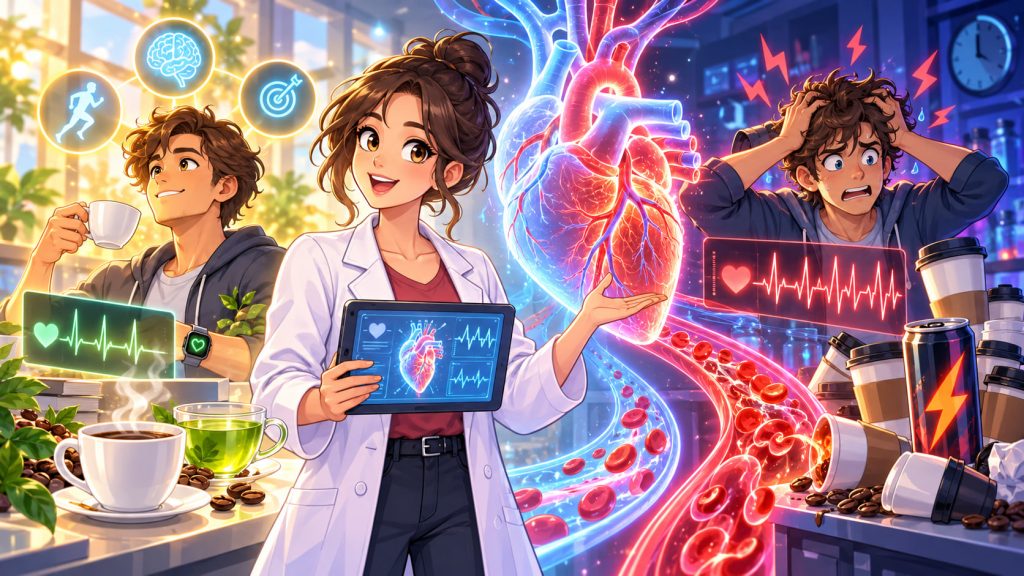
Caffeine is one of the most widely consumed stimulants in the world. Coffee, tea, energy drinks, chocolate, and some medications can all deliver meaningful doses of caffeine, often several times a day.
For most healthy adults, moderate caffeine intake is well tolerated. Yet caffeine directly affects the nervous system, blood vessels, blood pressure, and heart rate, which raises an important question: is caffeine good or bad for cardiovascular health?
The answer depends on dose, individual sensitivity, genetics, existing heart conditions, sleep, and the type of beverage that delivers the caffeine.
How Caffeine Affects the Cardiovascular System
Caffeine blocks adenosine receptors in the brain and other tissues.
Adenosine normally promotes relaxation and helps blood vessels widen. When caffeine blocks its effects, alertness increases and several physiological changes can occur.
These may include:
- A temporary rise in blood pressure
- Increased alertness
- Slight changes in heart rate
- Increased release of stress hormones such as adrenaline
- Changes in blood vessel tone
These effects are usually strongest in people who do not regularly consume caffeine.
Habitual users often develop partial tolerance, meaning the same cup of coffee may produce a smaller cardiovascular response over time.
Caffeine and Blood Pressure
One of caffeine’s clearest short-term effects is a temporary increase in blood pressure.
In some people, systolic and diastolic pressure may rise for several hours after consuming caffeine.
This does not necessarily mean that moderate coffee consumption causes chronic hypertension.
Long-term observational research often finds that habitual coffee drinkers do not have dramatically higher rates of hypertension than non-drinkers, and some studies suggest neutral or even favorable associations.
However, individual responses vary significantly.
People with poorly controlled high blood pressure may be more sensitive to caffeine and may benefit from checking how their blood pressure responds after coffee or energy drinks.
The important distinction is between a temporary caffeine-related blood pressure rise and chronically elevated blood pressure.
Does Caffeine Increase Heart Rate?
Many people assume caffeine always makes the heart beat faster.
In reality, the response is more complicated.
Some people experience an increased heart rate, while others show little change. In certain circumstances, reflex mechanisms in the body may even produce a slight slowing of the pulse.
What people often notice most is not necessarily a sustained increase in heart rate but a stronger awareness of the heartbeat.
This may feel like pounding, fluttering, or skipped beats.
Caffeine and Heart Palpitations
Palpitations are among the most commonly reported cardiovascular symptoms associated with caffeine.
For sensitive individuals, large amounts of caffeine can trigger sensations such as:
- Racing heartbeat
- Fluttering
- Forceful beats
- Occasional skipped beats
However, research has challenged the old assumption that moderate coffee consumption routinely causes dangerous abnormal heart rhythms.
For many healthy people, ordinary amounts of coffee do not appear to significantly increase the risk of common arrhythmias.
Sensitivity matters more than the simple presence of caffeine.
Someone who repeatedly experiences palpitations after consuming caffeine should reduce intake and discuss persistent symptoms with a healthcare professional.
Coffee May Be Different From Pure Caffeine
Coffee contains much more than caffeine.
It also provides hundreds of biologically active compounds, including polyphenols and other antioxidants.
These compounds may influence inflammation, glucose metabolism, blood vessel function, and other processes related to cardiovascular health.
This helps explain why research on coffee consumption does not always produce the same results as research on isolated caffeine.
Moderate coffee intake is often associated with a lower risk of several chronic conditions and, in many studies, with favorable cardiovascular outcomes.
That does not prove that coffee itself prevents heart disease, but it suggests that moderate coffee consumption is not automatically harmful to the heart in healthy adults.
Possible Cardiovascular Benefits
Some large population studies have found that moderate coffee consumption is associated with lower rates of cardiovascular disease, stroke, and cardiovascular mortality.
Several mechanisms may contribute.
Coffee contains antioxidant compounds that may support blood vessel function and reduce oxidative stress.
Regular coffee intake has also been associated with metabolic effects that could indirectly influence heart health.
However, these observations should not be interpreted as a reason for non-coffee drinkers to start consuming caffeine specifically to protect their hearts.
Coffee can fit into a healthy lifestyle, but it is not a cardiovascular medication.
How Much Caffeine Is Considered Moderate?
For most healthy adults, total caffeine intake of up to about 400 milligrams per day is commonly considered an upper level that is unlikely to cause problems.
Approximate amounts vary widely:
- Espresso: around 60–80 mg per shot
- Brewed coffee: often 80–150 mg per cup
- Black tea: approximately 30–60 mg per cup
- Green tea: roughly 20–45 mg per cup
- Energy drinks: sometimes 80–300 mg or more per container
Serving size and preparation method can dramatically change caffeine content.
A large café coffee may contain several times more caffeine than a small homemade cup.
Why Energy Drinks Deserve Special Attention
Caffeine itself is only part of the cardiovascular story.
Energy drinks may contain large doses of caffeine combined with sugar, additional stimulants, and other active ingredients.
Rapid consumption can produce a stronger physiological response than slowly drinking a cup of coffee.
Some studies have observed temporary increases in blood pressure and changes in cardiac electrical activity after high-dose energy drinks.
Mixing energy drinks with alcohol can create additional concerns because caffeine may reduce the perception of intoxication without reducing alcohol’s impairment.
People with heart rhythm disorders, uncontrolled hypertension, or cardiovascular disease should be particularly cautious with highly caffeinated energy drinks.
Expert Perspective on Caffeine and the Heart
Cardiovascular specialists increasingly emphasize that moderate coffee consumption is generally compatible with heart health for most people.
The key issue is individual response rather than assuming caffeine is universally harmful or beneficial.
A cardiologist evaluating caffeine intake will usually consider blood pressure, heart rhythm, medications, sleep, anxiety, total daily caffeine exposure, and whether symptoms appear soon after consumption.
Someone who drinks two cups of coffee without symptoms is in a very different situation from someone who consumes several energy drinks and experiences palpitations and elevated blood pressure.
Who Should Be More Careful With Caffeine?
Some people may need to limit caffeine more aggressively.
Extra caution may be appropriate for people with:
- Uncontrolled hypertension
- Certain heart rhythm disorders
- Strong caffeine sensitivity
- Severe anxiety associated with palpitations
- Significant sleep problems
- Pregnancy
- Certain medication interactions
Pregnant individuals are generally advised to keep caffeine intake lower than the standard adult maximum.
Children and adolescents should also consume substantially less caffeine than adults.
Caffeine, Sleep, and Indirect Heart Health
One of caffeine’s most underestimated cardiovascular effects may come through sleep.
Caffeine can remain active in the body for many hours.
Consuming it late in the day may reduce sleep duration or sleep quality even when someone can still fall asleep normally.
Poor sleep is associated with increased blood pressure, metabolic disruption, stress hormone changes, and higher cardiovascular risk.
A caffeine habit that consistently damages sleep may become harmful indirectly, even if the caffeine itself causes no obvious heart symptoms.
Practical Ways to Use Caffeine More Safely
People who tolerate caffeine well usually do not need to eliminate it completely.
A practical approach is to keep total daily intake moderate, avoid rapidly consuming very large doses, and monitor individual symptoms.
It can also help to limit caffeine in the afternoon or evening.
Unsweetened coffee and tea are usually better choices than heavily sweetened caffeinated beverages.
If caffeine repeatedly causes tremor, anxiety, insomnia, palpitations, or significant blood pressure increases, reducing intake is sensible.
Suddenly stopping very high caffeine consumption can cause headaches, fatigue, and irritability, so gradual reduction may be easier.
Interesting Facts
- Caffeine can begin affecting the body within roughly 15–45 minutes after consumption.
- Its average half-life in healthy adults is usually several hours, although it varies considerably between individuals.
- Genetics influence how quickly the liver breaks down caffeine.
- Regular caffeine users often develop partial tolerance to its blood pressure effects.
- Coffee contains many biologically active substances besides caffeine.
- Decaffeinated coffee still contains small amounts of caffeine.
- Smoking can accelerate caffeine metabolism, while some medications can slow it down.
- A large energy drink may contain several times more caffeine than a cup of tea.
- Caffeine can remain in the body long enough for afternoon consumption to interfere with nighttime sleep.
Glossary
- Caffeine — A natural stimulant found in coffee, tea, cocoa, and several other plants.
- Cardiovascular System — The heart and blood vessels responsible for circulating blood throughout the body.
- Adenosine — A signaling molecule involved in relaxation, sleep pressure, and blood vessel regulation.
- Hypertension — Persistently elevated blood pressure.
- Systolic Blood Pressure — The pressure in arteries when the heart contracts.
- Diastolic Blood Pressure — The pressure in arteries between heartbeats.
- Palpitations — A noticeable sensation of the heart beating rapidly, strongly, irregularly, or unusually.
- Arrhythmia — An abnormal heart rhythm.
- Polyphenols — Plant compounds with antioxidant and other biological effects.
- Oxidative Stress — An imbalance between reactive molecules and the body’s ability to neutralize them.
- Half-Life — The time required for the amount of a substance in the body to decrease by approximately half.
- Tolerance — Reduced response to a substance after repeated exposure.