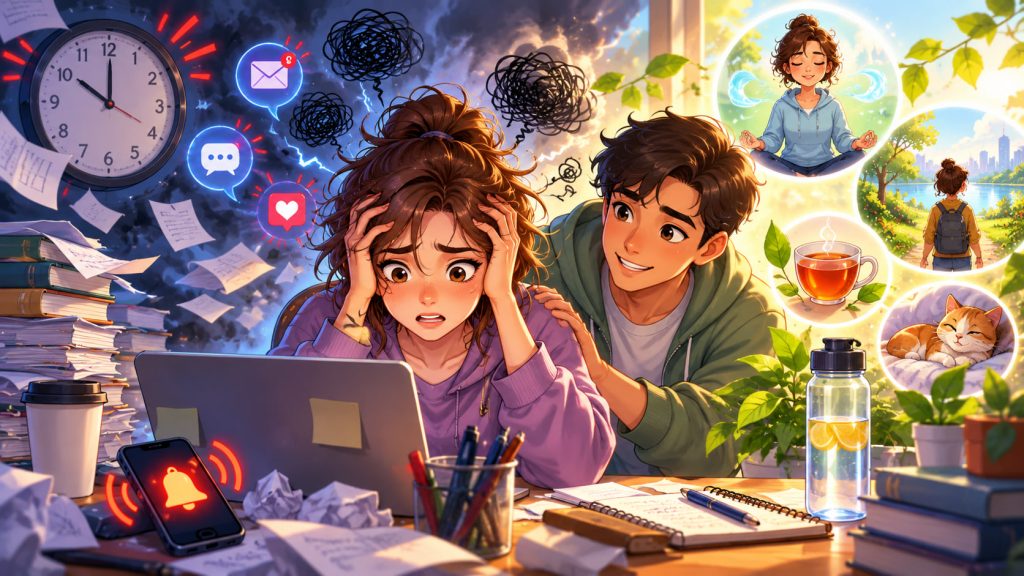
Stress is a normal part of life. Deadlines, family problems, financial pressure, uncertainty, illness, major changes, and even positive events can place demands on the mind and body.
But not all stress feels the same. Sometimes pressure can sharpen focus and motivate action. At other times, it becomes overwhelming, exhausting, and difficult to control. That harmful form of stress is often described as distress.
Distress can affect mood, sleep, concentration, digestion, relationships, and physical health. The important point is that distress is not simply “being weak” or “thinking too much.” It is a real psychological and physiological response to demands that feel greater than your available resources.
Understanding how distress works can make it easier to manage.
What Is Distress?
Distress is the unpleasant form of stress that appears when a person feels unable to cope effectively with pressure, uncertainty, or difficult circumstances.
It can be short-lived, such as the anxiety before an important examination, or persistent, such as months of financial strain or workplace conflict.
The body responds to distress by activating its stress systems. Stress hormones such as adrenaline and cortisol help prepare the body for action.
In the short term, this response can be useful. But when stress remains intense for long periods, the body receives fewer opportunities to return to its normal resting state.
Chronic distress can gradually become mentally and physically exhausting.
Distress vs. Eustress
Stress itself is not always harmful.
The term eustress refers to manageable stress that can increase motivation, concentration, and performance. Preparing for a competition, starting a new job, or working toward an exciting goal may create stress without producing a sense of helplessness.
Distress is different.
With distress, a challenge feels threatening, uncontrollable, or too demanding.
The same situation can produce eustress in one person and distress in another because people differ in experience, health, resources, personality, social support, and perception.
Common Signs of Distress
Distress can appear in many different ways.
Emotional signs may include:
- Irritability
- Anxiety
- Persistent worry
- Feeling overwhelmed
- Sadness
- Loss of motivation
Physical symptoms can include headaches, muscle tension, fatigue, digestive discomfort, a racing heartbeat, or changes in appetite.
Sleep often becomes affected. Some people have difficulty falling asleep, while others wake frequently or sleep longer without feeling rested.
Concentration may also become harder.
One of the clearest warning signs is when stress begins interfering with ordinary daily life rather than helping you adapt to it.
Why Distress Can Become Chronic
Sometimes the stressful event ends, but the mind continues responding as though the danger remains.
Repeated worrying, poor sleep, social isolation, lack of recovery time, and continuing uncertainty can keep the stress response active.
Modern life can amplify this pattern.
Constant notifications, difficult news, work messages, financial concerns, and pressure to remain productive can create a feeling that there is never a true pause.
The result is not necessarily one dramatic crisis. Often, chronic distress develops through many smaller pressures accumulating over time.
Expert Perspective: How We Interpret Stress Matters
Psychologist Richard Lazarus, one of the most influential researchers in modern stress theory, emphasized that stress depends partly on how people evaluate a situation.
A person unconsciously asks two important questions: “Is this situation threatening?” and “Do I have the resources to handle it?”
This helps explain why two people can experience the same event very differently.
The goal is not to convince yourself that every difficult situation is harmless. Instead, it can help to identify which parts of the problem are controllable, which resources are available, and what realistic action can be taken next.
A stressful situation often becomes easier to manage when it changes from a vague threat into a series of specific problems.
Start by Reducing the Immediate Stress Response
When distress feels intense, solving the entire problem immediately may be unrealistic.
Reducing physiological arousal can make clearer thinking easier.
Slow breathing is one simple technique. Longer, controlled exhalations can help shift the body toward a calmer state.
Walking, stretching, taking a shower, stepping outside, or temporarily leaving an overstimulating environment can also help.
These actions do not remove the underlying problem.
They create enough mental space to respond more deliberately rather than reacting automatically.
Break Large Problems Into Smaller Actions
Distress often grows when several concerns merge into one enormous problem.
Instead of thinking, “Everything is going wrong,” identify individual issues.
For example:
- What needs attention today?
- What can wait?
- What depends on someone else?
- What can realistically be changed?
- What is outside your control?
Choose one small action that can be completed.
Sending one email, making one appointment, paying one bill, cleaning one room, or planning tomorrow’s priorities may seem insignificant.
But completed actions restore a sense of control.
Protect Sleep and Recovery Time
Sleep is one of the first things distress can disrupt, and poor sleep can then make stress reactions stronger.
Keeping relatively consistent sleep and wake times can help regulate the body’s daily rhythms.
Reducing stimulating activities shortly before bed may also make it easier to settle.
Recovery does not only mean sleeping.
Quiet time, hobbies, nature, exercise, reading, music, and social connection can all give the nervous system periods when it is not responding to demands.
Rest is not wasted time. It is part of the body’s stress-regulation system.
Move Your Body Regularly
Physical activity is one of the most reliable lifestyle tools for managing stress.
Exercise can reduce muscular tension, improve sleep, support mood regulation, and provide a constructive outlet for physiological arousal.
It does not need to involve intense training.
Walking, cycling, swimming, dancing, gardening, or moderate strength training can all be useful.
Consistency usually matters more than intensity.
Do Not Isolate Yourself
Distress often encourages withdrawal.
People may feel that they do not want to burden others, or they may believe they should solve everything independently.
However, social support can reduce the perceived intensity of stressful situations.
Talking with a trusted friend, partner, family member, counselor, or colleague can help organize thoughts and provide emotional perspective.
Sometimes support means receiving advice.
At other times, simply being listened to is enough.
Watch for Coping Strategies That Create New Problems
Not every activity that temporarily reduces stress is helpful in the long term.
Excessive alcohol, overeating, compulsive shopping, gambling, constant scrolling, or avoiding responsibilities may provide short-term distraction while increasing distress later.
Healthy coping does not necessarily feel instantly pleasurable.
Often it involves actions that gradually improve stability, such as sleep, movement, planning, communication, and setting boundaries.
When Professional Support Is Worth Considering
Professional help can be useful when distress becomes persistent, intense, or difficult to manage alone.
A psychologist, therapist, counselor, or physician can help identify contributing factors and develop practical strategies.
Support is especially important when stress seriously affects sleep, work, relationships, eating, or daily functioning.
If distress is accompanied by thoughts of self-harm, suicide, or feeling unable to remain safe, immediate professional or emergency support is necessary.
Seeking help does not require waiting until the situation becomes extreme.
Early support can prevent temporary distress from becoming a much larger problem.
P.S. After I took up volunteering and started practicing Schultz’s autogenic training and meditation, my psychological problems vanished, and for many years now, I haven’t even given them a thought…
Interesting Facts
- The word stress originally came from fields such as physics and engineering before becoming widely used in psychology and medicine.
- Researcher Hans Selye helped popularize the distinction between beneficial stress and harmful distress.
- Short-term stress can temporarily increase alertness and reaction speed.
- Chronic stress can affect sleep, immune regulation, digestion, mood, and cardiovascular function.
- Social support can change how threatening a stressful situation feels.
- Regular physical activity can improve the body’s ability to recover after stressful events.
- Even positive life events such as marriage, moving, or starting a new job can generate significant stress.
- The brain does not always distinguish perfectly between a real immediate threat and a repeatedly imagined future threat.
Glossary
- Distress — Harmful or overwhelming stress that exceeds a person’s perceived ability to cope.
- Eustress — Manageable stress that can support motivation, adaptation, or performance.
- Chronic Stress — Stress that continues for an extended period rather than resolving quickly.
- Cortisol — A hormone involved in the body’s stress response, metabolism, and daily biological rhythms.
- Adrenaline — A hormone that increases heart rate, alertness, and energy availability during stressful situations.
- Stress Response — The body’s coordinated physical and psychological reaction to perceived demands or threats.
- Coping Strategy — A behavior or mental technique used to manage stress or difficult emotions.
- Social Support — Emotional, practical, or informational help provided by other people.
- Physiological Arousal — Increased activation of the body, such as faster heartbeat, muscle tension, or heightened alertness.
- Emotional Regulation — The ability to understand, manage, and respond to emotional experiences effectively.