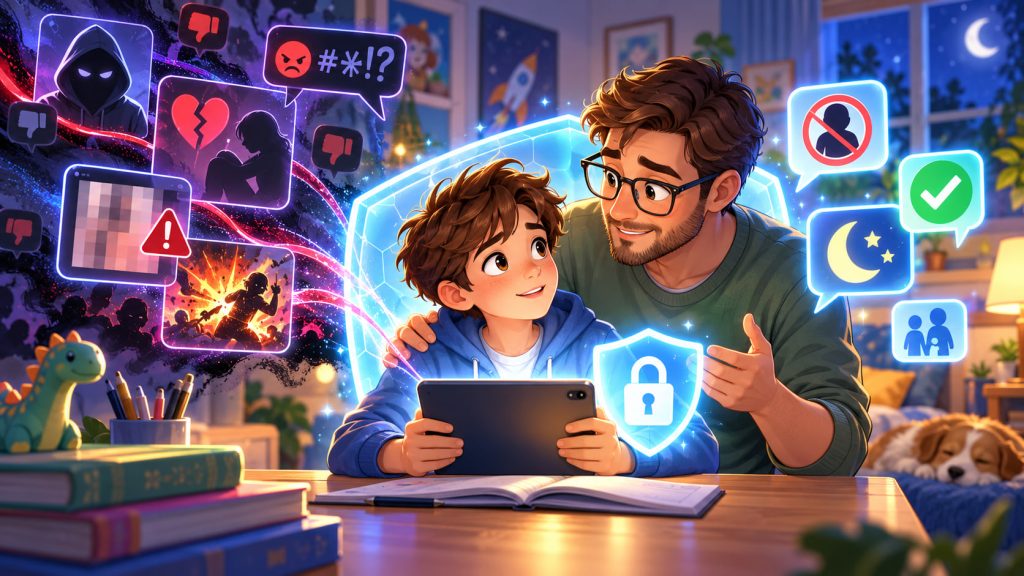
Social media can help children communicate, learn, create, and discover new interests. But the same platforms can also expose young users to disturbing material, manipulative communities, cyberbullying, sexual content, graphic violence, and posts that normalize self-harm or dangerous behavior.
For parents, the goal is not simply to ban technology. The most effective protection combines parental involvement, age-appropriate limits, privacy settings, digital literacy, and an atmosphere in which a child feels safe asking for help.
Understanding the risks is the first step toward reducing them.
Why Children Are Especially Vulnerable Online
Children and teenagers are still developing judgment, emotional regulation, and the ability to assess long-term consequences.
Social media platforms are designed to capture attention. Recommendation systems quickly learn what keeps a person watching, clicking, or reacting.
A child who pauses on disturbing material may therefore be shown more of the same.
This can create a dangerous feedback loop in which increasingly extreme content appears normal simply because it becomes familiar.
Repeated exposure can influence how children perceive relationships, appearance, violence, risk, and even their own self-worth.
Self-Harm and Suicide-Related Content
One of the most serious online risks is content that discusses or depicts self-harm.
Some posts encourage recovery and support. Others can romanticize suffering, present self-injury as part of an identity, or expose vulnerable children to communities where dangerous behavior is normalized.
Algorithms may unintentionally make the problem worse by recommending related material after a child interacts with only a few posts.
Parents should take sudden changes seriously, including increased secrecy, social withdrawal, unexplained injuries, intense hopelessness, or repeated interest in content focused on death or self-harm.
If a child talks about wanting to die, disappear, or hurt themselves, treat the statement as a real health concern rather than dismissing it as attention-seeking.
Sexual Content and Online Exploitation
Children can encounter sexual material accidentally through social feeds, search results, private messages, group chats, or links shared by other users.
Exposure may include pornography, sexualized influencer content, explicit memes, or adults attempting inappropriate conversations.
A particularly serious risk is grooming.
Grooming occurs when an adult or older person gradually builds trust with a child in order to manipulate them sexually, emotionally, or financially.
The person may pretend to be the same age, offer compliments, give gifts, encourage secrecy, or slowly move the conversation toward private topics and images.
Children need to understand a simple rule: anyone who asks them to hide an online relationship from their parents or pressures them for intimate images is creating an unsafe situation.
Violence and Graphic Content
Videos of fights, assaults, accidents, animal cruelty, war, and other graphic events can spread rapidly through social platforms.
Young users may encounter them without searching for them.
Repeated exposure can cause fear, nightmares, emotional numbness, anxiety, or intrusive thoughts.
For some children, violence may gradually become entertainment rather than something disturbing.
That desensitization can affect how they respond to aggression in real life.
Parents should avoid assuming that a child is unaffected simply because they do not immediately react.
Some children process disturbing images hours or days later.
Cyberbullying Can Follow a Child Everywhere
Traditional bullying usually stops when a child leaves school.
Cyberbullying can continue 24 hours a day.
It may involve insults, humiliating videos, fake accounts, exclusion from groups, rumors, threats, or coordinated harassment.
Because posts can be copied and shared quickly, a single embarrassing incident can feel impossible to escape.
The psychological impact can be severe.
Parents should focus first on protecting the child rather than immediately demanding that they defend themselves or confront the bully.
Saving evidence, blocking abusive accounts, reporting serious harassment, and involving the school when classmates are involved can all be important.
Dangerous Challenges and Risky Trends
Social media trends can encourage children to imitate dangerous behavior because popularity provides immediate social rewards.
Challenges may involve risky stunts, extreme dieting, misuse of household products, unsafe driving, choking behavior, or other actions capable of causing serious injury.
Most children do not participate simply because they lack intelligence.
Peer approval, curiosity, impulsivity, and fear of exclusion can be powerful motivators during adolescence.
Parents can reduce the risk by discussing how online popularity works and why viral behavior is not automatically safe.
The Mental Health Effect of Constant Comparison
Not every social-media danger is dramatic.
One of the most common problems is constant comparison.
Children may compare their bodies, clothes, homes, friendships, popularity, or achievements with carefully edited images of other people.
Filters and selective posting can create unrealistic expectations.
A teenager may logically understand that photographs are edited while still emotionally feeling inadequate.
Excessive social comparison has been associated with problems such as poor body image, anxiety, sleep disruption, and lower self-esteem.
Children need repeated reminders that social media shows selected moments, not an accurate measurement of another person’s entire life.
Expert Perspective: Connection Matters More Than Surveillance Alone
Child-development and mental-health professionals consistently emphasize that technical restrictions work best when combined with a strong parent-child relationship.
Parental controls can block some material, but they cannot prevent every disturbing video, message, or conversation.
A child who fears punishment may hide an online problem.
A child who expects calm help is more likely to report it early.
This is why experts encourage parents to have regular conversations about online experiences rather than waiting until something goes wrong.
The message should be clear: “If something frightening, sexual, threatening, or confusing happens online, you can tell me and we will deal with it together.”
Set Age-Appropriate Digital Rules
Children need clear limits just as they do in other areas of life.
Useful rules can include:
- Keeping accounts private
- Accepting messages only from known people
- Not sharing a home address, school, phone number, or live location
- Never sending intimate photographs
- Keeping devices out of bedrooms overnight
- Setting reasonable daily screen limits
- Asking permission before installing new social apps
- Blocking and reporting suspicious users
- Telling an adult about threats or sexual requests
Rules should become more flexible as children demonstrate responsibility.
The goal is gradually teaching safe independence.
Use Parental Controls, But Do Not Rely on Them Completely
Most phones, tablets, app stores, and major platforms provide tools for limiting content, purchases, communication, and screen time.
Parents should use these features, particularly for younger children.
However, filters are imperfect.
Children may also access content through browsers, friends’ devices, secondary accounts, or newly emerging platforms.
Technical controls therefore work best as one layer of protection rather than the entire strategy.
Teach Children How Algorithms Work
Children often assume that a social-media feed represents what everyone is interested in.
It does not.
Recommendation systems personalize content based on previous behavior.
Teach children that watching disturbing content, even out of curiosity, can cause the platform to show more of it.
They should know how to use options such as “not interested,” block, mute, and report.
Understanding the algorithm gives children more control over what enters their digital environment.
Protect Sleep and Offline Life
Late-night social-media use can interfere with sleep.
Notifications, group chats, videos, and fear of missing out encourage children to remain online long after they should be resting.
Poor sleep affects attention, mood, learning, and emotional control.
Creating device-free periods before bedtime is one of the simplest protective measures.
Offline activities are equally important.
Sports, hobbies, friendships, family time, reading, and outdoor activity give children sources of identity that do not depend on likes or follower counts.
Warning Signs Parents Should Notice
Online problems are not always obvious.
Pay attention to significant behavioral changes such as:
- Suddenly hiding screens when adults enter
- Becoming distressed after using a phone
- Avoiding school or friends
- Major changes in sleep
- Unexplained fear or anxiety
- Rapid changes in eating habits or body image
- Obsession with a particular online person
- Receiving unexplained gifts or money
- Increasing secrecy about online activity
- Signs of self-injury
A single sign does not automatically prove that something dangerous is happening.
Several changes together deserve closer attention.
What to Do If Something Serious Happens
The first reaction matters.
Avoid immediately shouting, confiscating every device, or blaming the child.
If a child has been manipulated, threatened, bullied, or exposed to disturbing material, they may already feel ashamed or frightened.
Preserve relevant messages or screenshots when necessary.
Block and report abusive accounts.
If there are credible threats, sexual exploitation, extortion, or attempts by an adult to obtain intimate images from a child, involve appropriate authorities.
If the child appears emotionally overwhelmed, professional psychological or medical support may also be necessary.
The child should understand that asking for help will increase their safety, not increase their punishment.
Interesting Facts
- Social-media feeds are usually personalized, meaning two children using the same platform may see completely different content.
- Private messaging can carry greater risk than public posts because inappropriate conversations are harder for other users to notice.
- Sleep disruption is one of the most common ways excessive social-media use can affect everyday functioning.
- Blocking a user usually stops direct interaction, while reporting alerts the platform to possible rule violations.
- Children are more likely to disclose uncomfortable online experiences when they expect calm support from adults.
- Online grooming often begins with ordinary conversation and may develop gradually over weeks or months.
- A child does not have to actively search for graphic or sexual material to encounter it online.
Glossary
- Algorithm — A system that decides which posts, videos, or recommendations a user is likely to see.
- Cyberbullying — Harassment, humiliation, intimidation, or abuse carried out through digital technology.
- Grooming — A process in which someone builds trust with a child in order to manipulate or exploit them.
- Parental Controls — Settings that allow adults to restrict content, communication, purchases, apps, or screen time.
- Self-Harm — Intentional injury to one’s own body, often associated with severe emotional distress.
- Graphic Content — Images or videos showing severe injury, violence, death, or other disturbing material.
- Desensitization — Reduced emotional response after repeated exposure to something disturbing.
- Digital Literacy — The ability to understand, evaluate, and use digital information and online services safely.
- Online Exploitation — The manipulation or abuse of a person through digital communication, often for sexual, financial, or other harmful purposes.
- Social Comparison — The process of judging oneself by comparing appearance, popularity, success, or lifestyle with other people.