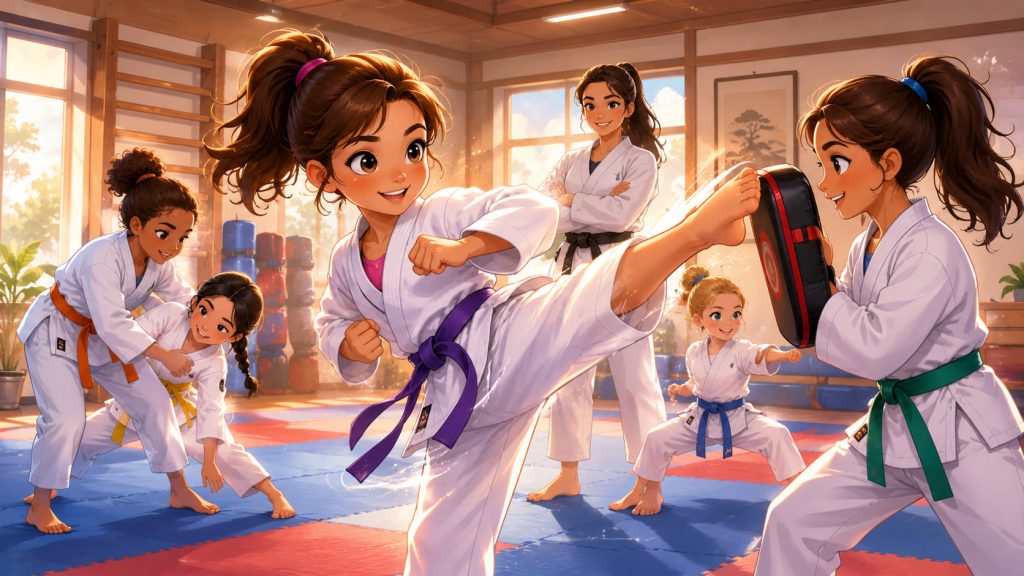
Martial arts are often associated with strength, combat, and competition, but they offer much more than fighting skills. For girls, martial arts can provide a structured way to improve fitness, confidence, coordination, discipline, and personal safety.
From karate and taekwondo to judo, aikido, kung fu, and Brazilian jiu-jitsu, there are many styles to choose from. Each has a different training culture, technical focus, and level of physical contact.
The best martial art for a girl is not the one that looks most impressive, but the one that matches her personality, goals, age, and comfort level.
Why Martial Arts Can Be Especially Valuable for Girls
Martial arts develop both physical and mental skills.
Regular training can improve:
- Balance
- Flexibility
- Coordination
- Strength
- Endurance
- Reaction speed
- Body awareness
These benefits can support performance in many other activities, including dance, gymnastics, athletics, and team sports.
But the psychological benefits may be just as important.
Girls who train consistently often become more comfortable with challenges, physical effort, competition, and learning from mistakes.
Martial arts teach that progress comes from practice, not instant talent.
That mindset can be valuable far beyond the training hall.
Confidence Without Aggression
One of the biggest misconceptions about martial arts is that they make children more aggressive.
Well-run schools usually teach the opposite.
Students learn to control their movements, follow rules, respect training partners, and avoid unnecessary conflict.
Confidence often grows because the student gradually learns what her body can do.
A technique that seems impossible at first may become natural after weeks or months of repetition.
This gives children a concrete experience of improvement.
They learn that nervousness, difficulty, or failure does not mean they should quit.
Martial Arts and Self-Defense
Many parents choose martial arts because they want their daughters to feel safer.
That can be a useful goal, but realistic expectations matter.
No martial art can guarantee safety in every situation.
Effective self-defense includes much more than punching or throwing.
It involves:
- Awareness of surroundings
- Recognizing unsafe situations
- Setting verbal boundaries
- Moving away from danger
- Seeking help
- Using physical techniques only when necessary
Martial arts can improve balance, reaction time, confidence, and the ability to remain composed under pressure.
The most useful self-defense skill is often avoiding or escaping a dangerous situation rather than trying to win a fight.
Karate: Structured and Versatile
Karate is one of the most popular martial arts for children.
Training commonly includes punches, kicks, blocks, stances, forms, and controlled partner exercises.
Many karate schools have clearly structured belt systems, which can motivate children by giving them visible milestones.
Karate may suit girls who enjoy technique, repetition, discipline, and individual progress.
Some schools emphasize traditional forms, while others focus more heavily on competition or practical sparring.
Because training styles vary greatly, visiting the specific school matters more than simply choosing the word “karate.”
Taekwondo: Speed, Flexibility, and Dynamic Kicking
Taekwondo is known for fast, powerful kicking techniques.
Classes often include flexibility work, combinations, forms, pad training, and sparring.
It can be especially appealing to children who enjoy energetic movement.
Taekwondo may help develop:
- Leg strength
- Flexibility
- Balance
- Coordination
- Explosive movement
Competition is also widely available.
For some girls, the athletic and dynamic nature of taekwondo makes it especially motivating.
Judo: Learning to Throw and Fall Safely
Judo focuses heavily on throws, balance, gripping, and ground control.
Punches and kicks are generally not the central part of normal sport judo training.
One major benefit is learning how to fall safely.
Students practice breakfalls repeatedly so they can reduce the impact of hitting the ground.
This skill can be useful outside martial arts as well.
Judo also teaches students how to use leverage and positioning rather than relying only on raw strength.
That makes it an interesting choice for girls who enjoy close-contact technical training.
Brazilian Jiu-Jitsu: Technique and Problem-Solving
Brazilian jiu-jitsu, often shortened to BJJ, focuses primarily on grappling and ground techniques.
Students learn positional control, escapes, holds, and submissions.
The training can feel almost like physical problem-solving.
A smaller student can sometimes control a larger partner through leverage, timing, and technique.
This is one reason BJJ has become increasingly popular among women and girls.
However, it involves close physical contact, so some children may need time to become comfortable with the format.
A respectful training environment is essential.
Aikido: Control and Movement
Aikido emphasizes movement, balance, redirection, joint control, and throws.
Compared with many competitive martial arts, traditional aikido often places less emphasis on winning matches.
It may appeal to girls who prefer cooperative technical practice rather than frequent competition.
The style can develop coordination and body awareness, although the training approach varies significantly between schools.
Kung Fu and Other Traditional Styles
“Kung fu” is a broad term covering many Chinese martial arts traditions.
Some styles emphasize fast hand techniques, others include powerful stances, acrobatics, weapons training, forms, or animal-inspired movement patterns.
Because there is so much variation, the quality and philosophy of the school are especially important.
Traditional martial arts can be highly engaging for children who enjoy learning complex movement sequences and cultural traditions.
What Age Is Best to Start?
There is no single perfect age.
Some martial arts schools offer introductory classes for children as young as four or five.
At that age, training is often focused more on coordination, listening, balance, simple movements, and fun.
Around ages six to eight, many children can handle more structured technical instruction.
Older children and teenagers can generally train with greater tactical and physical complexity.
Readiness matters more than age alone.
A child who can follow instructions, work safely with partners, and enjoy structured practice is usually ready to begin.
Expert Perspective: The Instructor Matters More Than the Style
Sports coaches and child-development specialists often emphasize that the quality of instruction is more important than the name of the martial art.
A good instructor understands how to teach children safely.
They should encourage progress without humiliation, manage contact carefully, adapt exercises to age and experience, and create a respectful atmosphere.
Warning signs include excessive aggression, unsafe sparring, pressure to continue through injuries, or a culture that rewards intimidation.
A strong school should make children feel challenged but secure.
What Parents Should Look for in a Martial Arts School
Before enrolling a child, watch a class.
Pay attention to how instructors speak to students.
The atmosphere should be disciplined but supportive.
Look for:
- Clear safety rules
- Age-appropriate exercises
- Controlled partner work
- Proper protective equipment
- Respect between students
- Clean training areas
- Reasonable class sizes
- Instructors who explain techniques carefully
It is also useful to ask how injuries, sparring, grading, and competition are handled.
A trial lesson can reveal more than advertising or online photos.
Competition Is Optional
Some girls love tournaments.
Others have no interest in competing.
Both choices are valid.
Competition can teach emotional control, preparation, sportsmanship, and how to handle both victory and disappointment.
But martial arts do not have to become competitive sports.
Many students train for fitness, skill development, confidence, social interaction, or personal enjoyment.
Long-term motivation matters more than collecting medals.
Safety and Injury Prevention
Martial arts are physical activities, so injuries can happen.
Common problems may include bruises, sprains, strains, and minor joint injuries.
Good coaching reduces risk.
Warm-ups, appropriate protective gear, controlled contact, correct technique, and gradual progression are important.
Children should also be encouraged to report pain rather than hide it.
Training through a significant injury can turn a minor problem into a more serious one.
Martial Arts Can Become a Lifelong Skill
One of the strongest advantages of martial arts is that they can grow with the student.
A child may begin with simple coordination exercises and later develop advanced technical, athletic, or competitive skills.
Some continue training into adulthood.
Others eventually move into coaching, fitness, self-defense training, or competition.
The value is not limited to physical techniques.
Consistency, patience, self-control, and confidence are often the most lasting skills martial arts provide.
P.S. The goal of true martial arts is, first and foremost, victory over oneself, over the bad in you, and finding yourself inside you…
“The main point of the martial arts is completely different, and all these tricks may never be used by you in your whole life. I hope to God they will never be used. Your task is to learn to understand the cause and effect, the depth and the essence of the situation, and to resolve it peacefully… Every fool can snarl and punch… But do not give in to your animal instincts. It’s much more important to be human in any situation, to understand why and by what this aggression is caused. And how to solve the dispute in the right way so as to gain a friend instead of making an enemy.” – Sensei of Shambala.
Interesting Facts
- Many martial arts use belt systems to represent progress, but belt colors and ranking structures differ between styles and schools.
- Judo became an Olympic sport in 1964.
- Taekwondo is especially famous for its large variety of kicking techniques.
- Brazilian jiu-jitsu places heavy emphasis on leverage and positional control.
- Breakfall training in judo teaches students how to reduce the force of landing.
- Some traditional martial arts combine physical training with breathing, concentration, and formal etiquette.
- Girls and women now participate in martial arts at recreational, professional, and Olympic levels around the world.
- Martial arts training can improve coordination because students repeatedly practice complex movement patterns involving both sides of the body.
Glossary
- Martial Arts — Structured systems of combat, self-defense, physical training, or competitive techniques.
- Sparring — Controlled practice in which students apply techniques against a training partner.
- Grappling — Close-contact fighting involving holds, positioning, throws, and ground control.
- Leverage — Using body position and mechanical advantage to create force efficiently.
- Breakfall — A technique used to land more safely after being thrown or falling.
- Forms — Predetermined sequences of techniques practiced individually, often called kata or poomsae depending on the martial art.
- Submission — A grappling technique designed to make an opponent signal that they cannot safely continue.
- Dojo — A Japanese term commonly used for a martial arts training hall.
- Protective Gear — Equipment such as gloves, mouthguards, chest protectors, headgear, or shin guards used to reduce injury risk.
- Self-Defense — Skills and strategies intended to help a person avoid, escape, or respond to dangerous situations.