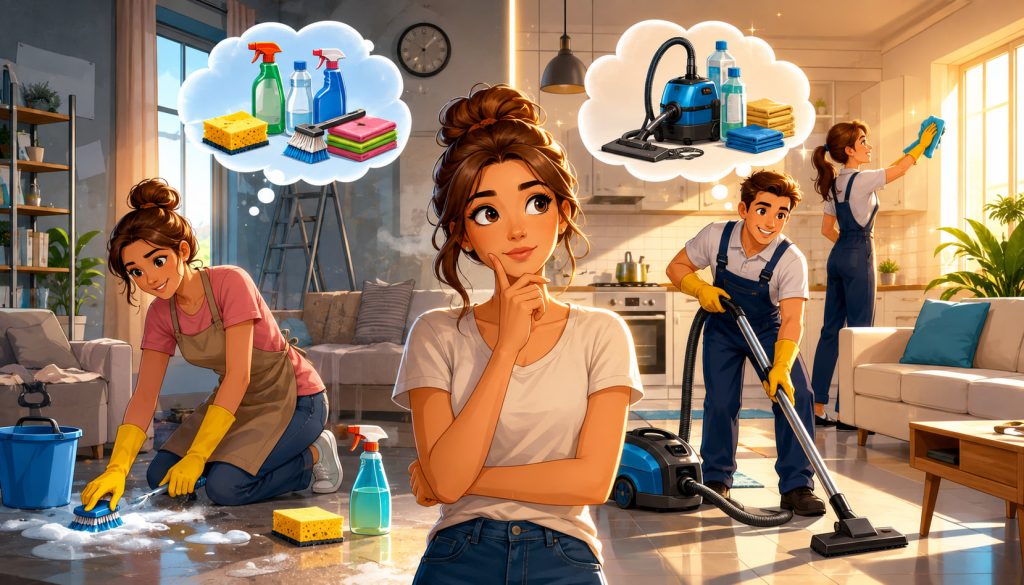
Keeping a home clean sounds simple until everyday life gets in the way. Dust accumulates, bathrooms need scrubbing, kitchens collect grease, and floors somehow become dirty again almost immediately after being washed.
For many households, the real question is no longer whether cleaning needs to be done, but whether it makes more sense to do it yourself or hire professional cleaners.
Both approaches have advantages. Routine cleaning is often easy to handle independently, while deep cleaning, post-renovation work, difficult stains, and large properties may justify professional help.
The best choice depends on time, cost, equipment, the level of contamination, and the result you expect.
What Professional Home Cleaning Actually Includes
Professional cleaning services can range from basic maintenance to highly specialized work.
A standard cleaning visit commonly includes:
- Vacuuming and mopping floors
- Dusting accessible surfaces
- Cleaning kitchens
- Sanitizing bathrooms
- Wiping mirrors and glass
- Emptying waste bins
- Cleaning exterior surfaces of furniture and appliances
More intensive services may include ovens, refrigerators, windows, upholstery, carpets, tiles, grout, hard-to-reach areas, and heavy grease deposits.
It is important to check exactly what is included before booking a cleaning service, because the meaning of “deep cleaning” can vary substantially between companies.
When Regular Cleaning Is Easy to Do Yourself
Most everyday household cleaning does not require professional equipment.
Vacuuming floors, wiping surfaces, cleaning sinks, changing bed linen, and maintaining a bathroom can usually be handled with basic household products.
DIY cleaning makes particular sense when the home is relatively small and cleaned regularly.
Frequent maintenance also prevents dirt from becoming difficult to remove.
A kitchen countertop wiped every day requires far less effort than one covered with weeks of accumulated grease.
The same principle applies to showers, sinks, floors, and household appliances.
Regular light cleaning is usually faster and cheaper than repeatedly waiting until the home requires a major deep clean.
When Professional Cleaners Make Sense
One of the strongest reasons to hire professional cleaners is simply lack of time.
Cleaning a large home thoroughly can take many hours. For people with demanding jobs, children, frequent travel, or other responsibilities, outsourcing the work may be worth the expense.
Professionals can also be useful before or after major events.
Moving into a new home, leaving a rental property, preparing for guests, or cleaning after a large celebration can create considerably more work than routine maintenance.
Another common situation is seasonal deep cleaning.
Areas behind furniture, inside kitchen cabinets, around appliances, and along difficult-to-reach surfaces may receive little attention during normal weekly cleaning.
Post-Renovation Cleaning Is a Different Challenge
Cleaning after construction or renovation is one of the clearest situations where professional help can be valuable.
Renovation dust is extremely fine and can settle almost everywhere.
It may enter:
- Cabinets
- Ventilation grilles
- Window tracks
- Furniture joints
- Radiators
- Light fixtures
- Small cracks and gaps
Ordinary vacuum cleaners are not always ideal for large amounts of fine construction debris.
Professional teams may use powerful vacuums, specialized filters, floor equipment, scrapers, and cleaning agents designed for construction residue.
Post-renovation cleaning is often much more demanding than ordinary household cleaning.
Difficult Stains and Specialized Surfaces
Some materials require more knowledge than others.
Natural stone, hardwood, stainless steel, delicate upholstery, glass, and certain modern coatings can be damaged by unsuitable cleaning products.
For example, strongly acidic cleaners may damage some types of natural stone.
Abrasive products can scratch polished surfaces.
Excess water can cause problems for certain wooden floors or furniture.
Professional cleaners who regularly work with these materials should understand which products and techniques are appropriate.
This becomes especially important when the surface itself is expensive to repair or replace.
Carpets and Upholstery
Routine vacuuming is easy to perform at home, but deeper carpet and upholstery cleaning is more complicated.
Soft furnishings can accumulate dust, skin particles, food debris, pet hair, and stains below the visible surface.
Professional extraction machines can apply cleaning solution and remove contaminated moisture more effectively than ordinary household vacuum cleaners.
However, professional treatment is not necessary every week.
Regular vacuuming, immediate stain treatment, and occasional deeper cleaning can usually keep carpets and upholstered furniture in good condition.
The Hidden Value of Professional Equipment
Cleaning quality depends not only on effort but also on equipment.
Professional cleaning companies may have access to commercial-grade vacuum cleaners, steam equipment, extraction machines, floor scrubbers, extension systems, and specialized detergents.
These tools can make large or difficult jobs considerably faster.
However, expensive equipment does not automatically guarantee a better result.
Technique, attention to detail, and correct product selection remain just as important as the machines themselves.
A careful homeowner can often achieve excellent results with simple tools when the task is straightforward.
Is Professional Cleaning More Hygienic?
Professional cleaning can improve hygiene, but professional service does not automatically mean that every surface becomes sterile.
For an ordinary home, complete sterilization is neither realistic nor necessary.
The goal is usually to remove dirt, organic residue, dust, and excessive microbial contamination from frequently used surfaces.
Areas that deserve particular attention include bathroom fixtures, kitchen worktops, door handles, switches, and other high-touch surfaces.
Cleaning and disinfecting are also different processes.
Cleaning physically removes dirt and many microorganisms, while disinfectants are designed to reduce or destroy specific microorganisms on suitable surfaces.
Expert Perspective: Cleaning Is About Method, Not Maximum Chemicals
Cleaning and hygiene specialists generally distinguish between effective cleaning and excessive chemical use.
Using more detergent does not necessarily produce a cleaner surface.
Too much product can leave residues that attract new dirt, create streaks, or require additional rinsing.
The correct approach is usually to choose a product suitable for the material, use the recommended amount, allow sufficient contact time when required, and mechanically remove the dirt.
Professional-level results often come from systematic technique rather than aggressive chemicals.
When DIY Cleaning May Be the Better Choice
Doing the work yourself gives you complete control over products, timing, and priorities.
It can also save significant money, particularly for frequent routine cleaning.
DIY cleaning is often the practical choice when:
- The home is regularly maintained
- There are no major stains or contamination
- The necessary equipment is already available
- The job can be completed safely
- You have enough time to do it properly
Some people also prefer handling personal spaces themselves rather than allowing unfamiliar workers into bedrooms, offices, or storage areas.
When You Should Avoid Doing It Yourself
Certain cleaning tasks involve unnecessary risk.
High exterior windows, unstable ladders, severe mold contamination, hazardous waste, major pest contamination, and environments affected by sewage or other biological hazards may require trained specialists.
Attempting these jobs without appropriate equipment can expose a homeowner to falls, chemicals, microorganisms, or contaminated dust.
Professional intervention may also make sense when a problem repeatedly returns despite normal cleaning.
Persistent mold, for example, can indicate an underlying moisture problem rather than simply a dirty surface.
The Hybrid Approach Often Works Best
Professional cleaning does not have to replace personal cleaning completely.
Many households use a combination.
Routine maintenance is performed independently, while professionals visit periodically for deeper work.
For example, homeowners might vacuum and clean bathrooms weekly while arranging professional window, carpet, upholstery, or deep kitchen cleaning several times per year.
This hybrid approach can provide professional-level results without paying for services that are easy to handle independently.
Interesting Facts
- Household dust can contain textile fibers, skin particles, pollen, soil particles, pet material, and microscopic debris.
- Microfiber cloths are effective because their extremely fine fibers can physically capture very small particles.
- Warm water does not always clean better; some stains can actually become harder to remove when exposed to heat.
- Cleaning from higher surfaces downward helps prevent dust from falling onto areas that have already been cleaned.
- Vacuuming before wet-mopping generally produces better results because loose dust and debris are removed first.
- Excess detergent can leave a film on floors and other surfaces, making them appear dirty more quickly.
- Professional carpet extraction removes both cleaning solution and suspended dirt from within textile fibers.
- A recurring mold problem often indicates excessive moisture, poor ventilation, leakage, or condensation that needs to be addressed separately.
Glossary
- Deep Cleaning — Intensive cleaning that targets areas and contamination not normally addressed during routine household maintenance.
- Post-Renovation Cleaning — Specialized removal of construction dust, debris, adhesive residue, paint splashes, and other materials left after building or renovation work.
- Disinfection — The use of chemical or physical methods to reduce or destroy microorganisms on surfaces.
- Extraction Cleaning — A method commonly used for carpets and upholstery in which cleaning solution is applied and then removed together with dissolved dirt.
- Microfiber — A synthetic material made from extremely fine fibers that efficiently captures dust and dirt.
- High-Touch Surface — A surface frequently touched by hands, such as door handles, switches, faucets, and appliance controls.
- Abrasive Cleaner — A cleaning product containing particles or materials that remove dirt through friction.
- Contact Time — The amount of time a cleaning or disinfecting product needs to remain on a surface to work effectively.
- Cross-Contamination — The transfer of dirt, microorganisms, or contaminants from one surface or area to another.
- Maintenance Cleaning — Regular light cleaning performed to prevent significant accumulation of dirt and contamination.