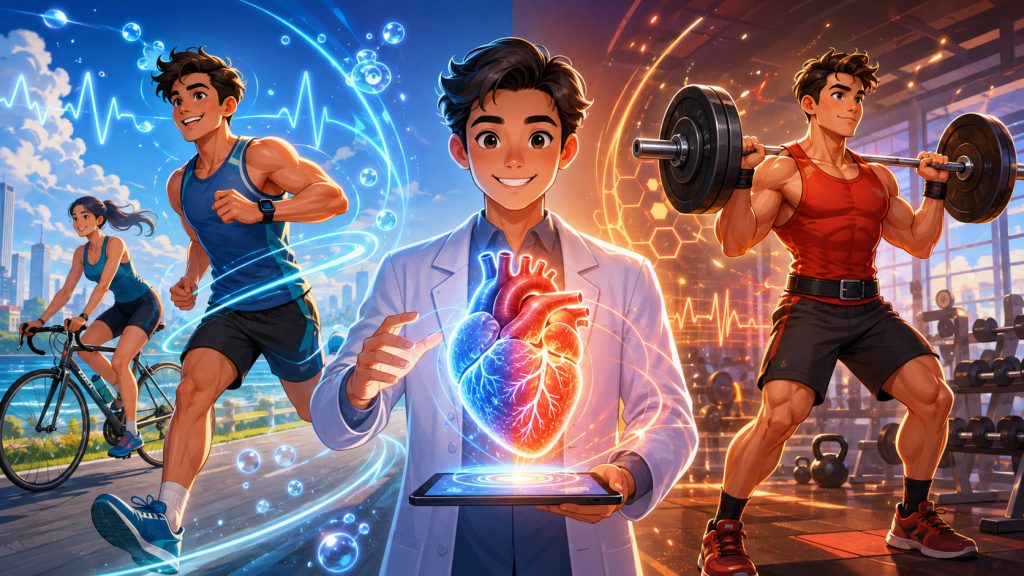
Exercise is one of the strongest tools for supporting cardiovascular health, but not all training affects the heart in the same way.
Endurance exercise such as running, cycling, swimming, and brisk walking places long-lasting demands on the cardiovascular system. Strength training, including weightlifting and resistance exercises, creates shorter but more intense increases in pressure and muscular force.
Both can benefit the heart.
The most complete approach to cardiovascular fitness usually combines endurance training with regular strength work rather than treating them as competitors.
What Happens to the Heart During Endurance Exercise?
During endurance exercise, working muscles need more oxygen.
The heart responds by beating faster and pumping more blood with each contraction.
Blood vessels supplying active muscles widen, allowing circulation to increase.
This raises cardiac output, which is the total amount of blood the heart pumps each minute.
Over time, regular aerobic training can make this process more efficient.
A trained heart may pump more blood with each beat, allowing resting heart rate to become lower.
How Endurance Training Changes the Heart
Long-term endurance training can produce structural adaptations in the heart.
The left ventricle, which pumps oxygenated blood throughout the body, may become better able to fill with blood and eject a larger volume during each heartbeat.
This adaptation is sometimes called an athlete’s heart.
In healthy athletes, these changes are generally considered a normal response to repeated training.
Endurance training can also improve:
- Aerobic capacity
- Blood vessel function
- Blood pressure regulation
- Insulin sensitivity
- Circulation
- Exercise tolerance
One of the biggest cardiovascular benefits of endurance training is improved efficiency in delivering oxygen to working tissues.
Why VO2 Max Matters
VO2 max describes the maximum amount of oxygen the body can use during intense exercise.
It depends on several systems working together:
- The lungs
- The heart
- Blood circulation
- Hemoglobin
- Muscles
- Mitochondria
Higher cardiorespiratory fitness is strongly associated with better long-term health outcomes.
Endurance training is particularly effective at improving VO2 max because it repeatedly challenges the body’s ability to transport and use oxygen.
Running, cycling, rowing, swimming, and interval training can all improve aerobic capacity when performed consistently.
What Happens to the Heart During Strength Training?
Strength training creates a different cardiovascular response.
When lifting a heavy weight, contracting muscles can temporarily compress blood vessels.
Blood pressure rises, sometimes substantially, especially during heavy sets.
The heart must pump against this increased resistance.
However, these pressure increases are usually short-lived and fall after the effort ends.
Over time, appropriately performed resistance training can improve overall cardiovascular health rather than harming the heart.
Can Strength Training Lower Blood Pressure?
Regular resistance training can contribute to improved blood pressure control.
The effect is usually less obvious during the workout itself because blood pressure temporarily rises while lifting.
The long-term adaptation is different.
Strength training may improve vascular function, body composition, glucose metabolism, and muscular efficiency.
Greater muscle mass also helps the body handle glucose more effectively.
Strength training supports cardiovascular health indirectly as well as through direct adaptations in the circulatory system.
Strength Training and Body Composition
One important advantage of resistance training is its ability to maintain or increase muscle mass.
Muscle is metabolically active tissue.
Maintaining it becomes increasingly important with age because people naturally tend to lose muscle over time.
Greater muscle strength can make everyday physical activity easier.
Someone who is stronger may find walking stairs, carrying groceries, or performing household tasks less physically demanding.
Strength training can also support healthy body composition, which matters because excessive visceral fat is associated with higher cardiovascular risk.
Endurance Training Usually Has the Stronger Aerobic Effect
When the primary goal is improving cardiorespiratory endurance, aerobic training generally has the advantage.
Long-duration exercise directly challenges the heart, lungs, and circulation to deliver oxygen continuously.
This makes endurance training especially effective for increasing:
- VO2 max
- Stroke volume
- Exercise endurance
- Aerobic efficiency
Strength training can improve cardiovascular fitness to some degree, particularly when performed with shorter rest periods or in circuit formats.
However, traditional heavy resistance training does not usually replace dedicated aerobic exercise.
Strength Training Provides Benefits Endurance Exercise Cannot Fully Replace
Endurance exercise is excellent for cardiovascular conditioning, but it does not provide the same stimulus for muscle and bone as resistance training.
Strength work is particularly valuable for:
- Maintaining muscle mass
- Increasing strength
- Supporting bone density
- Improving joint stability
- Preserving physical independence with age
Strong muscles also reduce the relative effort required during daily activities.
This can indirectly reduce cardiovascular strain during ordinary movement.
A healthy heart benefits from a body that is both aerobically fit and physically strong.
The Role of Blood Pressure During Heavy Lifting
Heavy lifting can cause very large temporary increases in blood pressure.
This is especially true when a person holds their breath during exertion.
Breath-holding under strain can contribute to the Valsalva maneuver, which changes pressure inside the chest and influences circulation.
For healthy trained individuals, these responses are usually managed naturally.
However, people with uncontrolled high blood pressure, certain heart conditions, or vascular problems may need medical guidance before performing very heavy resistance training.
Breathing normally and avoiding unnecessary prolonged straining can reduce excessive pressure responses.
Which Type of Training Is Better for Resting Heart Rate?
Endurance training generally has the greater effect on resting heart rate.
Regular aerobic exercise can increase stroke volume, meaning the heart pumps more blood with every contraction.
As a result, fewer beats may be needed to maintain circulation at rest.
Well-trained endurance athletes can therefore have significantly lower resting heart rates than sedentary individuals.
A low resting heart rate in a trained athlete can be normal.
However, an unusually slow heart rate accompanied by dizziness, weakness, fainting, or other symptoms should be evaluated medically.
Can Too Much Endurance Training Affect the Heart?
Moderate and appropriately progressive endurance training is strongly associated with cardiovascular benefits.
Very high volumes of intense endurance exercise create different physiological stresses.
Elite endurance athletes may develop pronounced cardiac adaptations, including enlargement of some heart chambers.
Most of these changes are normal athletic adaptations.
Research also suggests that some lifelong high-volume endurance athletes may have an increased likelihood of certain rhythm disturbances, particularly atrial fibrillation.
This does not mean endurance training is unhealthy.
It shows that exercise benefits exist alongside the principle that extremely high training volumes can produce different effects from ordinary recreational exercise.
Expert Perspective
Cardiovascular specialists commonly recommend both aerobic and resistance exercise because they influence different components of health.
Major exercise guidelines typically encourage adults to perform regular moderate or vigorous aerobic activity while also including muscle-strengthening sessions during the week.
Sports cardiologists also distinguish between the normal temporary stress produced during exercise and the long-term adaptations that make the cardiovascular system more efficient.
The practical message is straightforward: the heart generally benefits most from varied, progressive exercise that combines aerobic conditioning with muscular strength.
What Does a Balanced Training Week Look Like?
A practical program does not need to be complicated.
Someone might perform aerobic exercise several times per week and strength train two or three times.
For example:
- Brisk walking, jogging, swimming, or cycling
- Full-body resistance training
- One longer easy endurance session
- Occasional higher-intensity intervals
- Recovery days or light activity
The exact balance depends on age, health, goals, fitness level, and training experience.
A competitive runner will naturally spend more time on endurance work.
A powerlifter will emphasize strength.
For general health, however, combining both approaches offers a broader range of benefits.
What About Interval Training?
High-intensity interval training sits somewhere between traditional steady endurance training and highly demanding athletic work.
Short periods of intense exercise are alternated with recovery.
This can produce strong cardiovascular adaptations in relatively little time.
Interval training can improve VO2 max and exercise capacity.
However, it is physically demanding and should be introduced gradually, especially for people returning to exercise after long inactivity.
Not every workout needs to be intense.
Easy and moderate exercise remains extremely valuable.
Exercise Intensity Matters More Than the Label
The terms “cardio” and “strength” can be misleading.
A demanding circuit of squats, push-ups, kettlebell swings, and carries can significantly raise heart rate.
Heavy resistance training with long rest periods may produce little sustained aerobic demand.
Similarly, walking slowly and competitive cycling are both endurance activities but create completely different cardiovascular loads.
The heart responds to duration, intensity, muscle mass involved, recovery periods, and training frequency—not simply the name of the exercise.
Interesting Facts
- The heart is a muscular organ that adapts to repeated physical training.
- Endurance training can increase the amount of blood pumped with each heartbeat.
- Well-trained endurance athletes often have lower resting heart rates.
- Strength training can temporarily raise blood pressure significantly during a heavy lift.
- Long-term resistance training can still contribute to better blood pressure control.
- VO2 max is one of the most widely used measurements of cardiorespiratory fitness.
- Stronger muscles can make everyday tasks less demanding on the cardiovascular system.
- The heart may enlarge slightly in trained athletes as a normal physiological adaptation.
- Both aerobic fitness and muscular strength are associated with healthier aging.
- Recovery is part of cardiovascular adaptation because many training improvements occur between workouts.
Glossary
- Endurance Training — Exercise designed to improve the body’s ability to sustain activity for extended periods.
- Strength Training — Exercise that challenges muscles against resistance to increase strength or muscle capacity.
- Cardiovascular System — The heart and blood vessels responsible for circulating blood throughout the body.
- Cardiac Output — The amount of blood pumped by the heart each minute.
- Stroke Volume — The amount of blood pumped from the heart with each beat.
- VO2 Max — The maximum amount of oxygen the body can use during intense exercise.
- Resting Heart Rate — The number of heartbeats per minute when the body is at rest.
- Blood Pressure — The force of circulating blood against the walls of blood vessels.
- Athlete’s Heart — Normal structural and functional changes that can develop in response to long-term intensive training.
- Valsalva Maneuver — A pressure-producing breathing action that can occur when a person strains while holding their breath.
- Atrial Fibrillation — An irregular heart rhythm originating in the upper chambers of the heart.
- Aerobic Capacity — The body’s ability to use oxygen during sustained physical activity.
- Visceral Fat — Fat stored around internal organs within the abdominal cavity.
- Cardiorespiratory Fitness — The ability of the heart, lungs, blood vessels, and muscles to support sustained physical activity.