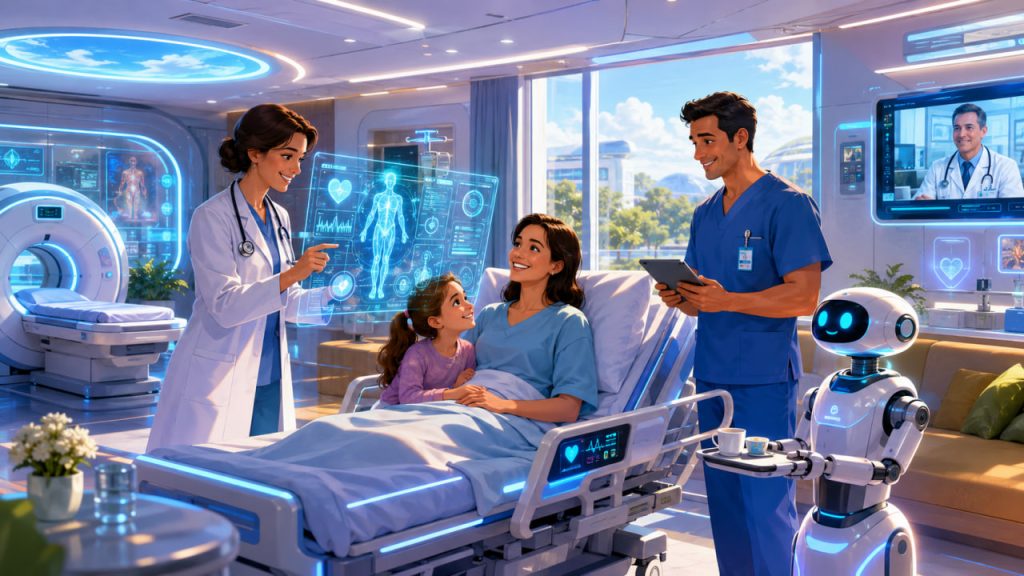
A modern hospital is no longer just a building with doctors, beds, operating rooms, and medical equipment. It is becoming a connected health ecosystem where technology, architecture, data, safety, sustainability, and patient comfort work together.
The hospital of the future will not be defined only by robots or artificial intelligence. It will be defined by a bigger idea: faster diagnosis, safer treatment, less stress for patients, better working conditions for medical staff, and more personalized care.
Healthcare is moving toward hospitals that are digital, resilient, energy-efficient, patient-centered, and deeply connected with care outside the hospital walls.
What Makes a Hospital “Modern”?
A modern hospital combines advanced medicine with smart organization.
It uses electronic health records, digital imaging, laboratory automation, intensive-care monitoring systems, telemedicine, and coordinated clinical workflows. The goal is to reduce delays, support better decisions, and make patient care more accurate.
The World Health Organization’s Global Strategy on Digital Health emphasizes that digital health should strengthen health systems and support health and well-being for everyone.
The best modern hospital is not simply high-tech. It is high-tech in ways that make care safer, clearer, and more accessible.
Technology matters most when it solves real clinical problems.
Patient Safety Comes First
In every hospital, safety is the foundation.
Patient safety includes preventing medication errors, infections, wrong-site procedures, diagnostic delays, falls, and communication failures between care teams.
The World Health Organization’s Global Patient Safety Action Plan 2021–2030 focuses on eliminating avoidable harm in healthcare and improving safety across different areas of medical practice.
Future hospitals will use more real-time alerts, barcode medication systems, smart beds, automated checklists, infection-control monitoring, and predictive analytics.
But the human side will remain essential. No technology can replace a culture where medical workers communicate clearly, double-check critical steps, and speak up when something seems wrong.
Artificial Intelligence in the Hospital
Artificial intelligence is already entering healthcare through imaging tools, decision-support systems, triage assistance, workflow optimization, and AI-enabled medical devices.
The U.S. Food and Drug Administration maintains a public list of AI-enabled medical devices authorized for marketing in the United States, showing that AI is already part of the regulated medical-device landscape.
In the hospital of the future, AI may help detect patterns in scans, prioritize urgent cases, support doctors with clinical information, forecast bed demand, and identify patients at higher risk of deterioration.
AI should be understood as a medical assistant, not a replacement for doctors and nurses.
The strongest future model is human plus machine: clinical judgment, empathy, and experience supported by powerful data analysis.
The Rise of Smart Hospital Rooms
A future hospital room may look very different from the traditional patient room.
Smart rooms can include sensors, digital displays, remote monitoring, adjustable lighting, voice-controlled systems, fall-risk alerts, and easier communication with nurses.
Instead of waking a patient repeatedly for routine checks, some measurements may be monitored quietly and continuously. Instead of confusing paper instructions, patients may see personalized recovery guidance on a bedside screen.
The goal is simple: make the room safer for clinicians and calmer for patients.
A hospital room should support healing, not add unnecessary stress.
Telemedicine and Hospital-at-Home Care
The hospital of the future will not always require a patient to stay inside the hospital.
Some people can be monitored at home with connected devices, video visits, digital check-ins, and rapid response teams. This model can be especially useful for selected patients who are stable but still need medical supervision.
Telemedicine also helps specialists reach patients in rural areas, smaller towns, or overloaded clinics.
This does not mean hospitals will disappear. It means the hospital becomes the center of a wider network. Care will follow the patient more than the patient always following the hospital.
Robotics and Automation
Robots are already useful in some hospitals, especially for surgery, pharmacy tasks, cleaning, supply transport, and rehabilitation support.
In the future, robots may deliver medications, move linens, disinfect rooms, assist with mobility therapy, and help reduce repetitive physical strain on hospital workers.
This is important because hospitals are labor-intensive environments. Nurses, technicians, cleaners, pharmacists, and support staff perform thousands of small but essential tasks every day.
Automation can give professionals more time for the human work that matters most: assessment, communication, comfort, decision-making, and care.
Green and Resilient Hospitals
A future hospital must also be strong during crises.
Hospitals need reliable power, clean water, safe buildings, emergency planning, infection-control capacity, and resilience during storms, heat waves, outbreaks, and infrastructure failures.
The PAHO/WHO Smart Hospitals initiative focuses on improving hospital resilience, strengthening structural and operational safety, and adding green technologies.
The related Smart Hospitals Toolkit describes smart health facilities as those that connect structural and operational safety with green interventions at a reasonable cost-benefit ratio.
A hospital of the future should heal people without wasting energy, resources, or environmental opportunity.
Solar panels, efficient ventilation, better insulation, water-saving systems, smart energy management, and sustainable materials may become normal parts of hospital design.
Personalized and Precision Medicine
Modern hospitals increasingly use genetic testing, biomarkers, advanced imaging, and detailed patient data to guide treatment decisions.
In the future, more treatments may be tailored to a person’s biology, disease subtype, lifestyle, risk factors, and treatment response.
This is especially important in cancer care, cardiology, rare diseases, and chronic illness management.
Personalized medicine does not mean every patient receives a completely unique treatment. It means doctors can choose more accurately from available options.
The future hospital will treat fewer patients as “average cases” and more patients as individuals.
Better Experience for Patients and Families
Hospitals can be frightening. People often arrive in pain, uncertainty, or fear.
That is why future hospital design will focus more on comfort, privacy, natural light, noise reduction, family spaces, clear navigation, and better communication.
A good hospital experience includes:
- Clear explanations
- Shorter waiting times
- Respectful staff communication
- Easy-to-understand discharge instructions
- Comfortable recovery spaces
- Better emotional support
Technology may improve efficiency, but compassion will remain the most important part of care.
Expert Perspective
The World Health Organization’s digital health strategy highlights an important principle: digital transformation should be guided by strategy, resources, governance, and integration into health systems, not adopted randomly.
That idea is central to the hospital of the future. A smart hospital is not a hospital filled with gadgets. It is a hospital where every tool has a purpose: safer care, better access, stronger resilience, and improved health outcomes.
The Hospital of the Future Will Be More Connected
The future hospital will connect many layers of care.
Ambulances may transmit patient data before arrival. Emergency departments may prepare before the patient reaches the door. AI systems may help prioritize scans. Smart rooms may monitor recovery. Home devices may continue observation after discharge.
This connected model can reduce fragmentation.
Instead of separate islands of care, the future hospital becomes part of a continuous patient journey.
Interesting Facts
- Some modern hospitals already use robots to transport supplies, medications, and laboratory samples.
- Future hospital rooms may adjust lighting and temperature automatically to support patient comfort.
- AI-enabled medical devices are already part of regulated healthcare technology in the United States.
- Smart hospitals focus not only on digital tools but also on safety, resilience, and environmental performance.
- Telemedicine can connect hospital specialists with patients far outside major medical centers.
- Digital twins may one day help hospitals simulate patient flow, energy use, and emergency capacity.
- The most advanced hospital design still depends on trained, compassionate medical professionals.
Glossary
- Modern Hospital — A healthcare facility that combines advanced medicine, digital systems, safety protocols, and coordinated patient care.
- Hospital of the Future — A next-generation hospital model using smart technology, sustainability, AI, automation, and patient-centered design.
- Digital Health — The use of digital technologies to support healthcare delivery, patient monitoring, records, communication, and decision-making.
- Artificial Intelligence — Computer systems that can analyze data, detect patterns, and support decisions.
- Smart Hospital Room — A patient room equipped with connected sensors, digital tools, and automated systems.
- Telemedicine — Medical care delivered remotely through video, phone, or digital platforms.
- Hospital-at-Home — A care model where selected patients receive hospital-level monitoring or treatment at home.
- Precision Medicine — Medical care tailored to a person’s biology, condition, and individual risk factors.
- Patient Safety — Systems and practices designed to prevent avoidable harm during healthcare.
- Resilient Hospital — A hospital designed to keep functioning during emergencies, disasters, or infrastructure stress.