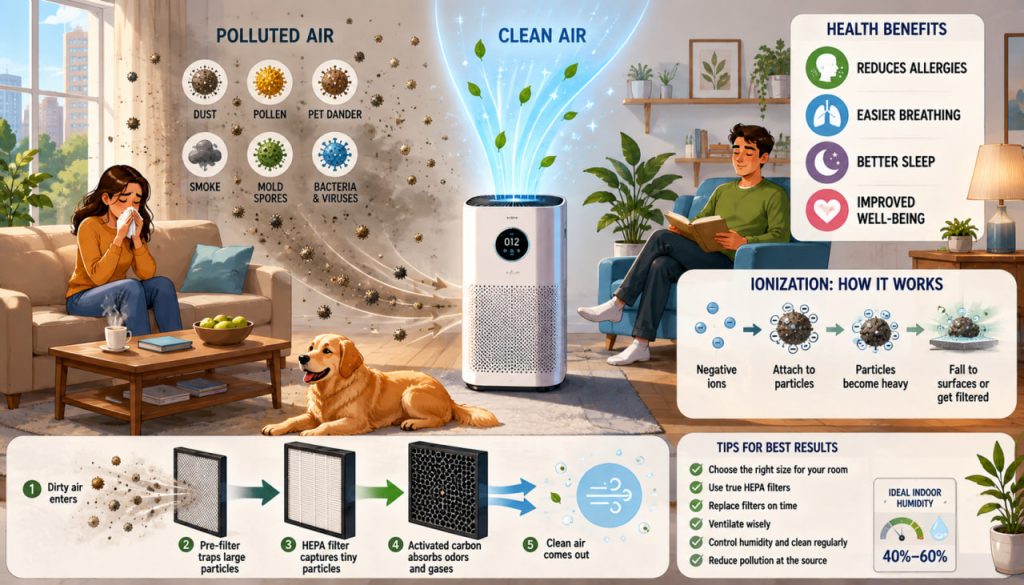
Indoor air can look clean and still contain dust, smoke particles, pollen, mold spores, pet dander, volatile chemicals, viruses, bacteria, and microscopic pollution from cooking or outdoor traffic.
This matters because most people spend a large part of life indoors. The air inside a home can affect sleep, allergies, asthma, headaches, energy, respiratory comfort, and long-term health.
Air filtration and ionization are often advertised as easy solutions. But they are not equal. Good filtration can be genuinely useful. Ionization requires much more caution.
To make a smart decision, it helps to understand what these technologies actually do, what they can remove, and what health risks they may or may not reduce.
Why Indoor Air Quality Matters
Air quality affects the body every time you breathe.
Fine particles can enter deep into the lungs. Some very small particles may influence the cardiovascular system. Allergens can trigger sneezing, coughing, itchy eyes, and asthma symptoms. Smoke and combustion particles can irritate the airways. Chemical pollutants may cause headaches, throat irritation, or other symptoms in sensitive people.
The World Health Organization links air pollution exposure with serious health risks, including heart disease, stroke, lung cancer, chronic respiratory disease, and pneumonia. Indoor and outdoor pollution are both part of the problem.
Cleaner air does not guarantee perfect health, but polluted indoor air can quietly increase stress on the lungs and heart.
What Air Filtration Does
Air filtration removes particles by pulling air through a filter.
A good purifier uses a fan to move room air through filter material. Dust, pollen, pet dander, smoke particles, and other airborne particles become trapped in the filter instead of continuing to circulate.
The most trusted type for home use is HEPA filtration. A true HEPA filter is designed to capture very small airborne particles effectively.
Portable HEPA air cleaners can be useful in bedrooms, living rooms, offices, classrooms, and homes near traffic, wildfire smoke, dust, or allergens. CDC recommends portable or built-in HEPA fan/filtration systems as one strategy for improving indoor air cleanliness.
What Air Filtration Cannot Do
A filter is not magic.
A HEPA filter is excellent for many particles, but it does not solve every indoor air problem.
It may not remove gases or odors unless the device also includes enough activated carbon or another gas-phase filtration material. It cannot fix moisture problems that cause mold growth. It cannot remove pollution that is already settled on carpets, furniture, bedding, or shelves unless those particles become airborne again.
EPA notes that the usefulness of any air cleaner depends on its efficiency, proper selection for the pollutant, proper installation for the space, and regular maintenance.
The best air purifier is part of a plan, not a substitute for cleaning, ventilation, humidity control, and pollution source reduction.
What Ionization Does
Ionizers release charged particles, or ions, into the air.
These ions attach to airborne particles. The charged particles may then clump together, stick to surfaces, or be collected by an electrostatic plate inside the device.
This sounds attractive, but there is a major concern: some ionizers and ozone-generating air cleaners can produce ozone. Ozone is useful high in the atmosphere, but at breathing level it is a lung irritant.
EPA warns that under certain conditions, ion generators and other ozone-generating air cleaners can produce ozone levels above those considered harmful to human health.
For home health, filtration is usually a safer first choice than ionization.
The Ozone Problem
Ozone can irritate the lungs, worsen asthma symptoms, and cause coughing or throat irritation. It can also react with indoor chemicals from cleaning products, air fresheners, paints, carpets, or furniture and create additional byproducts.
EPA specifically warns that some air cleaners with electrostatic precipitators, ionizers, UV lights without adequate coating, and plasma air cleaners may have the potential to emit ozone.
This does not mean every device with an ionizer is equally dangerous. Some products are designed to meet ozone-emission limits. But it does mean buyers should be careful.
Avoid devices that advertise “ozone,” “active oxygen,” or strong odor destruction through ozone. Do not use ozone generators in occupied rooms.
Filtration vs Ionization: Which Is Better?
For most homes, filtration wins.
A quality HEPA air purifier has a clearer benefit-risk profile. It physically captures particles and does not need to chemically alter indoor air.
Ionization may reduce some airborne particles, but it can also create concerns about ozone, surface deposition, and uncertain real-world performance.
ASHRAE’s 2024 position document on filtration and air cleaning says ozone introduced into indoor spaces should be reduced as low as reasonably achievable, and that some air-cleaning technologies should be used with caution.
The practical rule is simple: choose mechanical filtration first, and treat ionization as optional only if the device is independently tested for low ozone emissions.
How to Choose a Good Air Purifier
The most important number is CADR, or Clean Air Delivery Rate.
CADR tells you how much clean air a purifier can deliver. A purifier with too low a CADR may technically work but clean the room too slowly to matter.
EPA advises choosing a portable air cleaner with a CADR large enough for the size of the room where it will be used.
Look for:
- True HEPA filtration
- CADR suitable for room size
- Low noise on the speed you will actually use
- Replacement filters that are easy to buy
- Sealed filter design
- Optional activated carbon for odors and gases
- No ozone generation
- Clear maintenance indicators
A quiet purifier that runs daily is better than a powerful purifier that is too loud to use.
When Air Filtration Is Most Important
Air filtration is especially valuable in certain situations.
It can help if you live near heavy traffic, industrial areas, wildfire smoke, dusty roads, or frequent outdoor pollution. It is also useful for homes with pets, allergies, asthma, smokers nearby, or poor ventilation.
During wildfire smoke events, a HEPA purifier in a closed room can create a cleaner breathing zone. In bedrooms, it may reduce nighttime exposure to allergens and fine particles.
People with asthma, COPD, allergies, heart disease, older adults, children, and pregnant people may benefit most from reducing indoor particle exposure.
EPA states that studies using portable HEPA air cleaners have demonstrated small improvements in cardiovascular and respiratory health.
Ventilation Still Matters
Filtration removes particles from indoor air. Ventilation replaces stale indoor air with outdoor air.
Both can be important.
However, ventilation should be used wisely. Opening windows can help when outdoor air is clean and weather conditions are safe. But during wildfire smoke, heavy traffic pollution, extreme heat, or high pollen days, bringing outdoor air inside may make indoor conditions worse.
CDC describes improving indoor air cleanliness through filtration and germicidal ultraviolet air treatment as part of ventilation intervention strategies.
The healthiest strategy is usually source control, ventilation when outdoor air is good, and filtration when particles need to be removed.
Source Control Comes First
Before buying expensive devices, remove or reduce pollution sources.
Do not smoke indoors. Use a kitchen exhaust fan when cooking. Reduce candles and incense. Fix water leaks quickly. Keep humidity under control. Vacuum with a good filter. Wash bedding. Clean dust. Store chemicals properly. Avoid unnecessary fragranced sprays.
Air purifiers work better when they are not fighting constant pollution.
This is especially important for mold. A purifier may capture some airborne spores, but it will not solve mold growth if moisture remains.
Expert Perspective
Public health and building science experts generally agree that filtration can be a useful layer of indoor air protection, while ozone-producing technologies require caution.
EPA’s home air cleaner guidance emphasizes choosing the right device for the pollutant and room size, while warning that some ionizers and ozone-generating products can emit harmful ozone. CDC also identifies HEPA filtration as a practical way to improve indoor air cleanliness.
The expert takeaway is clear: for health-focused home use, a properly sized HEPA purifier is usually more reliable than an ionizer.
How Important Is It Really?
Air filtration is important, but its value depends on your situation.
If your home has clean outdoor air, good ventilation, no pets, no smoke, little dust, and no allergy problems, a purifier may be helpful but not essential.
If you have allergies, asthma, pets, wildfire smoke, urban pollution, poor ventilation, or vulnerable family members, filtration can be a meaningful health-supporting upgrade.
Ionization is less essential. In many homes, it is better avoided unless the product has credible safety testing and can be used without ozone risk.
Clean air is not a luxury feature. It is part of a healthier indoor environment. But the safest path is simple: reduce pollution at the source, ventilate wisely, and use proven filtration when needed.
Interesting Facts
- Indoor air can contain pollution from cooking, cleaning products, furniture, pets, dust, outdoor traffic, and smoke.
- HEPA filtration targets particles, not all gases or odors.
- Activated carbon can help reduce some odors and gaseous pollutants, but it must be replaced regularly.
- Some ionizers can produce ozone, which can irritate the lungs.
- A purifier that is too small for the room may run constantly and still clean poorly.
- Air purifiers work best when doors and windows are managed carefully.
- Filtration is especially useful during wildfire smoke events and high-pollen seasons.
Glossary
- Air Filtration — The process of removing particles from air using a filter.
- Ionization — A technology that releases charged ions to make airborne particles clump or stick to surfaces.
- HEPA Filter — A high-efficiency filter designed to capture very small airborne particles.
- CADR — Clean Air Delivery Rate; a measure of how quickly an air purifier delivers filtered air.
- PM2.5 — Fine particulate matter with particles 2.5 micrometers or smaller.
- VOC — Volatile organic compound; a chemical gas that can come from paints, cleaning products, furniture, and fragrances.
- Activated Carbon — A porous material used in filters to adsorb some odors and gases.
- Ozone — A reactive gas that can irritate the lungs when present in indoor air.
- Ventilation — The process of bringing outdoor air indoors and removing indoor air.
- Source Control — Reducing pollution by removing or limiting the source.
- MERV — Minimum Efficiency Reporting Value; a rating used for HVAC filters.
- HVAC — Heating, ventilation, and air conditioning system.