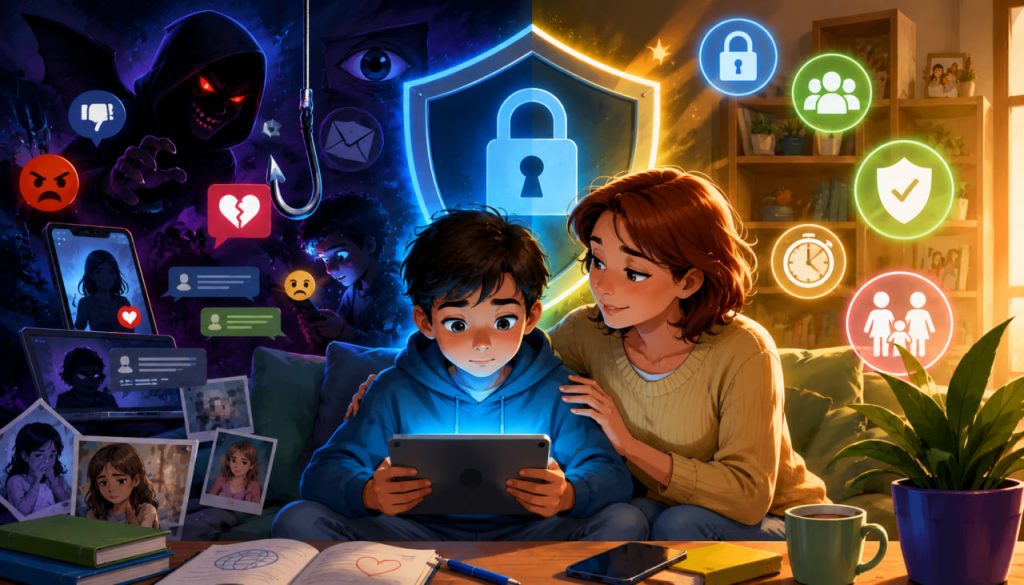
Social media can connect people, support learning, build communities, and help children express themselves. But it can also expose adults and kids to risks that are easy to underestimate.
The danger is not only “too much screen time.” Social networks can affect privacy, attention, sleep, self-esteem, mental health, relationships, financial security, and personal safety.
For children, the risks are greater because their emotional regulation, identity, judgment, and ability to recognize manipulation are still developing. The safest approach is not panic or total ignorance. It is active, calm, informed protection.
Why Social Media Can Become Dangerous
Social media platforms are designed to keep attention.
Notifications, endless feeds, short videos, likes, comments, recommendations, and algorithmic personalization can make users stay longer than planned. For adults, this can reduce focus and sleep quality. For children, it can become a daily environment that shapes emotions, habits, and self-image.
The U.S. Surgeon General’s advisory on social media and youth mental health states that social media use among young people is widespread and that current evidence raises serious concern about possible harm to children and adolescents.
The main risk is not one single post. It is repeated exposure to comparison, pressure, manipulation, and uncontrolled content.
Mental Health and Self-Esteem Risks
Social media can make life look like a competition.
People compare their real lives with edited photos, perfect vacations, filtered faces, luxury lifestyles, and staged happiness. Adults may feel behind. Children and teenagers may feel unattractive, unpopular, or unsuccessful.
This can contribute to anxiety, sadness, body dissatisfaction, low self-esteem, and fear of missing out. For teenagers, who are still forming identity and social confidence, this pressure can be especially intense.
Healthy protection starts with one message: online popularity is not a reliable measure of real worth.
Parents should repeat this calmly and often.
Cyberbullying and Social Pressure
Cyberbullying can follow a child everywhere.
Unlike school bullying that may stop at the classroom door, online harassment can continue at night, during weekends, and inside the child’s bedroom. It may include insults, exclusion, mocking photos, rumors, threats, impersonation, or group humiliation.
Children often hide cyberbullying because they fear losing their phone, being blamed, or making the situation worse.
Parents should avoid reacting with immediate punishment. Instead, say clearly: “You will not be punished for telling me what happened online.”
Save evidence, block harmful accounts, report abuse to the platform, and contact the school or authorities when threats, stalking, sexual pressure, or blackmail are involved.
Privacy and Personal Data
Social media collects and exposes information.
This may include names, photos, locations, school details, hobbies, contacts, browsing behavior, device data, and interests. Children may reveal personal information without understanding how long it can remain online.
The FTC explains that the Children’s Online Privacy Protection Act gives parents control over what information many websites and online services can collect from children under 13.
Adults should also be careful. Oversharing vacation plans, home addresses, children’s school uniforms, daily routines, or personal documents can create real-world risks.
Privacy settings help, but they are not a complete shield. The safest data is the data you never post.
Strangers, Grooming, and Online Manipulation
Not everyone online is who they claim to be.
Children can be contacted by adults pretending to be peers. Predators may use compliments, gifts, secrecy, emotional support, gaming chats, fake profiles, or pressure to move conversations to private apps.
NCMEC’s NetSmartz program provides age-appropriate online safety education to help children recognize and avoid digital risks.
Children should know simple rules:
- Do not keep online friendships secret from parents.
- Do not send private photos.
- Do not meet online contacts without trusted adult involvement.
- Do not continue a conversation that becomes sexual, threatening, or secretive.
- Tell an adult immediately if someone pressures, scares, or blackmails you.
A child must understand that asking for help is never shameful.
Scams, Fake Giveaways, and Financial Risks
Social media scams target both adults and children.
Common traps include fake giveaways, investment schemes, phishing links, fake stores, romance scams, gaming currency scams, job scams, impersonation, and “urgent help” messages from hacked accounts.
Children may be tricked into sharing passwords, payment details, verification codes, photos, or account access.
Adults should teach one simple rule: anything online that creates urgency, secrecy, or easy money should be treated as suspicious.
Use strong passwords, two-factor authentication, and separate passwords for important accounts.
Harmful Content and Algorithms
Social media algorithms can push users deeper into the same type of content.
A child who watches dieting videos may see more body-image content. A teenager who watches aggressive content may receive more extreme material. An adult who engages with fear-based posts may see more outrage and misinformation.
The FTC’s 2024 staff report on large social media and video streaming companies raised concerns about extensive data collection, targeted advertising, and the need for stronger teen privacy protections.
This is why parents should not rely only on platform promises. Check what your child watches, what the app recommends, and how the content makes them feel afterward.
Sleep, Attention, and Daily Life
Social media becomes harmful when it replaces basic needs.
Late-night scrolling can reduce sleep. Constant notifications can break concentration. Short videos can make slower tasks feel boring. Social comparison can affect mood before school or work.
A healthy family rule is to keep phones out of bedrooms at night. Another strong rule is no social media during meals, homework, family conversations, and the first or last part of the day.
Protecting sleep is one of the simplest and most powerful ways to reduce social media harm.
How Adults Can Protect Themselves
Adults also need boundaries.
Turn off nonessential notifications. Remove apps that trigger stress. Use app timers. Unfollow accounts that make you angry, jealous, or anxious. Do not argue endlessly with strangers. Avoid reading comments before sleep.
Check privacy settings regularly. Limit public information. Be cautious with location sharing. Do not post personal documents, travel details, or children’s identifying information.
A useful rule is: before posting, ask whether this information would still be safe if copied, saved, or shared outside your control.
How to Protect Your Child Without Destroying Trust
Protection works best when it is combined with trust.
The American Academy of Pediatrics recommends creating a family media plan that reflects each family’s priorities and helps children balance online and offline life.
A good family plan should include:
- Allowed apps and age rules
- Screen-free times
- Phone-free bedrooms
- Privacy rules
- What to do if something scary happens
- Rules for photos and location sharing
- Consequences that are clear but not extreme
- Regular parent-child check-ins
Do not make the internet a forbidden mystery. Make it a guided space.
Parental Controls: Useful but Not Enough
Parental controls can block adult content, limit screen time, restrict purchases, manage downloads, and filter websites.
They are useful, especially for younger children. But they are not perfect. Children may find ways around them, use friends’ devices, create secret accounts, or move to less visible platforms.
Parental controls are a safety net, not a parenting replacement.
The real protection is a combination of technical tools, open conversation, emotional support, media literacy, and clear family boundaries.
Expert Perspective
Public health and child safety organizations increasingly recommend a balanced approach: reduce harmful exposure, protect privacy, teach digital judgment, and keep communication open.
The U.S. Surgeon General’s advisory emphasizes that social media safety for youth is not only a family issue; platforms, policymakers, researchers, parents, and young people all have roles in reducing harm.
The practical expert lesson is clear: children need protection before problems happen, not only rescue after damage is done.
A Practical Safety Checklist for Families
Start with the basics.
Use private accounts for children. Turn off public location sharing. Disable direct messages from strangers when possible. Review followers. Teach children not to share school names, addresses, phone numbers, passwords, or private photos.
Keep devices out of bedrooms at night. Talk weekly about what your child sees online. Watch for mood changes after screen time. Encourage offline hobbies, sports, reading, creativity, sleep, and real friendships.
If a child becomes secretive, anxious, withdrawn, obsessed with likes, afraid of messages, or suddenly deletes accounts, take it seriously.
Your goal is not to control every click. Your goal is to build a child who knows how to stay safe when you are not watching.
P.S. All we can give our children is our love and our example. Teaching a child good habits, instilling discipline, and striving to become a kind and loving person ourselves are the best things we can give our children.
Interesting Facts
- Many children use social media before they fully understand privacy and manipulation.
- Cyberbullying can feel more intense because it can happen anytime and anywhere.
- Likes and comments can strongly influence how children evaluate themselves.
- Private accounts are safer than public accounts, but they do not guarantee privacy.
- Screens in bedrooms can make sleep problems worse.
- Social media scams often use urgency, fear, rewards, or emotional pressure.
- Children are more likely to ask for help when they know they will not be immediately punished for being honest.
Glossary
- Social Media — Online platforms where users create, share, watch, and interact with content.
- Cyberbullying — Bullying, harassment, or humiliation through digital platforms.
- Algorithm — A system that decides what content users see based on behavior and platform rules.
- Digital Footprint — The trail of information a person leaves online.
- Privacy Settings — Controls that limit who can see personal information or contact a user.
- Grooming — Manipulative behavior used by predators to gain a child’s trust for harmful purposes.
- Phishing — A scam that tries to steal passwords, codes, or personal information.
- Two-Factor Authentication — A security method that requires a second proof of identity beyond a password.
- Screen Time — Time spent using phones, tablets, computers, TVs, or game systems.
- FOMO — Fear of missing out; anxiety caused by feeling excluded from events or online activity.
- Parental Controls — Tools that help parents manage content, screen time, purchases, and app access.
- Media Literacy — The ability to understand, evaluate, and question digital content.