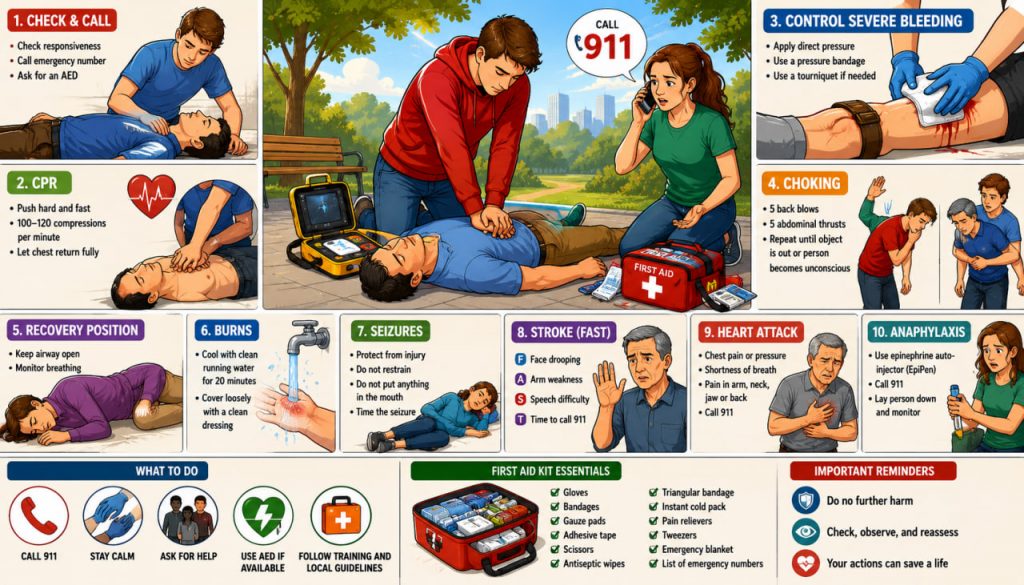
First aid is the immediate care given to someone who is injured or suddenly becomes seriously ill before professional medical help arrives.
Its purpose is not to replace doctors or paramedics. The goal is to preserve life, prevent the condition from worsening, reduce suffering, and support recovery until emergency services take over.
In many emergencies, the first few minutes matter more than specialized equipment. Calling for help, opening an airway, controlling severe bleeding, or starting CPR can dramatically change the outcome. WHO describes care at the scene as the first stage of a patient’s journey through the emergency-care system and emphasizes the importance of trained community responders.
Make Sure the Scene Is Safe
Before approaching, look for hazards such as traffic, fire, smoke, electricity, unstable structures, aggressive animals, chemicals, or deep water.
Do not become a second casualty. Move the injured person only when they face an immediate danger, such as fire or approaching traffic, or when movement is necessary to provide lifesaving care.
Use disposable gloves when available, especially if blood or other body fluids are present.
Introduce yourself to a conscious person, explain that you know first aid, and ask permission to help. If the person is unconscious or unable to respond, emergency assistance is generally assumed to be necessary.
Check Responsiveness, Breathing, and Major Bleeding
Speak loudly and gently tap the person’s shoulders.
If there is no response, call your local emergency number or direct another person to call. Ask someone to bring an automated external defibrillator, or AED, if one is available.
Open the airway and check whether the person is breathing normally. Occasional gasps are not normal breathing and may occur during cardiac arrest.
At the same time, look for severe bleeding. WHO’s community first-aid approach prioritizes catastrophic bleeding before airway and breathing because uncontrolled blood loss can become fatal within minutes.
Do not spend too long trying to diagnose the exact problem. Identify immediate threats to life and act.
CPR and Cardiac Arrest
Someone who is unresponsive and not breathing normally may be in cardiac arrest.
For an adult or teenager who suddenly collapses, an untrained bystander can perform Hands-Only CPR:
- Call the local emergency number.
- Push hard and fast in the center of the chest.
Place the heel of one hand in the center of the chest, place the other hand on top, interlock the fingers, and keep the arms straight. Compress the chest at approximately 100–120 times per minute, allowing it to return fully after every compression.
Adult compressions should usually be about 5–6 centimeters deep. Continue until the person starts breathing normally, trained help takes over, an AED instructs you to pause, the environment becomes unsafe, or you are physically unable to continue.
Rescue breaths remain important in situations such as drowning, many pediatric arrests, drug overdose, and prolonged respiratory emergencies. Because infant and child techniques differ from adult CPR, practical training is strongly recommended.
How to Use an AED
An AED analyzes the heart rhythm and delivers a shock only when an appropriate shockable rhythm is detected.
Turn it on and follow its spoken or visual instructions. Expose the chest, attach the pads as shown in the diagrams, and ensure that nobody is touching the person while the device analyzes the rhythm or delivers a shock.
Resume chest compressions immediately when instructed.
An AED cannot accidentally shock a normal heart simply because an inexperienced person presses the button. The device determines whether a shock is advised.
Severe Bleeding
Life-threatening bleeding may be continuous, spurting, pooling on the ground, or soaking rapidly through clothing or dressings.
Expose the injury if possible and apply firm, direct pressure with gauze, cloth, or a gloved hand. Maintain pressure continuously rather than repeatedly lifting the dressing to inspect the wound.
For severe bleeding from an arm or leg that cannot be controlled with direct pressure, a commercial tourniquet may be lifesaving when used correctly. Place it above the wound, not directly over a joint, tighten until the bleeding stops, and note the time. The American Red Cross recommends direct pressure and, for trained responders, tourniquet use or wound packing when appropriate.
Do not remove deeply embedded objects. Apply pressure around them and wait for professional help.
Choking
A person with mild choking may still be able to cough, speak, or breathe. Encourage forceful coughing and monitor them.
Severe choking may cause an inability to speak, breathe, or cough effectively. The person may clutch the throat, become silent, or develop bluish skin.
For a conscious adult or child over one year old, current first-aid approaches commonly use cycles of five back blows followed by five abdominal thrusts until the obstruction clears or the person becomes unresponsive. Techniques differ for infants and pregnant people, so formal instruction is important.
If the person becomes unresponsive, lower them carefully, call emergency services, and begin CPR. Look inside the mouth only when an object is clearly visible. Never perform a blind finger sweep, because it can push the obstruction deeper.
The Recovery Position
An unconscious person who is breathing normally should usually be placed on their side in the recovery position.
This helps keep the airway open and allows fluids such as vomit or saliva to drain rather than enter the lungs.
Continue checking breathing until help arrives. If breathing stops or becomes abnormal, roll the person onto their back and begin CPR.
Avoid unnecessary movement when a serious spinal injury is suspected, but maintaining breathing takes priority over protecting the spine.
Burns and Scalds
Stop the burning process and remove the person from the heat source without putting yourself at risk.
Cool a thermal burn under cool or lukewarm running water for at least 20 minutes. Remove loose clothing and jewelry near the injury before swelling develops, but do not pull away anything stuck to the skin.
Do not use ice, butter, toothpaste, oils, or greasy creams. Ice can worsen tissue damage, while household remedies may trap heat and contaminate the wound.
After cooling, cover the burn loosely with a clean, non-fluffy dressing or suitable plastic film. Seek urgent medical care for large, deep, chemical, electrical, facial, airway, hand, foot, genital, or major-joint burns, and for serious burns in children or vulnerable adults.
Seizures
During a seizure, protect the person from nearby hazards.
Move hard or sharp objects away, place something soft beneath the head, loosen tight clothing around the neck, and record how long the seizure lasts.
Do not restrain the person. Do not place anything in their mouth, and do not attempt to give food, water, or medication during active convulsions.
When the movements stop, check breathing and place the person in the recovery position if they are breathing normally.
Call emergency services when it is a first seizure, lasts more than five minutes, repeats without recovery, occurs in water, causes serious injury or breathing difficulty, or affects a pregnant person or very young infant.
Stroke and Heart Attack
Use the FAST test to recognize common stroke signs:
- Face: One side droops.
- Arms: One arm is weak or drifts downward.
- Speech: Speech is slurred, confused, or absent.
- Time: Call emergency services immediately.
Note when symptoms began or when the person was last known to be well. Treatment is highly time-sensitive.
Possible heart-attack symptoms include chest pressure, squeezing or discomfort, pain spreading to the arms, jaw, back, or stomach, shortness of breath, sweating, nausea, and sudden weakness.
Symptoms may be less typical in women, older people, and those with diabetes. Call emergency services rather than driving the person yourself. A heart attack is caused by blocked blood flow to the heart and requires urgent hospital treatment.
Anaphylaxis and Poisoning
Anaphylaxis is a severe allergic reaction that may cause throat or tongue swelling, difficulty breathing, wheezing, widespread hives, dizziness, vomiting, or collapse.
Call emergency services immediately. Help the person use their prescribed epinephrine device according to its instructions. Epinephrine is the critical first-line treatment and should not be delayed while waiting to see whether symptoms improve.
For suspected poisoning, do not automatically induce vomiting or give food, drink, or medication. Contact emergency services or the appropriate poison center and preserve the packaging or container for identification.
If the person is unconscious but breathing, use the recovery position. If they are not breathing normally, begin CPR.
Common First-Aid Mistakes
Avoid actions that can make an emergency worse:
- Giving food or drink to an unconscious or seriously injured person
- Moving someone unnecessarily after major trauma
- Removing an embedded object
- Putting objects into the mouth during a seizure
- Applying ice directly to burns
- Using improvised tourniquets without knowing the correct technique
- Delaying an emergency call while searching online
- Assuming gasping means normal breathing
- Leaving an unconscious person alone
Calling for professional help early is part of first aid—not an admission that you do not know what to do.
Expert Perspective
The 2025 American Heart Association CPR and Emergency Cardiovascular Care guidelines emphasize a coordinated “chain of survival”: rapid recognition, activation of emergency response, early high-quality CPR, prompt defibrillation, advanced care, and recovery support.
WHO similarly promotes a systematic approach to life-threatening illness and injury because early interventions can save lives before a patient reaches a hospital.
Reading about first aid is useful, but hands-on CPR, AED, bleeding-control, and choking training is the most reliable way to build the confidence and muscle memory needed in a real emergency.
Interesting Facts
- Hands-Only CPR can be performed by an untrained bystander during a sudden adult or teenage collapse.
- AEDs give spoken instructions and deliver a shock only when their analysis indicates one is needed.
- Severe external bleeding can become fatal within minutes.
- Normal-looking gasps may occur during cardiac arrest and should not be mistaken for effective breathing.
- Cooling a burn with running water for 20 minutes can reduce tissue damage and improve healing outcomes.
- Nothing should be placed in a person’s mouth during a seizure.
- A person can have a stroke without losing consciousness.
- Epinephrine should be given promptly during suspected anaphylaxis.
- CPR methods differ for adults, children, and infants.
- First-aid and CPR skills should be refreshed regularly because guidelines and practical competence can change over time.
Glossary
- First Aid — Immediate assistance given before professional medical care becomes available.
- CPR — Cardiopulmonary resuscitation, using chest compressions and sometimes rescue breaths to support circulation and oxygen delivery.
- Cardiac Arrest — Sudden loss of effective heart function, normal breathing, and responsiveness.
- Heart Attack — Damage caused when blood flow to part of the heart is blocked.
- AED — Automated external defibrillator, a device that analyzes heart rhythm and may deliver an electrical shock.
- Airway — The passage through which air travels into and out of the lungs.
- Recovery Position — A side-lying position used for an unconscious person who is breathing normally.
- Tourniquet — A device tightened around a limb to control life-threatening bleeding.
- Anaphylaxis — A rapid, potentially fatal allergic reaction.
- Epinephrine — Emergency medication used to treat anaphylaxis.
- FAST — A stroke-recognition test covering Face, Arms, Speech, and Time.
- Shock — A life-threatening state in which tissues do not receive adequate blood flow and oxygen.
- Seizure — A temporary disturbance of brain activity that may affect movement, awareness, or behavior.
- Scald — A burn caused by hot liquid or steam.
- Rescue Breaths — Breaths delivered to provide oxygen during CPR.
- Emergency Medical Services — Professional prehospital medical responders, commonly abbreviated as EMS.