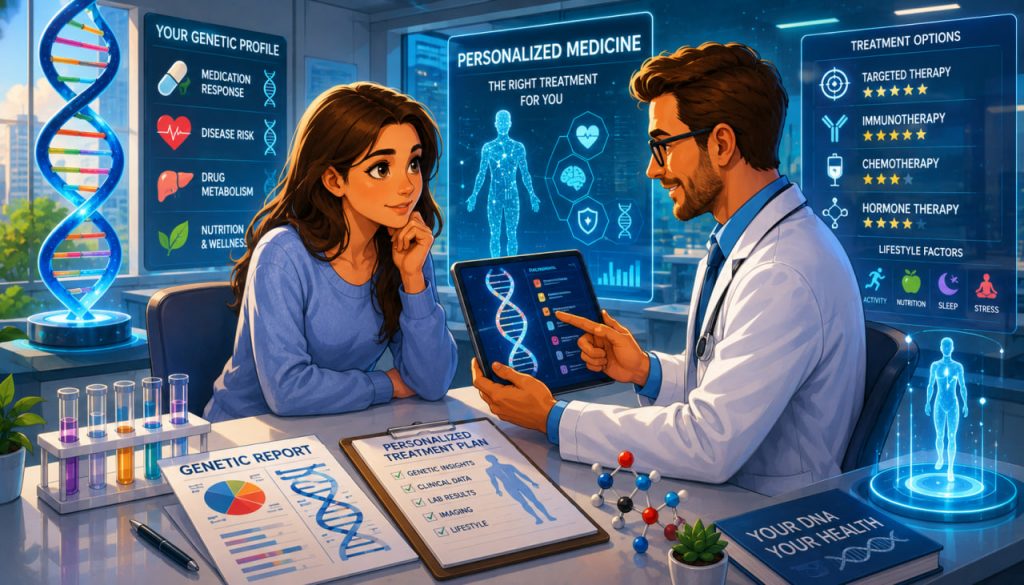
Traditional medicine often begins with a standard treatment that works for many patients. Doctors then adjust the medication, dosage, or strategy according to the person’s response.
Personalized medicine aims to make that process more precise from the beginning. It uses information about a patient’s genes, medical history, lifestyle, environment, laboratory results, and sometimes the molecular characteristics of a disease.
The goal is not to create a completely unique medicine for every individual. The goal is to identify which prevention strategy, diagnostic test, or treatment is most likely to benefit a particular patient.
What Is Personalized Medicine?
Personalized medicine is closely related to the terms precision medicine, individualized medicine, and genomic medicine.
The National Human Genome Research Institute describes personalized medicine as the use of an individual’s genetic profile to guide decisions about preventing, diagnosing, and treating disease. Precision medicine usually has a broader meaning because it can also include electronic health records, lifestyle, environmental exposure, proteins, and other biological data.
A personalized medical decision might involve:
- Choosing a cancer drug based on a tumor mutation
- Adjusting a medication dose according to inherited variants
- Increasing screening for someone with hereditary disease risk
- Avoiding a treatment likely to cause a serious adverse reaction
- Classifying a disease by its molecular features rather than symptoms alone
Genes can inform treatment, but they rarely provide the entire answer.
How Genetic Information Can Guide Treatment
Genes contain instructions that influence how the body develops and functions. Small differences in DNA can affect disease risk, drug metabolism, immune responses, and the biological pathways involved in illness.
A genetic test may examine one variant, a group of genes, the protein-coding exome, or most of the genome.
The result can sometimes reveal why a patient developed a condition or why a particular treatment may work better than another. Genomic medicine is already influencing oncology, pharmacology, rare-disease diagnosis, and infectious-disease care.
However, most common diseases are not caused by one gene. Diabetes, cardiovascular disease, asthma, and many psychiatric conditions result from complex interactions among numerous variants, behavior, age, environment, and chance.
Personalized medicine therefore combines genetic findings with ordinary clinical evidence rather than replacing it.
Pharmacogenomics: Choosing Medicines More Precisely
Pharmacogenomics studies how genetic variation affects medication response.
Some people break down a drug rapidly, while others process it slowly. The same standard dose may therefore be ineffective for one patient but produce excessive drug levels or adverse effects in another.
Pharmacogenomic information may help a healthcare professional:
- Select one medication instead of another
- Choose a more appropriate starting dose
- Estimate the likelihood of benefit
- Reduce the risk of toxicity
- Decide whether closer monitoring is necessary
NHGRI defines pharmacogenomics as the use of genomic information to help choose medications and dosages predicted to work best for an individual patient.
The FDA maintains tables of pharmacogenetic associations and biomarkers mentioned in drug labeling. These include inherited variants, tumor mutations, gene-expression differences, chromosomal abnormalities, and certain protein biomarkers.
Pharmacogenomic testing does not guarantee that a drug will work. Kidney function, liver function, age, other medications, diet, adherence, and the underlying disease remain important.
Genetics can reduce trial and error, but it does not remove clinical judgment.
Personalized Cancer Treatment
Cancer is one of the clearest examples of precision medicine.
Two tumors arising in the same organ may contain different molecular changes and respond very differently to treatment. Doctors can analyze a tumor for mutations, proteins, or other biomarkers that influence its growth.
Biomarker testing may help determine whether a patient is likely to benefit from:
- A targeted therapy
- Immunotherapy
- A particular chemotherapy
- A clinical trial
- More intensive monitoring
The National Cancer Institute explains that precision oncology uses information about a tumor to improve diagnosis, treatment selection, evaluation of response, and prognosis.
Some treatments block a specific abnormal protein or molecular pathway. When the relevant biomarker is absent, the same medication may provide little benefit.
Tumor testing is different from inherited genetic testing. Tumor sequencing examines mutations acquired by cancer cells, while germline testing looks for variants present throughout the body and potentially shared with relatives.
Sometimes tumor analysis suggests that an inherited variant may also be present, leading to additional testing and genetic counseling.
Rare and Undiagnosed Diseases
Personalized genomic medicine can be especially valuable for patients with unexplained symptoms or suspected rare disorders.
A rare genetic disease may affect only a small number of people, making it difficult for an individual doctor to recognize. Exome or genome sequencing can search many genes simultaneously and may identify a molecular diagnosis after years of inconclusive testing.
A diagnosis can:
- End a long diagnostic search
- Clarify expected complications
- Guide surveillance
- Identify an available therapy
- Prevent unnecessary procedures
- Reveal risks for relatives
- Support reproductive planning
However, sequencing does not always provide an answer. It may find no relevant variant or identify a variant of uncertain significance whose medical meaning remains unclear.
Disease Prevention Based on Genetic Risk
Personalized medicine is not limited to treating existing illness.
Certain inherited variants substantially increase the risk of cancers, heart rhythm disorders, abnormal cholesterol levels, or other diseases. When such a variant is identified, doctors may recommend earlier screening, more frequent monitoring, preventive medication, or selected risk-reducing procedures.
The value of this information depends on whether an effective action exists.
A genetic result is most useful when it leads to a clear step, such as:
- Earlier colonoscopy
- Additional breast imaging
- Cardiac monitoring
- Testing close relatives
- Avoiding a specific medication
- Treating dangerously high cholesterol sooner
For many low-impact variants, the result changes risk only slightly and may not alter medical care.
A higher genetic risk is not the same as a diagnosis, and a lower genetic risk is not a guarantee of protection.
Why Personalized Medicine Is More Than DNA
The phrase “treatment based on your genes” is useful, but incomplete.
Precision medicine may incorporate:
- Age and biological sex
- Symptoms and medical history
- Family history
- Lifestyle
- Environmental exposure
- Imaging
- Laboratory tests
- Proteins and metabolites
- Microorganisms living in and on the body
- Electronic health-record data
The NCI defines precision medicine as care that uses information about genes, proteins, environment, and lifestyle to prevent, diagnose, or treat disease.
A person’s preferences also matter. Two medically reasonable options may differ in side effects, cost, convenience, fertility implications, or effects on daily life.
Personalized care is therefore not only molecular. It should also reflect what matters to the patient.
The Limits of Gene-Based Treatment
Personalized medicine is powerful, but it is not equally developed for every condition.
A test may identify a biological difference without revealing an effective treatment. Some associations are supported by strong clinical evidence, while others come from early research or small studies.
Additional limitations include:
- Uncertain genetic findings
- Incomplete scientific knowledge
- Differences among laboratories
- Limited access to specialists
- High testing or treatment costs
- Underrepresentation of some populations in genomic databases
- Difficulty integrating results into ordinary healthcare
- The possibility of unexpected family information
A test can be technically accurate but clinically unhelpful when the result does not change prevention or treatment.
This principle is called clinical utility.
Privacy and Genetic Discrimination
Genetic information is sensitive because it can identify an individual and reveal information about biological relatives.
Patients should understand:
- Who can access the result
- Where the data will be stored
- Whether the sample may be used for research
- Whether information may be shared with commercial partners
- How long the laboratory retains the data
- Whether deletion can be requested
Legal protections differ among countries and may not cover every form of insurance, employment, research, or commercial testing.
Unexpected discoveries can also affect families. A test may reveal inherited disease risk, previously unknown relatives, or biological relationships that differ from what a person believed.
Genetic counseling can help patients consider these possibilities before testing.
Expert Perspective
The National Human Genome Research Institute describes genomic medicine as the use of a person’s genomic information in clinical care to support diagnosis, predict outcomes, and guide treatment.
The FDA takes a similarly practical view. Its pharmacogenetic guidance states that a patient’s genotype may help determine treatment strategy, dosage, expected benefit, or the likelihood of toxicity—but only alongside other clinical information.
These perspectives highlight the central rule of personalized medicine: genetic information becomes medically valuable when it improves a real decision rather than merely producing more data.
Who May Benefit Most?
Personalized or genomic evaluation may be particularly useful for people who have:
- A suspected inherited disorder
- Cancer that may respond to targeted treatment
- An unusual or difficult-to-diagnose condition
- Serious reactions to certain medications
- A strong family history of early disease
- A known pathogenic variant in the family
- A medication with established pharmacogenomic guidance
- Multiple unsuccessful treatment attempts
Broad genetic testing is not necessary for every patient.
Before testing, it is reasonable to ask what question the test is intended to answer, what actions may follow, whether the result requires confirmation, and who will interpret it.
Interesting Facts
- Humans have roughly the same set of genes, but millions of DNA differences contribute to individual variation.
- A tumor’s genetic profile can differ substantially from the inherited DNA in the rest of the body.
- Pharmacogenomic information appears in the labeling of many medicines.
- Some targeted cancer therapies are selected according to a molecular alteration rather than only the organ where the cancer began.
- Genetic variants can affect both medication effectiveness and the likelihood of adverse reactions.
- Exome sequencing focuses mainly on protein-coding regions, which represent only a small portion of the genome.
- A genetic diagnosis may benefit relatives who have never shown symptoms.
- Personalized medicine often uses environmental and lifestyle data as well as genetics.
- The same pathogenic variant may produce different symptoms in different people.
- A large genetic panel is not automatically more useful than a carefully selected test.
Glossary
- Personalized Medicine — Medical care adapted to characteristics of an individual patient, including genetics, health history, environment, and preferences.
- Precision Medicine — An approach that uses biological, clinical, environmental, and lifestyle data to guide prevention, diagnosis, or treatment.
- Genomic Medicine — The use of genomic information as part of clinical care.
- Genome — The complete set of an individual’s genetic material.
- Genetic Variant — A difference in DNA sequence between individuals or cells.
- Pathogenic Variant — A genetic change supported by evidence as causing or increasing the risk of disease.
- Pharmacogenomics — The study of how genetic variation influences medication response.
- Biomarker — A measurable biological characteristic used to assess disease, predict response, or guide treatment.
- Targeted Therapy — Treatment designed to act on a specific molecule or pathway involved in disease.
- Tumor Sequencing — Analysis of genetic changes found within cancer cells.
- Germline Variant — An inherited or reproductive-cell genetic variant generally present throughout the body.
- Somatic Variant — A genetic change acquired by certain cells during a person’s lifetime.
- Exome Sequencing — Analysis of most protein-coding regions of the genome.
- Variant of Uncertain Significance — A genetic change whose medical effect is not yet understood.
- Clinical Utility — The likelihood that a test result will improve a practical medical decision.
- Genetic Counseling — Professional guidance that helps patients understand genetic risks, tests, and possible results.