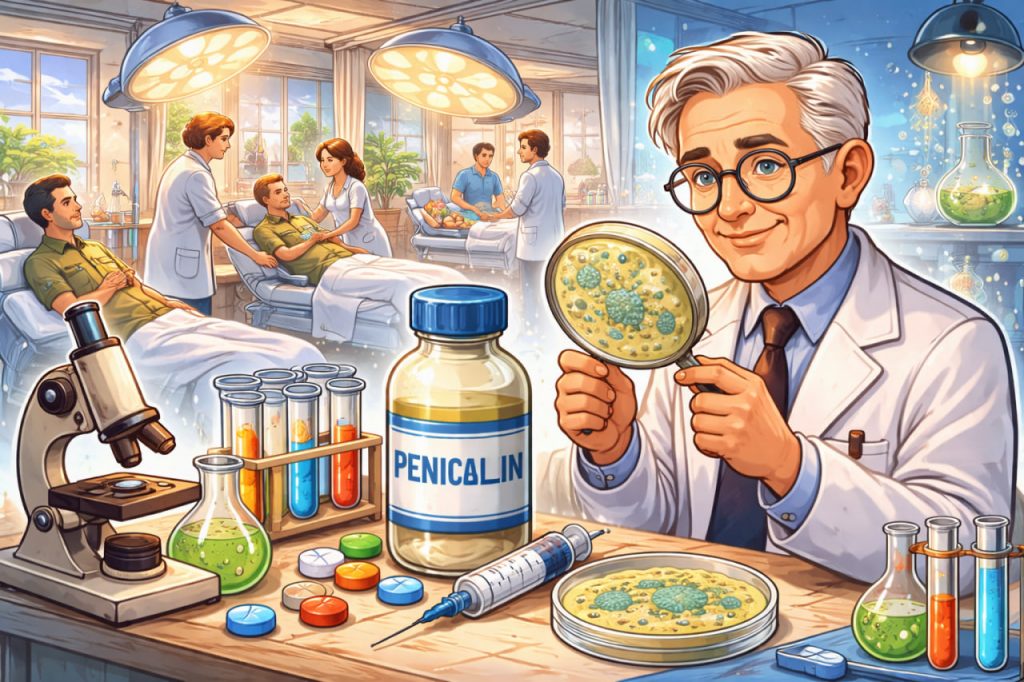
Penicillin is one of the most important medical discoveries in human history. As the first widely used antibiotic, it revolutionized the treatment of bacterial infections and saved millions of lives. Before its discovery, even minor injuries or common infections could become fatal. Today, penicillin remains a cornerstone of modern medicine and a symbol of scientific breakthrough. Understanding its history, mechanism, and impact helps us appreciate how it transformed healthcare and continues to influence medicine today.
What Is Penicillin
Penicillin is a group of antibiotics derived from fungi of the genus Penicillium. It works by killing bacteria or preventing their growth, making it highly effective against a wide range of infections. Penicillin specifically targets the cell walls of bacteria, weakening them and causing the bacteria to burst and die.
This selective action makes penicillin safe for human use, as human cells do not have cell walls. As a result, it became one of the first treatments that could effectively fight infections without causing severe harm to the patient.
The Discovery of Penicillin
Penicillin was discovered in 1928 by Alexander Fleming, a Scottish bacteriologist. The discovery was accidental but groundbreaking. Fleming noticed that a mold growing in one of his laboratory dishes had killed the surrounding bacteria.
He later identified the mold as Penicillium notatum and concluded that it released a substance capable of destroying harmful bacteria. Although Fleming recognized its potential, it took more than a decade before scientists were able to develop penicillin into a usable drug.
From Discovery to Mass Production
Turning penicillin into a practical medicine required the work of other scientists, including Howard Florey and Ernst Boris Chain. During World War II, they developed methods to produce penicillin on a large scale.
This advancement allowed penicillin to be used to treat wounded soldiers, significantly reducing death rates from infections. By the mid-20th century, penicillin became widely available and marked the beginning of the antibiotic era.
How Penicillin Works
Penicillin works by interfering with the formation of bacterial cell walls. Without a strong cell wall, bacteria cannot maintain their structure and eventually die.
This mechanism is particularly effective against Gram-positive bacteria, which have thick cell walls. Penicillin does not work against viruses, which is why it cannot treat illnesses like the common cold or flu.
Expert Perspective on Antibiotics
The importance of antibiotics like penicillin is widely recognized in the medical community. According to Alexander Fleming:
“The time may come when penicillin can be bought by anyone in the shops… then there is the danger that the ignorant man may easily underdose himself and by exposing his microbes to non-lethal quantities of the drug make them resistant.”
This early warning highlights a major issue today—antibiotic resistance, which occurs when bacteria evolve and become less sensitive to antibiotics.
The Problem of Antibiotic Resistance
One of the biggest challenges in modern medicine is the rise of antibiotic-resistant bacteria. Overuse and misuse of antibiotics have accelerated this process.
Examples of misuse include:
- Taking antibiotics for viral infections
- Not completing prescribed courses
- Overuse in agriculture
When bacteria become resistant, infections become harder to treat, requiring stronger or alternative medications.
Modern Uses of Penicillin
Despite the rise of resistance, penicillin is still widely used to treat many conditions, including:
- Strep throat
- Pneumonia
- Skin infections
- Syphilis
Doctors carefully choose when to use penicillin to ensure effectiveness and reduce the risk of resistance.
Impact on Global Health
The discovery of penicillin dramatically increased life expectancy worldwide. It transformed medicine from a field with limited treatment options into one capable of curing serious infections.
Penicillin also paved the way for the development of other antibiotics, leading to a wide range of treatments that continue to save lives today.
Future of Antibiotics
Scientists are now working to develop new antibiotics and alternative treatments to combat resistant bacteria. Research includes:
- New drug compounds
- Bacteriophage therapy
- Improved diagnostic tools
The legacy of penicillin continues as researchers seek solutions to modern medical challenges.
Interesting Facts
- Penicillin was discovered by accident in a laboratory
- It was first widely used during World War II
- It has saved hundreds of millions of lives
- Some bacteria have developed resistance to penicillin
- It led to the creation of many other antibiotics
Glossary
- Antibiotic — a substance that kills or inhibits bacteria
- Bacteria — microscopic organisms that can cause infections
- Cell Wall — a structure that protects bacterial cells
- Antibiotic Resistance — the ability of bacteria to survive antibiotic treatment
- Gram-Positive Bacteria — bacteria with thick cell walls sensitive to certain antibiotics