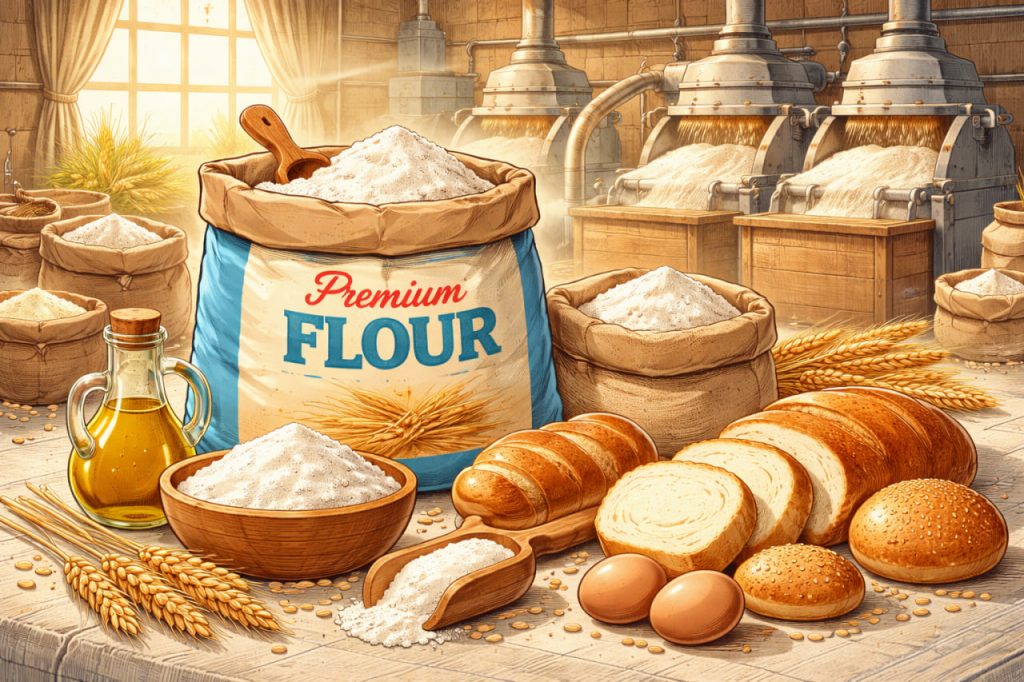
Premium white flour, often labeled as the highest grade, is one of the most common food products in the modern world. It is used in bread, pastries, pasta, sauces, and countless processed foods, making it seem almost unavoidable in everyday diets. Despite its refined nature and industrial processing, this flour is surprisingly cheap, widely available, and remarkably uniform across different countries. Its dominance is not accidental but the result of technological innovation, economic efficiency, and historical shifts in food production. To understand why premium white flour became so widespread, it is necessary to look at how it was developed, how it is produced, and why modern food systems favor it over less refined alternatives.
The Origins of Refined White Flour
For most of human history, flour was coarse, dark, and stone-ground, containing all parts of the grain. Early societies consumed whole-grain flour because milling technology could not easily separate the bran and germ from the endosperm. This changed dramatically during the Industrial Revolution, when steel roller mills were introduced in the 19th century. These mills allowed grain processors to strip away the outer layers of wheat and produce extremely fine, white flour with a long shelf life. Food historian Dr. Andrew Collins explains:
“White flour was not created for nutrition,
but for stability, transport, and industrial scalability.”
Refined flour quickly became a symbol of progress and purity, especially in urban societies where white bread was associated with wealth and modernity.
Why Premium Flour Became So Cheap
One of the main reasons premium white flour is inexpensive is its industrial efficiency. Modern wheat varieties are bred specifically for high yields and compatibility with large-scale milling. Automated roller mills can process enormous quantities of grain with minimal labor, reducing production costs significantly. Additionally, removing the germ and bran prevents the natural oils in wheat from going rancid, allowing flour to be stored and transported for long periods without spoilage. This dramatically lowers losses across supply chains. Economists also note that flour production benefits from economies of scale, government subsidies for grain farming, and global trade networks, all of which contribute to its low price.
Shelf Life and Global Distribution
Unlike whole-grain flour, premium white flour can remain stable for months or even years when stored properly. This characteristic makes it ideal for global distribution, emergency reserves, and mass food manufacturing. Large food corporations prefer ingredients that behave predictably in recipes and machinery, and refined flour provides consistent texture, absorption, and baking performance. As a result, it became the backbone of industrial baking and packaged food production. According to food systems researcher Dr. Maria Jensen:
“Refined flour is a logistical dream —
it travels well, stores well, and behaves the same everywhere.”
This reliability explains why the same type of flour can be found in bakeries and supermarkets across continents.
Cultural Shifts and Consumer Preference
The widespread use of premium white flour was also driven by cultural perception. For decades, white bread was marketed as cleaner, softer, and more desirable than darker, coarse alternatives. In many societies, refined flour became associated with comfort, convenience, and modern living. Governments and institutions reinforced this trend by standardizing flour grades and fortifying white flour with vitamins to address nutritional deficiencies. Over time, consumers became accustomed to the taste and texture of refined flour, making it the default choice for home cooking and commercial food production.
Modern Reassessment and Changing Attitudes
In recent years, premium white flour has faced growing criticism from nutritionists and food researchers. The removal of bran and germ significantly reduces fiber and micronutrient content, altering how the body processes carbohydrates. This has led to renewed interest in whole-grain and less refined flours. However, despite changing attitudes, premium white flour remains dominant due to its low cost, availability, and compatibility with existing food infrastructure. Experts emphasize that its prevalence is less about individual choice and more about how modern food systems are designed.
P.S. It’s not just a coincidence that store shelves are filled with white flour products, which are easily adulterated with additives that consumers may not be aware of. I personally recommend not skimping on your health and getting your body used to healthy foods.
Interesting Facts
- Premium white flour became widespread only 150–200 years ago, despite wheat being cultivated for over 10,000 years.
- Removing the germ extends shelf life but eliminates most of wheat’s natural oils and antioxidants.
- Many countries legally require white flour to be fortified with vitamins to compensate for nutrient loss.
- White flour was once considered a luxury food reserved for the upper classes.
Glossary
- Endosperm — the starchy inner part of the wheat grain used to make white flour.
- Bran — the outer layer of the grain, rich in fiber and micronutrients.
- Germ — the nutrient-dense part of the grain that can sprout into a new plant.
- Roller Milling — an industrial process that uses steel rollers to refine grain into fine flour.
- Shelf Life — the length of time a food product remains safe and usable.