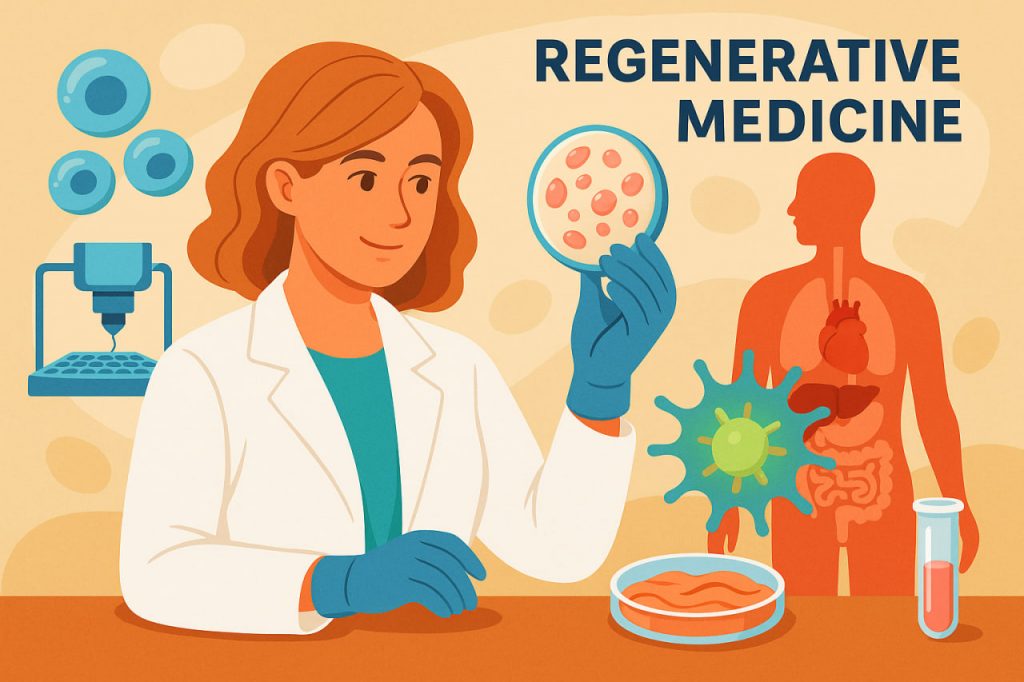
Regenerative medicine is a rapidly advancing field focused on repairing, replacing, or regenerating damaged tissues and organs by activating the body’s natural healing mechanisms. Instead of only treating symptoms, this approach aims to address the underlying causes of injury or degeneration. Scientists combine biology, engineering, and clinical research to stimulate tissue renewal that was once thought impossible. From chronic injuries to age-related degeneration, regenerative strategies promise to transform how medicine approaches recovery. While the field is still evolving, its potential impact on healthcare is profound. Understanding regenerative medicine helps explain why it is considered one of the most important frontiers of modern science.
The Core Principles of Regenerative Medicine
At its foundation, regenerative medicine seeks to restore function by encouraging cells to repair themselves or by replacing damaged structures with biologically compatible materials. This includes strategies such as tissue engineering, cellular therapies, and biologically active scaffolds. Rather than relying solely on mechanical replacements, regenerative approaches aim to integrate seamlessly with the body. According to biomedical researcher Dr. Olivia Grant:
“Regenerative medicine shifts the focus from managing damage
to reactivating the body’s own capacity for renewal.”
This philosophy distinguishes regenerative medicine from conventional treatments that often rely on long-term management instead of restoration.
Stem Cells and Tissue Regeneration
One of the most well-known components of regenerative medicine is the use of stem cells, which have the unique ability to develop into different cell types. These cells play a natural role in growth and repair throughout life. In regenerative research, stem cells are studied for their potential to support the repair of muscles, cartilage, nerves, and organs. Scientists also explore how to guide stem cells to behave predictably and safely within the body. Ethical considerations, biological complexity, and strict regulation shape how this research progresses, ensuring that safety remains a top priority.
Tissue Engineering and Biomaterials
Tissue engineering combines living cells with biomaterials that act as temporary frameworks for new tissue growth. These scaffolds are designed to support cells as they multiply and organize into functional structures. Over time, the scaffold may degrade naturally, leaving behind regenerated tissue. This approach is being explored for skin repair, bone reconstruction, and organ support. Advances in 3D bioprinting have further expanded the possibilities, allowing scientists to design complex tissue structures with remarkable precision.
Regenerative Medicine in Chronic and Degenerative Conditions
Many chronic conditions involve gradual tissue damage that the body cannot fully repair on its own. Regenerative medicine aims to interrupt this cycle by restoring damaged structures before irreversible loss occurs. Research focuses on improving mobility, restoring function, and enhancing quality of life rather than offering temporary relief. Importantly, experts emphasize that regenerative strategies must be evidence-based and carefully tested. According to clinical scientist Dr. Marcus Liu:
“True regeneration requires patience, rigorous trials,
and respect for the complexity of human biology.”
This cautious approach helps prevent unrealistic expectations and unsafe applications.
Challenges and the Future of Regenerative Medicine
Despite its promise, regenerative medicine faces significant challenges. Controlling cell behavior, ensuring long-term safety, and achieving consistent outcomes remain major scientific hurdles. Regulatory frameworks must balance innovation with patient protection. As research advances, collaboration between scientists, clinicians, and engineers becomes increasingly important. The future of regenerative medicine lies not in quick fixes, but in carefully designed therapies that work in harmony with the body’s natural systems.
Interesting Facts
- The human body naturally regenerates skin and blood cells throughout life.
- Some animals can regenerate entire limbs, inspiring regenerative research in humans.
- 3D bioprinting allows scientists to design custom tissue structures.
- Regenerative medicine combines biology, engineering, and material science.
- Many regenerative approaches aim to reduce the need for invasive surgery.
Glossary
- Regenerative Medicine — a field focused on repairing or replacing damaged tissues and organs.
- Stem Cells — cells capable of developing into different specialized cell types.
- Tissue Engineering — the creation of biological tissues using cells and supportive materials.
- Biomaterials — materials designed to interact safely with biological systems.
- 3D Bioprinting — a technology that constructs tissue-like structures layer by layer.