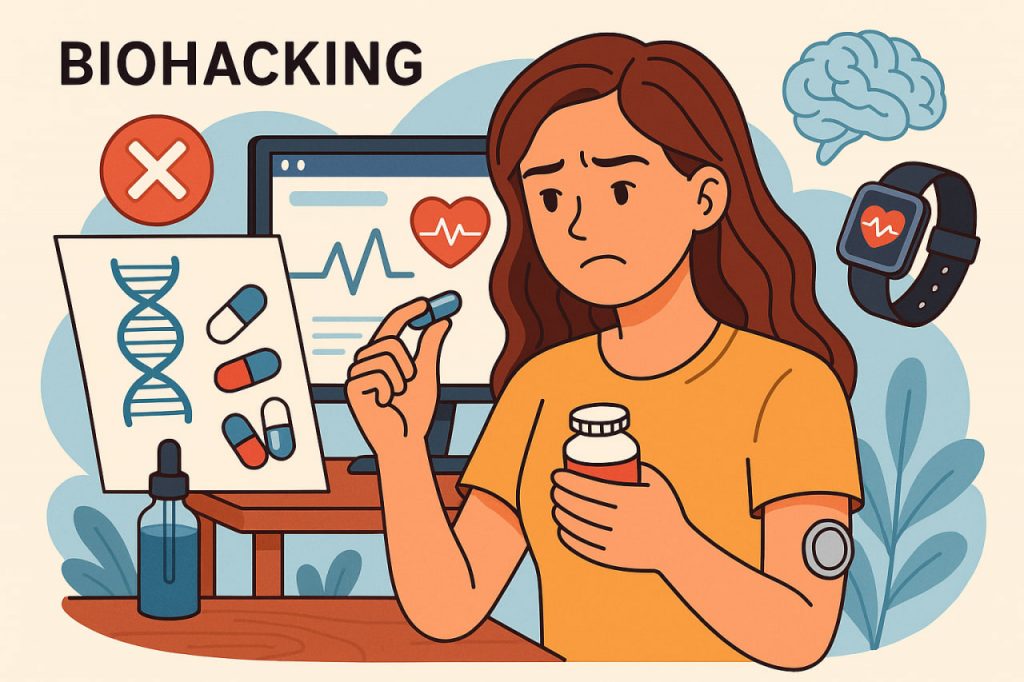
Biohacking has become a popular trend among people seeking to optimize their bodies and minds using science, technology, and self-experimentation. It ranges from simple lifestyle adjustments, such as sleep tracking and dietary changes, to extreme interventions involving implants, unregulated supplements, or experimental routines. While proponents claim biohacking can enhance productivity, longevity, and mental performance, critics warn that many practices lack solid scientific validation. The growing popularity of biohacking raises serious concerns about safety, ethics, and long-term health consequences. Understanding both the concept and its risks is essential before adopting any form of self-experimentation. What appears to be self-improvement can, in some cases, become self-harm.
What Is Biohacking?
Biohacking refers to a broad set of practices aimed at modifying biological processes to improve physical or cognitive performance. Some forms are relatively mild, such as using wearable devices to monitor sleep or adjusting daily routines based on circadian rhythms. Others are far more invasive, including implanted chips, extreme fasting protocols, or unsupervised hormonal manipulation. The problem lies in the lack of consistent definitions and regulation. According to health researcher Dr. Laura Bennett:
“Biohacking is not a single method but a collection of experiments,
many of which move faster than scientific evidence can support.”
This diversity makes it difficult to distinguish safe self-care from risky experimentation.
Unregulated Experiments and Hidden Risks
One of the biggest dangers of biohacking is the reliance on unregulated methods. Many biohackers test supplements, devices, or routines without clinical oversight or long-term studies. The human body is a complex system, and altering one process can unintentionally disrupt others. For example, extreme optimization strategies may interfere with metabolism, hormone balance, or immune function. Without professional supervision, individuals may misinterpret short-term effects as long-term benefits. This trial-and-error approach increases the risk of lasting damage that may not be immediately noticeable.
Psychological Pressure and Obsessive Control
Biohacking is often promoted as empowerment, but it can create psychological stress and unhealthy perfectionism. Constant self-monitoring may lead to anxiety, sleep disturbances, or obsessive behavior focused on numbers rather than well-being. When personal value becomes tied to performance metrics, mental health can suffer. Psychologist Dr. Marcus Hill notes:
“The pursuit of constant optimization can turn the body into a project,
rather than a living system that needs balance and rest.”
This mindset may erode self-trust and increase dissatisfaction, even when measurable improvements occur.
Social Media Influence and Misinformation
Much of modern biohacking culture spreads through social media, where bold claims often overshadow scientific nuance. Influencers may promote extreme routines without disclosing risks, limitations, or failures. Simplified success stories can mislead audiences into copying practices unsuitable for their biology or lifestyle. Algorithms favor dramatic transformations, not cautious science. As a result, misinformation spreads quickly, encouraging individuals to adopt potentially harmful behaviors without understanding underlying mechanisms.
Ethical and Long-Term Health Concerns
Beyond individual risks, biohacking raises ethical questions about human enhancement and inequality. Access to advanced technologies may widen gaps between those who can afford experimentation and those who cannot. Long-term effects of many biohacking practices remain unknown, especially when interventions accumulate over time. Scientists emphasize that health optimization should prioritize safety, evidence, and individual variability. Sustainable well-being is built through informed choices, not shortcuts.
P.S. Study the human biology deeply, its complexity and interconnection. God originally arranged everything perfectly for us, and the only normal biohacking is a healthy lifestyle.
Interesting Facts
- The term biohacking originally described DIY biology experiments, not lifestyle trends.
- Some biohacking communities openly admit that long-term risks are unknown.
- Wearable tracking can improve awareness but may also increase health anxiety.
- Extreme biohacking routines often ignore genetic and biological differences.
- Many biohacking ideas later inspire formal research—but only after rigorous testing.
Glossary
- Biohacking — self-directed experimentation aimed at altering biological functions.
- Self-Quantification — the practice of tracking bodily data such as sleep or activity.
- Unregulated Intervention — a method used without formal scientific or medical approval.
- Optimization Mindset — the belief that every biological process must be maximized.
- Placebo Effect — perceived improvement caused by belief rather than actual change.