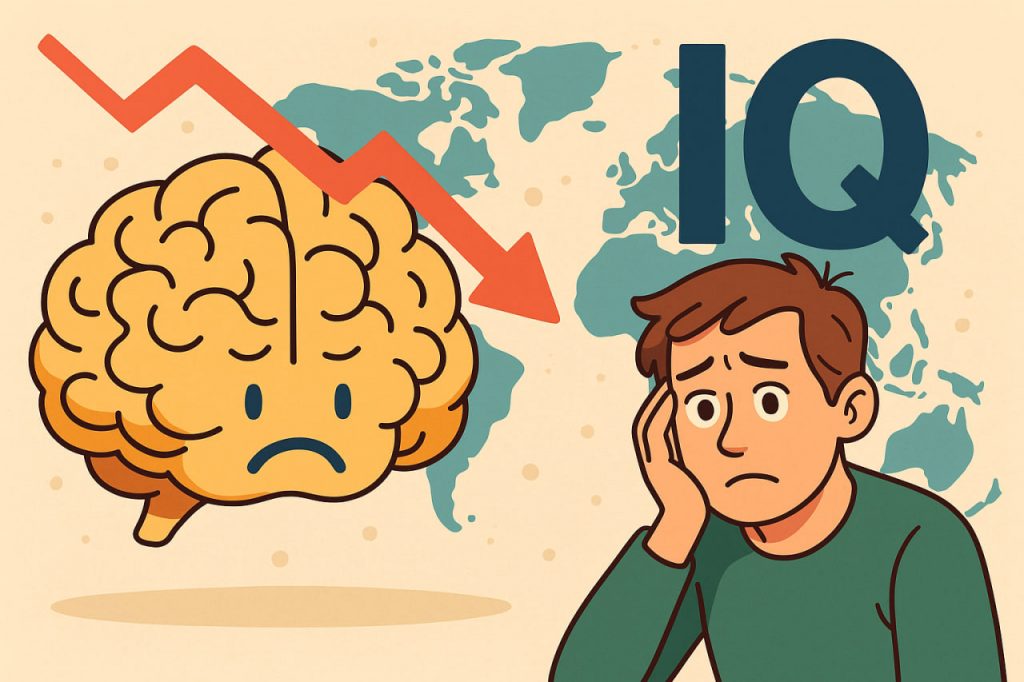
Over the past century, researchers have observed patterns suggesting that average IQ scores in several developed countries may be gradually declining. This trend, known as the “reverse Flynn effect,” contrasts with the earlier rise in IQ scores during the 20th century, when improvements in education, nutrition, and living conditions boosted cognitive performance worldwide. While the global picture is complex and varies by region, many scientists are concerned that shifts in the environment, lifestyle, technology use, and social structures may be subtly influencing cognitive development across populations. Understanding these patterns is essential for developing strategies that support brain health, education, and long-term human potential.
The idea of falling IQ does not mean that people are becoming “less intelligent” in a simple or universal way. IQ tests measure specific cognitive skills, and changes in test performance may reflect alterations in how societies think, learn, or solve problems. Modern life places different demands on the brain compared to life 50 or 100 years ago. Digital technologies support memory and problem-solving but may also reduce the everyday cognitive challenges that once strengthened certain mental abilities. Environmental exposures, dietary patterns, reduced reading habits, and increased stress also contribute to the discussion about global cognitive trends.
What the Reverse Flynn Effect Shows
The original Flynn effect — rising IQ scores through the 20th century — was observed in many countries due to better nutrition, education, and healthcare. But in recent decades, the trend has reversed in some populations. Studies from Scandinavia, the UK, and parts of Western Europe show small but consistent declines in average IQ test scores.
According to cognitive researcher Dr. Helena Ward:
“The decline in IQ scores is modest, but it signals underlying changes
in how modern environments shape cognitive development.”
This shift is not universal, but it raises important questions about global mental performance.
Possible Causes of IQ Decline
Researchers suggest multiple interacting factors:
- Environmental toxins: Exposure to microplastics, heavy metals, pesticides, and air pollution may affect brain development.
- Digital overload: Constant screen exposure reshapes attention and memory patterns.
- Lower reading rates: Deep reading strengthens complex reasoning; its decline may influence cognitive skills.
- Dietary changes: Modern processed diets may reduce essential nutrients needed for optimal brain function.
- Sleep disruptions: Urban lifestyles and devices disturb sleep cycles, affecting cognitive performance.
- Education changes: Different teaching methods shift the types of reasoning students practice.
No single cause explains the decline; it is likely a combination of many subtle influences affecting large populations over time.
Biological and Environmental Contributors
The brain is sensitive to early-life conditions such as prenatal health, exposure to pollutants, access to stimulating environments, and emotional stability. Some researchers believe that endocrine disruptors and pollutants — including the micro- and nanoplastics discussed in previous studies — may play a larger role than previously thought. Others highlight the importance of physical activity, which supports neuroplasticity but has decreased in many societies.
Are Humans Really Getting Less Intelligent?
Not necessarily. IQ tests measure specific cognitive skills, not creativity, emotional intelligence, adaptability, or technological competence. Modern life emphasizes different forms of intelligence that IQ tests do not always capture. For example, digital multitasking and rapid information filtering were not relevant skills a century ago.
As intelligence theorist Dr. Marcus Levin notes:
“A decline in traditional IQ does not mean a decline in human potential —
it reflects a shift in the cognitive environment.”
The challenge lies in preserving core reasoning skills while adapting to new technological realities.
How Society Can Respond
Researchers stress the importance of promoting environments that support cognitive development:
- encouraging reading and critical thinking
- ensuring cleaner air, water, and food systems
- creating policies to reduce toxic exposures
- promoting balanced diets and physical activity
- protecting childhood development environments
- regulating screen time and improving sleep hygiene
These measures support both individual and collective cognitive resilience.
Interesting Facts
- The Flynn effect increased IQ scores by over 30 points in some countries during the 20th century.
- Recent declines in IQ have been observed mainly in high-income nations.
- Air pollution exposure has been linked to reduced cognitive performance in children.
- Reading activates more than 10 interconnected brain networks.
- Sleep deprivation can temporarily lower IQ scores by up to 13 points.
Glossary
- Reverse Flynn Effect — the observed decline in IQ scores in some populations in recent decades.
- Neuroplasticity — the brain’s ability to change, adapt, and reorganize itself.
- Endocrine Disruptors — chemicals that interfere with hormonal systems and development.
- Cognitive Performance — measurable abilities such as memory, reasoning, and problem-solving.
- Environmental Exposure — contact with pollutants or substances that may affect health.