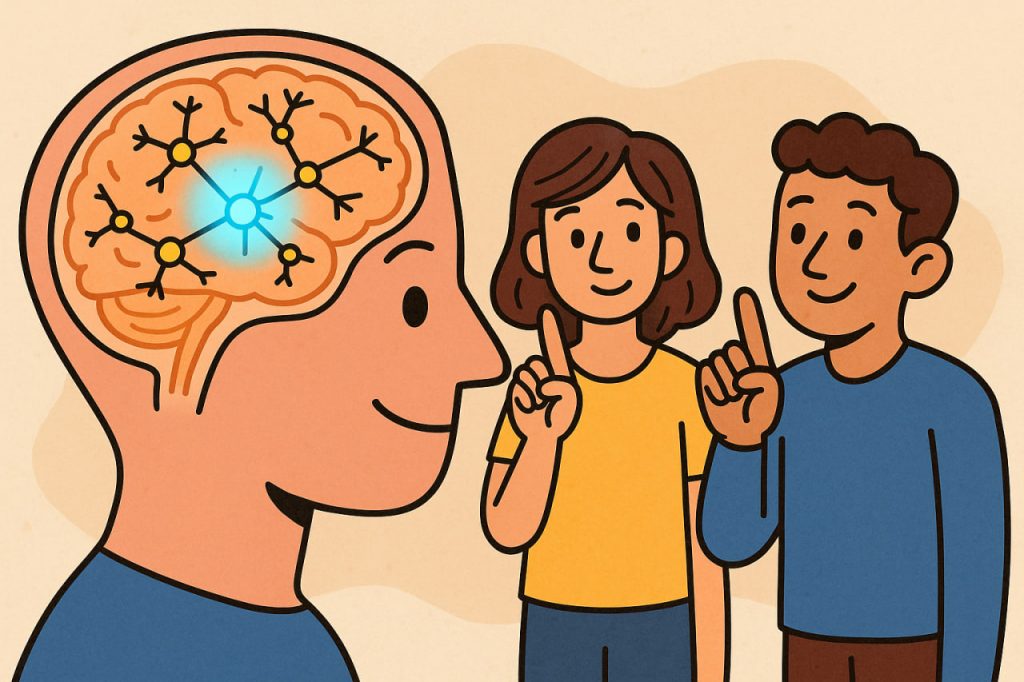
Mirror neurons are a unique class of brain cells that activate both when a person performs an action and when they observe someone else performing the same action. Discovered in the early 1990s by Italian neuroscientists studying macaque monkeys, mirror neurons quickly became one of the most fascinating findings in modern neuroscience. These cells appear to bridge the gap between self and others, allowing the brain to “mirror” external behavior internally. This mechanism helps explain imitation, learning, empathy, social bonding, and even the foundations of language development. Although research continues, mirror neurons remain central to understanding how humans connect with one another.
Mirror neurons fire not only during movement, but also when interpreting facial expressions, gestures, and emotional cues. This suggests that humans possess neural circuits designed to understand others from the inside out. Such a system may help infants learn by imitation, support adults in reading emotions, and enable complex social interactions. The discovery of mirror neurons shifted scientific thinking about the brain, revealing that cognition is deeply intertwined with perception and embodiment.
How Mirror Neurons Work
Mirror neurons are located in several brain regions, including the premotor cortex and parietal lobes. They help translate visual or auditory information into internal motor representations. In simple terms, when you see someone grasp an object, your brain simulates the same movement. According to neuroscientist Dr. Helena Ward:
“Mirror neurons allow us to internally recreate another person’s experience —
they are the brain’s built-in mechanism for understanding others.”
This mirroring process happens automatically and rapidly, supporting social learning and intuitive understanding.
Role in Learning and Imitation
Humans learn countless skills through observation: speaking, writing, using tools, or performing social behaviors. Mirror neurons help encode these actions, making it easier to replicate them. This mechanism is especially active in childhood, when imitation forms the basis for acquiring language, gestures, and cultural norms.
Mirror Neurons and Empathy
One of the most intriguing functions of mirror neurons is their link to emotional understanding. When we see someone experiencing joy, pain, or sadness, our mirror-neuron system activates patterns that resemble the observed state. This helps us interpret emotional signals, predict behavior, and respond appropriately. Although empathy is influenced by many neural networks, mirror neurons contribute to the immediate, instinctive part of emotional resonance.
As social-cognition researcher Dr. Marcus Levin notes:
“Mirror neurons give us the ability to ‘feel’ what others feel —
they create the foundations of human social connection.”
Communication and Language Development
Some theories suggest that mirror neurons may have played an important evolutionary role in the emergence of language. Before spoken communication developed, early humans relied on gestures, facial expressions, and shared motor cues. Mirror neurons may have helped transform gesture-based communication into symbolic language by linking perception and action within the brain.
Debates and Misconceptions
Despite their popularity, mirror neurons are not a magical explanation for all social behavior. They work together with many other brain systems. Researchers continue to investigate their exact mechanisms, limitations, and variations across individuals. Some debates focus on whether mirror neurons directly cause empathy or simply contribute to it. Nevertheless, their influence on learning, social cognition, and emotional processing is widely supported.
Why Mirror Neurons Matter Today
Understanding mirror neurons helps explain:
- why human beings learn so quickly through observation
- how social skills develop in childhood
- why we instinctively mimic others’ gestures or emotions
- how therapy and education can use modeling techniques
- why group behavior spreads through shared emotional states
Mirror neurons highlight the deeply social nature of the human brain and reveal how interconnected our experiences truly are.
Interesting Facts
- Mirror neurons were discovered accidentally while studying grasping movements in monkeys.
- Infants show mirroring behavior within hours of birth, mimicking facial expressions.
- Laughing, yawning, and smiling can spread socially due to mirrored neural activation.
- Musicians and athletes show stronger mirror-neuron activity when observing familiar skills.
- Mirror neurons may help explain why storytelling and movies evoke strong emotional reactions.
Glossary
- Mirror Neuron — a brain cell that activates during both action and observation of action.
- Premotor Cortex — a brain region involved in planning and understanding movement.
- Embodied Cognition — the theory that thinking is influenced by body movement and perception.
- Empathy — the ability to understand and share another person’s emotional state.
- Social Cognition — mental processes that support social interaction and interpretation of others.