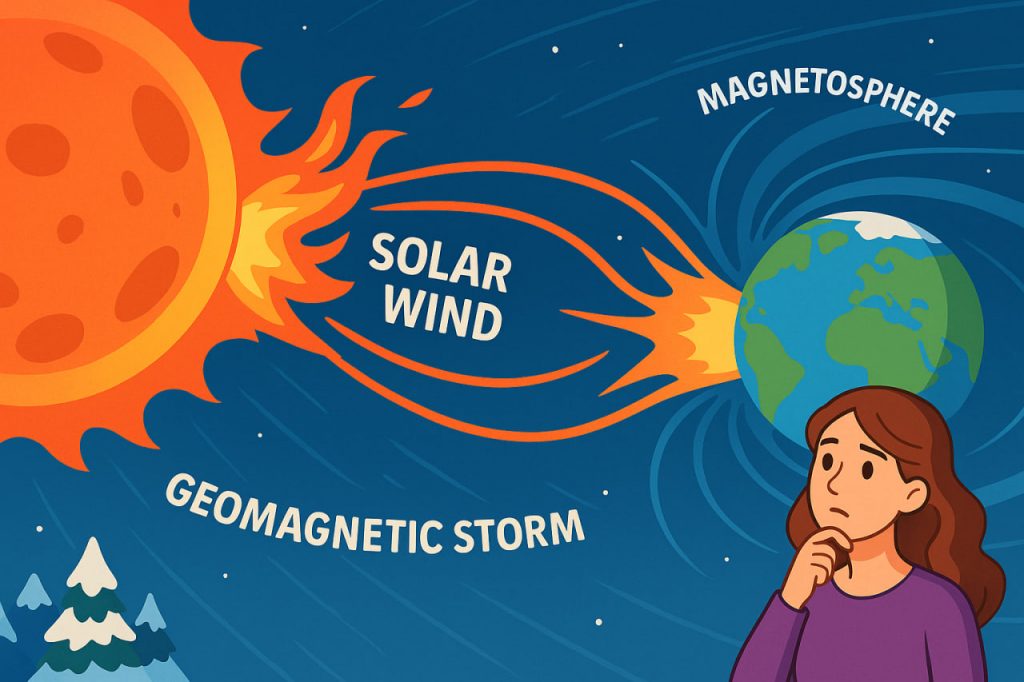
Magnetic storms, also known as geomagnetic storms, are large disturbances in Earth’s magnetic field caused by solar activity. These storms occur when charged particles from the Sun — carried by solar wind or erupting during solar flares and coronal mass ejections (CMEs) — collide with Earth’s magnetosphere. Although invisible, magnetic storms influence technology, satellites, radio communication, and, for some people, even physical well-being. Understanding how magnetic storms form helps scientists predict their impacts and protect infrastructure. These powerful phenomena demonstrate the dynamic connection between Earth and the Sun, reminding us that our planet exists within a constantly changing cosmic environment.
How Magnetic Storms Begin
Magnetic storms start with solar activity. The Sun regularly emits streams of charged particles known as solar wind, but during heightened activity it releases massive bursts of energy. These include:
- Solar flares — sudden bright flashes of radiation
- Coronal Mass Ejections (CMEs) — huge clouds of plasma and magnetic fields
- High-speed solar wind streams from coronal holes
When these energetic particles reach Earth, they interact with the magnetosphere — the protective magnetic shield surrounding our planet. According to solar physicist Dr. Elena Marquez:
“A magnetic storm is essentially the magnetosphere’s reaction
to a sudden flood of energy coming from the Sun.”
The disturbance causes Earth’s magnetic field lines to twist, compress, and realign, creating the conditions for a geomagnetic storm.
What Happens During a Magnetic Storm
Once solar particles enter the magnetosphere, they travel along magnetic field lines toward the poles, where they collide with atmospheric particles. This process releases energy that affects both the upper atmosphere and ground-level magnetic fields. As a result:
- The auroras (Northern and Southern Lights) become brighter and spread farther from the poles.
- Magnetic fluctuations intensify across the planet.
- Currents in the ionosphere change, affecting communications and navigation.
- Additional electric currents may be induced in power grids.
Many of these effects happen hundreds of kilometers above Earth’s surface, but their influence reaches technology and people below.
How Magnetic Storms Affect Technology
Geomagnetic storms can disrupt modern systems in several ways:
- Satellite malfunctions: radiation can interfere with electronics
- GPS inaccuracies: shifts in the ionosphere distort signals
- Radio communication problems: especially near the poles
- Power grid overloads: induced currents may damage transformers
- Aviation route changes: planes avoid polar flights during strong storms
While severe storms are rare, they can affect critical infrastructure, making forecasting essential.
How Magnetic Storms Affect Human Health
Although magnetic storms do not directly harm the human body, many people report sensitivity to changes in geomagnetic activity. Some experience:
- headaches or migraines
- fatigue and sleep disturbances
- irritability or mood changes
- fluctuations in blood pressure
Scientists continue studying these effects, as the human nervous and cardiovascular systems appear to react to geomagnetic fluctuations. As biophysics researcher Dr. Samuel Rhodes explains:
“Geomagnetic storms may not cause illness,
but they can trigger physiological responses in sensitive individuals.”
Staying hydrated, resting, and reducing stress may help minimize discomfort during storm periods.
Why Magnetic Storms Matter
Magnetic storms help scientists better understand the Sun–Earth relationship and develop technologies that protect satellites, communication systems, and power grids. Monitoring solar activity also improves forecasting, giving industries and governments time to prepare for strong events. These storms produce stunning natural displays such as auroras, but they also highlight the delicate balance between Earth’s magnetic shield and solar energy.
Interesting Facts
- Magnetic storms arise from the Sun’s 11-year activity cycle.
- The strongest known storm, the Carrington Event of 1859, caused telegraph fires and auroras visible near the equator.
- Auroras occur when solar particles collide with oxygen and nitrogen atoms in the upper atmosphere.
- Satellite systems have dedicated radiation shields to withstand geomagnetic storms.
- NASA and ESA constantly monitor the Sun to issue early storm warnings.
Glossary
- Magnetosphere — Earth’s protective magnetic shield against solar wind.
- Solar Wind — streams of charged particles flowing from the Sun.
- Coronal Mass Ejection (CME) — a massive burst of plasma and magnetic field from the Sun.
- Ionosphere — an upper atmospheric layer that affects radio communication.
- Aurora — glowing light displays near the poles caused by charged particles entering the atmosphere.