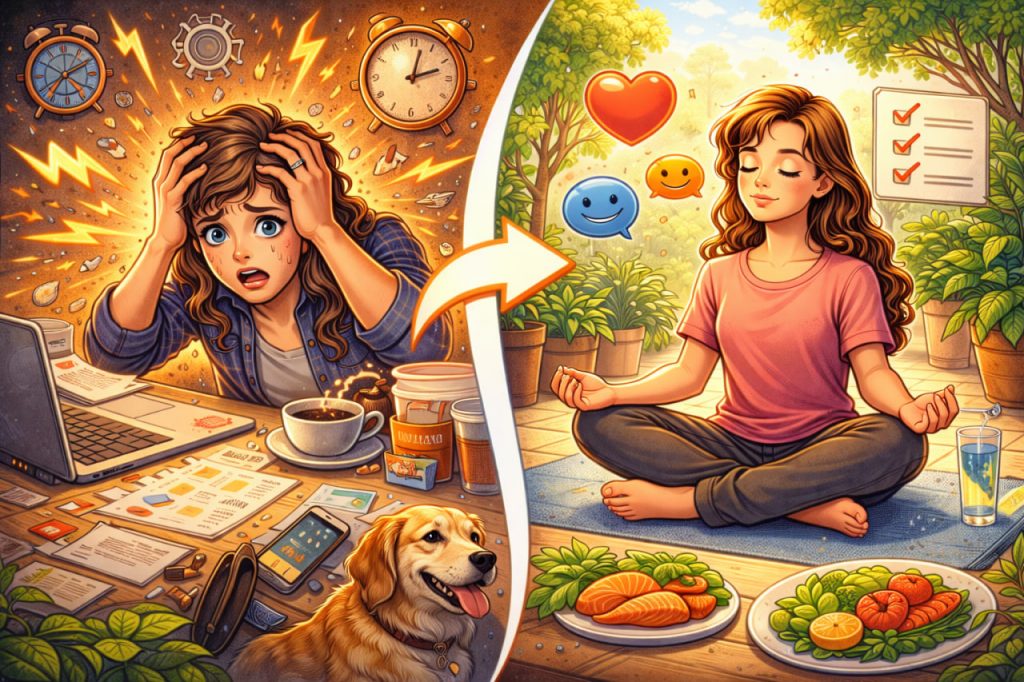
Stress is a natural physiological and psychological response to challenges, uncertainty, or perceived threats. It is not inherently negative; in fact, stress evolved to help humans survive by mobilizing energy and focus in critical situations. Problems arise when stress becomes constant and the body does not have enough time to recover. In modern life, stress is often triggered not by immediate danger, but by work pressure, social expectations, and information overload. Understanding what stress is and how to manage it allows people to protect both mental and physical health.
What Stress Really Is
Stress begins in the brain when a situation is interpreted as demanding or threatening. This perception activates biological systems that prepare the body for action. Hormones such as adrenaline and cortisol are released, increasing heart rate, alertness, and muscle tension. In short bursts, this response is useful and adaptive. Stress becomes harmful when it is prolonged and unrelenting. At that point, the same mechanisms that once protected us start to cause damage.
How Stress Affects the Body and Mind
Under stress, the body prioritizes survival over long-term balance. Digestion, immune responses, and restorative processes are temporarily suppressed. Mentally, attention narrows and thinking becomes more reactive. Over time, chronic stress contributes to fatigue, sleep problems, anxiety, and reduced concentration. Emotional regulation becomes more difficult, and small challenges may feel overwhelming. These effects are signals that the system is overloaded, not signs of personal weakness.
Common Sources of Modern Stress
Modern stress often comes from persistent rather than acute pressures. Work demands, financial uncertainty, social comparison, and constant digital connectivity all contribute. Unlike physical threats, these stressors do not resolve quickly. The body remains in a state of alert without a clear endpoint. This mismatch between ancient stress mechanisms and modern lifestyles explains why stress-related problems are so common today.
Healthy vs. Unhealthy Stress
Not all stress is harmful. Short-term stress can enhance performance, motivation, and learning. This type of stress is followed by recovery, allowing the body to return to balance. Unhealthy stress occurs when recovery is missing. Continuous pressure without rest leads to exhaustion and burnout. The key difference lies not in the presence of stress, but in the ability to recover.
Effective Ways to Cope With Stress
Managing stress begins with awareness. Recognizing early signs such as tension, irritability, or fatigue allows for timely response. Physical activity helps discharge accumulated stress hormones. Regular sleep and balanced nutrition support recovery. Breathing techniques and mindfulness calm the nervous system and restore focus. Equally important is setting boundaries and reducing unnecessary overload.
The Role of Social Support
Human connection is a powerful stress buffer. Sharing concerns with trusted people reduces emotional pressure and restores perspective. Feeling understood and supported lowers physiological stress responses. Isolation, by contrast, amplifies stress effects. Strong social bonds are not a luxury, but a protective factor for mental health. According to clinical psychologist Dr. Michael Andersson:
“Stress is not the enemy.
The real danger lies in ignoring recovery and emotional regulation.
When people learn to respond to stress rather than fight it,
resilience naturally increases.”
This highlights coping as adaptation, not avoidance.
Why Learning Stress Management Matters
Stress cannot be eliminated entirely, but it can be managed. Learning healthy coping strategies improves quality of life and long-term health. Effective stress management supports clearer thinking, emotional balance, and better relationships. It also reduces the risk of chronic illness. Understanding stress turns it from an invisible burden into a manageable process.
P.S. Personally, I recommend that everyone learn the simple autogenic training by Schultz, which is available on YouTube and other platforms. By practicing it every morning and evening for at least 12 minutes, you will find it much easier to live in this world and cope with stress. If you are interested in prayer and meditation practices, please feel free to ask in the comments.
Interesting Facts
- Stress responses evolved for short-term survival, not constant pressure.
- Chronic stress affects both mental and physical health.
- Recovery is as important as the stress response itself.
- Social support significantly reduces stress impact.
- Stress management skills improve long-term resilience.
Glossary
- Stress — the body’s response to perceived challenge or threat.
- Cortisol — a hormone involved in stress regulation.
- Chronic Stress — prolonged stress without adequate recovery.
- Recovery — the process of returning to physiological balance.
- Resilience — the ability to adapt and cope with difficulties.