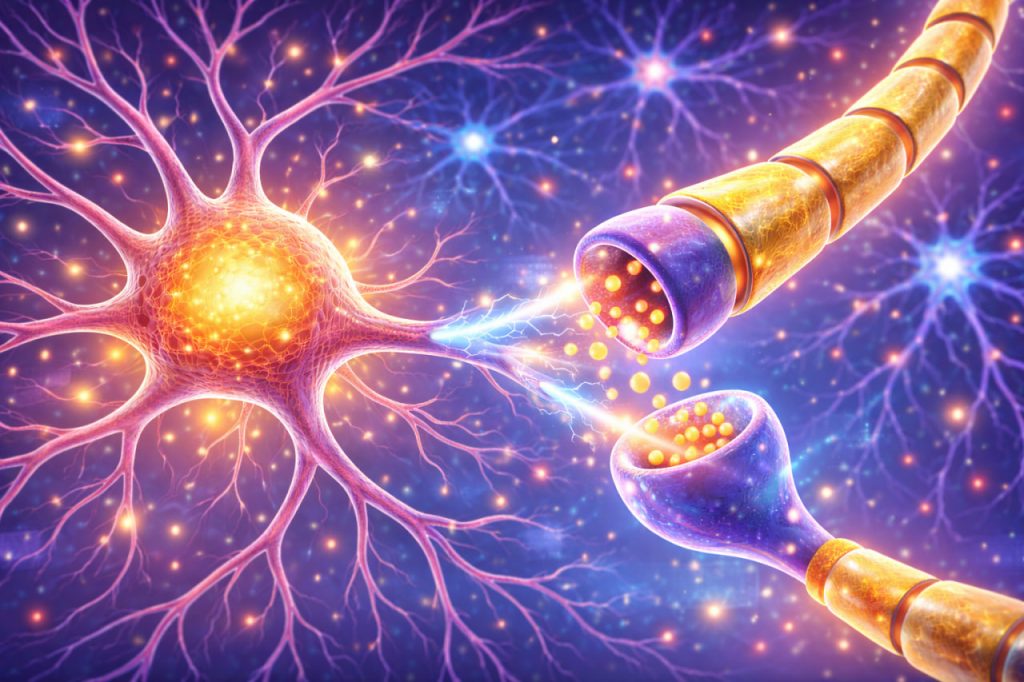
A neuron is a fundamental building block of the nervous system, responsible for receiving, processing, and transmitting information. Every thought, movement, sensation, and emotion depends on the coordinated activity of billions of neurons. Although neurons are microscopic, their collective behavior gives rise to complex processes such as memory, learning, and consciousness. Unlike most cells in the body, neurons are specialized for communication rather than physical support or energy storage. Understanding how a neuron works reveals how biological systems transform electrical and chemical signals into experience and behavior.
The Basic Structure of a Neuron
Each neuron consists of several distinct parts, each with a specific role. Dendrites receive incoming signals from other neurons. The cell body integrates these signals and determines whether to respond. The axon transmits signals away from the neuron toward other cells. At the end of the axon, specialized terminals pass the signal onward. This structure allows information to flow in a controlled and directional manner.
Electrical Signals Inside the Neuron
Neurons communicate internally using electrical impulses. When a neuron is sufficiently stimulated, it generates an action potential—a rapid change in electrical charge that travels along the axon. This signal is all-or-nothing: it either occurs fully or not at all. The speed and reliability of this process allow neurons to transmit information quickly across long distances in the body. Electrical signaling is what makes rapid responses, such as reflexes, possible.
Chemical Communication Between Neurons
Neurons do not touch each other directly. Instead, they communicate across small gaps called synapses using chemical messengers. When an electrical signal reaches the end of the axon, it triggers the release of neurotransmitters. These molecules cross the synapse and bind to receptors on the next neuron. This chemical step allows communication to be flexible and adjustable. According to neuroscientist Dr. Helen Foster:
“The synapse is where information becomes meaning,
because signals can be strengthened, weakened, or reshaped.”
This adaptability is crucial for learning and memory.
Why Neurons Are Not All the Same
Neurons come in many shapes and types, each adapted to a specific function. Some are designed to carry sensory information, others to control muscles, and others to process information internally. Their size, shape, and connectivity reflect their role within the nervous system. This diversity allows the brain to perform many tasks simultaneously. Specialization makes neural networks efficient and flexible.
Plasticity: The Neuron’s Unique Ability
One of the most remarkable features of neurons is plasticity—the ability to change connections based on experience. Neurons can strengthen existing synapses, weaken others, or form entirely new connections. This process underlies learning, adaptation, and recovery after injury. Plasticity allows the nervous system to reorganize itself throughout life. It is a key reason why experiences shape behavior and personality.
Energy and Support
Neurons are highly active cells and require constant energy. Supporting cells provide nutrients, remove waste, and maintain the chemical environment necessary for signaling. Without this support, neurons cannot function properly. This cooperation highlights that neural activity depends on both specialized signaling cells and a supportive cellular environment. Brain function is therefore a collective effort, not the work of neurons alone.
Why Neurons Are Special
Neurons are unique because they combine speed, adaptability, and precision. They convert physical signals into information, link perception to action, and allow abstract thought to emerge from biological processes. No other cell type integrates electrical signaling, chemical communication, and structural adaptability in the same way. Through networks of neurons, simple signals become complex behavior. Understanding neurons is essential to understanding the mind itself.
Interesting Facts
- A single neuron can form thousands of connections.
- Electrical signals in neurons travel faster than most cellular processes.
- Synaptic strength changes with experience and learning.
- Neurons can remain active for a human lifetime.
- Brain function depends on networks, not individual neurons.
Glossary
- Neuron — a nerve cell specialized for information transmission.
- Dendrite — a structure that receives incoming signals.
- Axon — a long extension that transmits electrical signals.
- Synapse — the gap where neurons communicate chemically.
- Plasticity — the ability of neural connections to change over time.