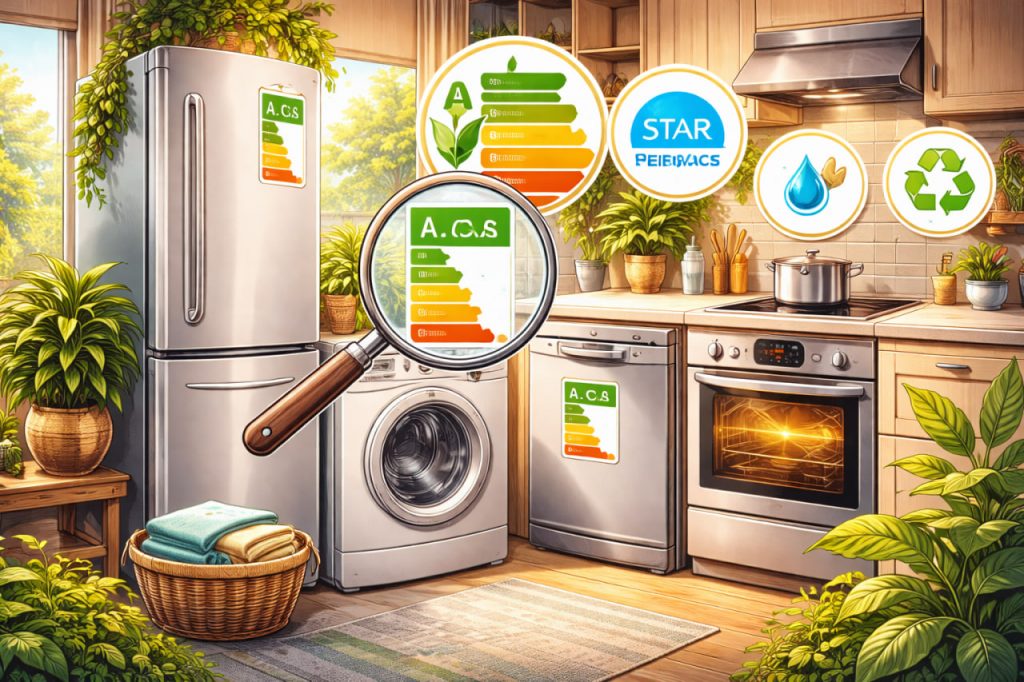
Choosing eco-friendly home appliances is not just about saving electricity—it’s about reducing long-term environmental impact while maintaining everyday comfort. Modern appliances vary widely in efficiency, materials, and lifecycle footprint, and marketing claims can be misleading. Labels and classes exist to help consumers make informed choices, but only when they are understood correctly. Energy efficiency, water use, durability, and recyclability all matter. Learning how to read certifications and compare real indicators allows buyers to choose appliances that are genuinely better for the planet and for household budgets.
Energy Efficiency Classes: What They Really Mean
Energy efficiency classes provide a standardized way to compare how much energy appliances consume. In many regions, the updated scale runs from A (most efficient) to G (least efficient), replacing older “A+++” systems that caused confusion. The class reflects energy use under standardized test conditions, allowing fair comparison between similar models. Importantly, two appliances with the same class can still differ in absolute consumption if their sizes or capacities differ. Always compare efficiency classes within the same category and size range to get meaningful results.
Understanding Energy Labels
Energy labels summarize key performance data at a glance. They typically include annual energy consumption, noise levels, capacity, and sometimes water usage. In Europe, the standardized energy label provides transparent, comparable information across brands. In other markets, certifications like Energy Star indicate that a product meets strict efficiency criteria. These labels are regulated and independently verified, making them more reliable than marketing slogans. Reading the full label helps identify trade-offs between performance and efficiency.
Water Efficiency and Resource Use
For appliances such as washing machines and dishwashers, water efficiency is just as important as electricity use. Efficient models reduce water consumption per cycle without compromising cleaning performance. Some labels include water usage per operation, allowing comparison between models. Reduced water use lowers energy demand as well, since heating water consumes power. Choosing appliances that optimize both resources significantly reduces environmental footprint over time.
Durability and Repairability
An often overlooked aspect of eco-friendliness is product lifespan. Appliances that last longer and can be repaired create less waste and reduce the need for new resource extraction. Some manufacturers now publish repairability scores or provide extended spare-parts availability. A slightly less efficient appliance that lasts twice as long may be more sustainable than a highly efficient model with a short lifespan. Longevity is a key element of true environmental responsibility.
Materials and End-of-Life Considerations
Eco-friendly appliances also consider what happens at the end of their life cycle. Models designed with recyclable materials and modular components are easier to disassemble and recycle. Some brands participate in take-back or recycling programs to reduce landfill waste. Avoiding excessive mixed plastics and prioritizing metal components improves recyclability. These factors are rarely visible at first glance, but they strongly influence environmental impact.
Avoiding Greenwashing
Not all “green” claims are meaningful. Terms like “eco mode” or “environmentally friendly” are often unregulated. Reliable indicators include official energy labels, third-party certifications, and transparent technical specifications. Comparing standardized metrics is more trustworthy than relying on branding language. True eco-friendly appliances demonstrate measurable performance improvements, not vague promises.
Making a Balanced Decision
The most sustainable choice balances efficiency, durability, and suitability for real household needs. Oversized appliances waste energy, while underpowered ones may require repeated use. Selecting the right capacity, using eco-modes properly, and maintaining appliances extends their benefits. Eco-friendly choices work best when combined with responsible usage habits. Informed selection empowers consumers to reduce environmental impact without sacrificing quality of life.
Interesting Facts
- Updated energy labels removed “A+++” to improve clarity and comparison.
- Water efficiency often reduces energy use indirectly.
- Durable appliances generate less waste over time.
- Official labels are independently verified, unlike marketing claims.
- Proper sizing is as important as efficiency class.
Glossary
- Energy Efficiency Class — a standardized rating of energy consumption.
- Energy Label — an official label showing key performance indicators.
- Water Efficiency — the amount of water used per operation.
- Repairability — how easily a product can be maintained and fixed.
- Greenwashing — misleading claims about environmental benefits.