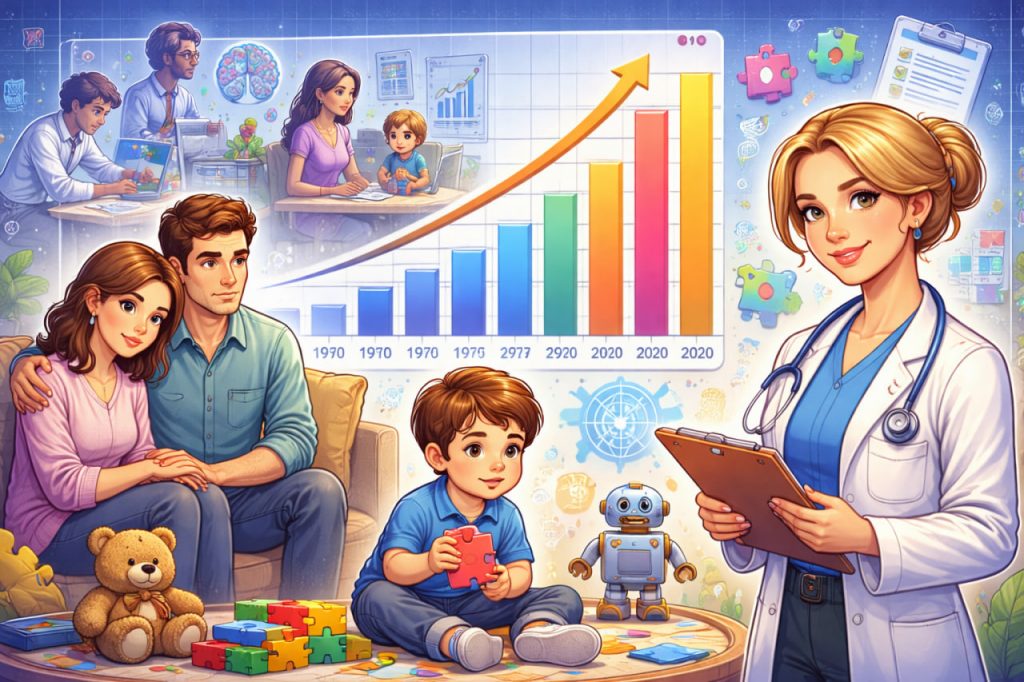
Over the past half century, the number of children identified with autism spectrum conditions has increased dramatically across many countries. This rise has attracted attention from scientists, educators, policymakers, and families, often provoking concern and debate. At first glance, the statistics may suggest a sudden surge in the condition itself, but the reality is more complex. Changes in diagnostic criteria, awareness, screening practices, and societal understanding all play a significant role. To understand what has truly changed, it is essential to look beyond raw numbers and examine how autism has been defined, recognized, and recorded over time. The growth in reported cases reflects not a single cause, but a convergence of scientific, medical, and social factors.
How Autism Was Understood in the Past
Fifty years ago, autism was considered a rare and narrowly defined condition. Early diagnostic frameworks focused on severe behavioral and communication difficulties, often excluding children with milder or atypical presentations. Many children who would today be identified as autistic were instead labeled with vague terms such as developmental delay or learning difficulties. Limited awareness among doctors and educators meant that diagnosis was inconsistent and often delayed. As a result, historical data significantly underrepresents the true number of autistic individuals. This narrow definition created the impression that autism was uncommon, when in fact many cases went unrecognized.
Expansion of Diagnostic Criteria
One of the most important drivers of rising autism prevalence is the broadening of diagnostic criteria. Over time, autism has come to be understood as a spectrum rather than a single, uniform condition. This shift allowed clinicians to identify a wider range of developmental profiles, including children with average or high cognitive abilities. Diagnostic manuals were revised multiple times, each update expanding inclusion and improving clarity. These changes did not create autism, but they did allow it to be recognized more accurately. As a result, prevalence statistics increased as more children met the updated definitions.
Increased Awareness and Early Screening
Public and professional awareness of autism has grown substantially over the past decades. Pediatricians, teachers, and parents are now more familiar with early signs related to communication, social interaction, and behavior. Screening programs have become more systematic, often occurring during early childhood checkups. Earlier identification leads to higher reported prevalence at younger ages. Increased awareness also reduces stigma, making families more likely to seek evaluation. This cultural shift has played a major role in the rising numbers seen in official records.
Changes in Reporting and Data Collection
Improvements in healthcare systems and data collection have also influenced autism statistics. Many countries now maintain centralized registries and standardized reporting methods. Educational systems track developmental diagnoses more consistently than in the past. These administrative improvements capture cases that previously would have been missed. As data quality improves, prevalence estimates become more accurate—but also higher. This trend reflects better measurement rather than a sudden biological change.
Environmental and Biological Factors
While diagnostic and social factors explain much of the increase, researchers also continue to explore biological and environmental influences. Genetics play a strong role in autism, and advances in genetic research have revealed complex interactions among multiple genes. Scientists also investigate prenatal and early developmental factors that may influence neurodevelopment. Importantly, no single environmental factor has been shown to explain the overall rise. Current scientific consensus views autism as the result of multiple interacting influences rather than a single cause.
Interpreting the Numbers Responsibly
The rising prevalence of autism does not necessarily mean that more children are becoming autistic in a biological sense. Instead, it reflects improved recognition, broader definitions, and better data systems. Misinterpreting these trends can lead to unnecessary fear or misinformation. Researchers emphasize the importance of distinguishing between true incidence and diagnostic prevalence. Understanding this difference allows society to focus on appropriate support, education, and inclusion rather than alarm.
A Shift in Perspective
Over the last 50 years, society’s view of autism has evolved significantly. Autism is increasingly understood not only as a clinical diagnosis, but as a form of neurodiversity within the human population. This shift encourages more inclusive approaches in education and community life. The rise in diagnosis has also amplified autistic voices, contributing to more nuanced discussions about strengths, challenges, and support needs. In this sense, the growing numbers reflect progress in understanding as much as change in statistics.
Interesting Facts
- Early autism diagnoses focused only on severe presentations.
- Modern definitions recognize autism as a spectrum, not a single condition.
- Improved screening leads to earlier identification in childhood.
- Many adults today were never diagnosed as children due to limited awareness.
- Better data collection increases reported prevalence without changing biology.
Glossary
- Autism Spectrum — a range of neurodevelopmental characteristics affecting communication and behavior.
- Diagnostic Criteria — standardized guidelines used to identify conditions.
- Prevalence — the number of identified cases within a population.
- Neurodevelopment — the growth and organization of the brain and nervous system.
- Neurodiversity — the concept that neurological differences are part of natural human variation.