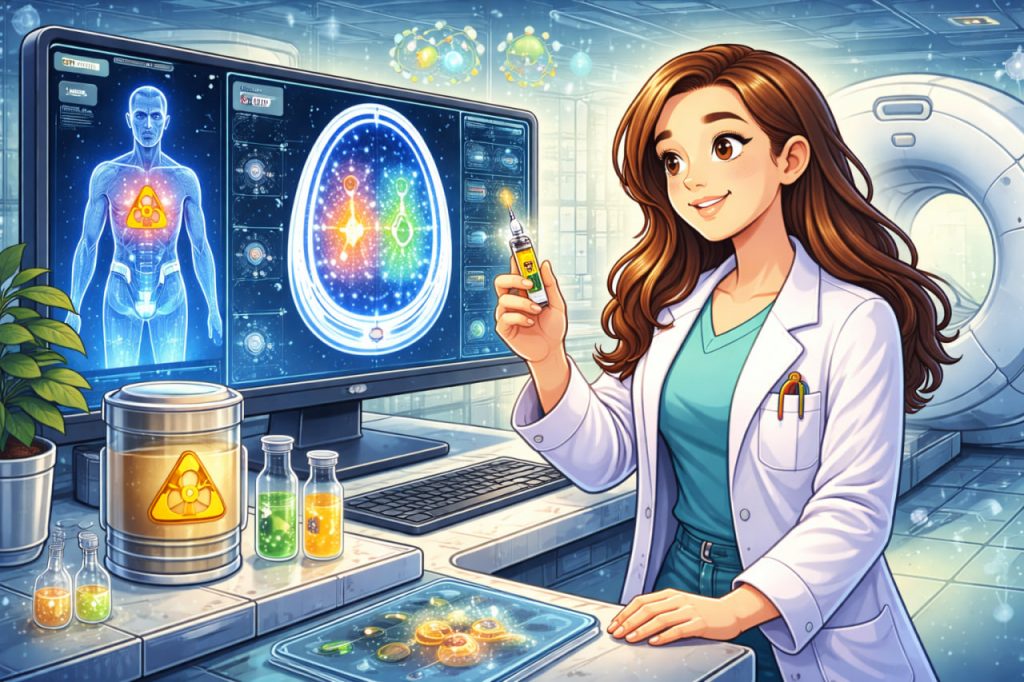
Nuclear medicine is a specialized field that uses the properties of atomic nuclei to study physiological processes inside the human body. Unlike conventional imaging methods that focus mainly on anatomy, nuclear medicine reveals function, showing how organs and tissues work in real time. By tracking tiny amounts of radioactive tracers, physicians can observe metabolism, blood flow, and cellular activity with high sensitivity. This approach has transformed diagnostics by enabling earlier detection of abnormalities before structural changes become visible. Nuclear medicine integrates physics, chemistry, biology, and medical science into a single, highly precise discipline. Understanding its principles explains why it plays a critical role in modern healthcare systems worldwide.
What Is Nuclear Medicine
Nuclear medicine involves the use of radioactive isotopes that emit detectable radiation as they decay. These isotopes are attached to biologically active molecules that participate in normal physiological processes. Once introduced into the body, they accumulate in specific organs or tissues based on biological behavior rather than anatomy alone. Specialized detectors capture the emitted radiation and convert it into images or quantitative data. According to medical physicist Dr. Andrew Coleman:
“Nuclear medicine allows us to see biology in action,
not just the structures where it takes place.”
This functional perspective distinguishes nuclear medicine from many other imaging techniques.
Diagnostic Imaging and Functional Insight
One of the primary applications of nuclear medicine is functional imaging, which assesses how organs perform their tasks. Techniques such as positron emission tomography and single-photon emission imaging provide information about metabolic rates, oxygen use, and cellular activity. These methods are especially valuable when early functional changes occur before visible anatomical damage. By analyzing how tissues absorb or process tracers, clinicians gain insight into complex biological systems. Functional imaging supports accurate assessment and informed clinical decision-making without invasive procedures.
Targeted Use of Radiation
A defining characteristic of nuclear medicine is the targeted nature of radiation use. The radioactive signal originates from within the body and is confined to specific biological pathways. The amounts involved are carefully calculated to be as low as reasonably achievable while still providing high-quality information. This targeted approach contrasts with external radiation sources and allows precise localization of physiological activity. Ongoing research focuses on improving targeting accuracy and minimizing unnecessary exposure.
Role in Research and Innovation
Beyond clinical use, nuclear medicine plays a vital role in biomedical research. It helps scientists study disease mechanisms, evaluate new diagnostic tools, and understand how biological systems respond to change. Imaging data generated through nuclear methods supports the development of personalized approaches to healthcare. Researchers also use nuclear techniques to explore molecular interactions at the cellular level. This research-driven foundation ensures that nuclear medicine continues to evolve alongside scientific progress.
Safety, Regulation, and Responsibility
The use of radioactive materials requires strict regulatory oversight and well-established safety protocols. Professionals working in nuclear medicine are highly trained in radiation physics, dosimetry, and protection principles. Continuous monitoring, quality control, and international standards ensure that procedures are conducted responsibly. Experts emphasize that benefits must always outweigh risks and that patient safety remains the top priority. According to radiation safety expert Dr. Laura Bennett:
“Precision and responsibility define nuclear medicine.
Every application is guided by evidence, regulation, and care.”
Interesting Facts
- Nuclear medicine focuses on organ function, not just structure.
- Radioactive tracers decay naturally and do not remain permanently in the body.
- Functional changes can be detected earlier than anatomical ones.
- Nuclear imaging combines physics, biology, and computing.
- The field contributed significantly to advances in personalized diagnostics.
Glossary
- Nuclear Medicine — a medical field that uses radioactive substances to study body function.
- Radioisotope — an unstable atom that emits radiation during decay.
- Tracer — a substance that follows biological pathways and emits detectable signals.
- Functional Imaging — imaging that shows how organs and tissues operate.
- Radiation Dosimetry — the measurement and calculation of radiation exposure.