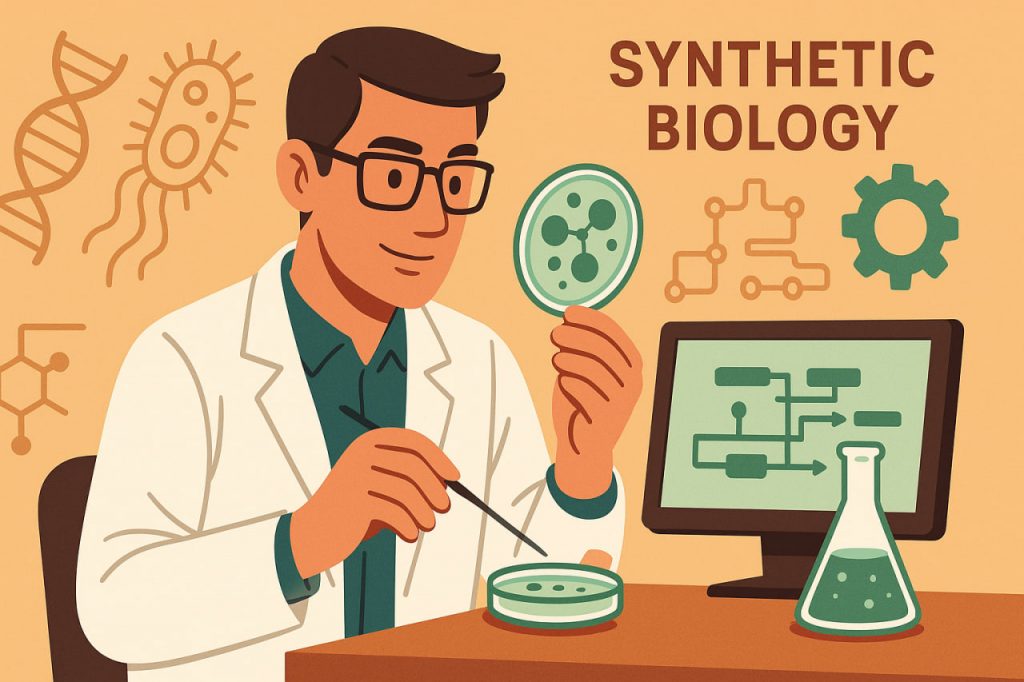
Synthetic biology is a rapidly developing scientific field that combines biology, engineering, and computer science to design and construct new biological systems or redesign existing ones. Unlike traditional genetic engineering, which typically modifies one or two genes, synthetic biology works with entire genetic circuits and pathways. Its goal is to make biological systems more predictable, programmable, and controllable. Scientists in this field treat DNA much like code, assembling genetic components to perform specific functions. Synthetic biology has the potential to transform medicine, energy production, agriculture, and environmental protection. At the same time, it raises important scientific and ethical questions about how far human control over living systems should go.
What Makes Synthetic Biology Different
Synthetic biology differs from classical biotechnology by applying engineering logic to living organisms. Researchers use standardized genetic parts, often called biological “modules,” that can be combined in various ways. These parts may control gene expression, sense environmental signals, or trigger specific cellular responses. According to bioengineer Dr. Nathan Cole:
“Synthetic biology is not about changing life randomly.
It is about designing biological systems with intention and reliability.”
This approach allows scientists to build cells that behave in predictable ways, reducing trial-and-error experimentation.
Building Biological Circuits
At the core of synthetic biology are genetic circuits, which function similarly to electronic circuits. These circuits can switch genes on or off, respond to chemical signals, or perform logical operations inside cells. For example, a synthetic circuit may instruct a bacterium to produce a substance only when specific conditions are met. Designing such systems requires deep understanding of molecular biology, mathematics, and computational modeling. Although living cells are far more complex than machines, advances in modeling and data analysis have significantly improved control over biological behavior.
Applications in Medicine and Industry
Synthetic biology offers promising applications across many sectors. In medicine, researchers are developing engineered microbes that can detect disease markers or produce therapeutic compounds inside the body. In industry, synthetic organisms can manufacture fuels, biodegradable plastics, and enzymes more efficiently than traditional chemical processes. Agriculture may benefit from crops engineered to resist stress or reduce the need for chemical fertilizers. Importantly, these innovations aim to make production more sustainable and environmentally friendly. However, experts stress that rigorous testing and regulation are essential before widespread use.
Ethical and Safety Considerations
The power to design living systems brings significant ethical responsibility. Concerns include unintended environmental effects, misuse of technology, and long-term ecological consequences. Scientists emphasize the importance of biosafety mechanisms, such as genetic “kill switches” that prevent engineered organisms from surviving outside controlled environments. According to ethicist Dr. Laura Simmons:
“The challenge is not whether synthetic biology can be done,
but how to ensure it is done responsibly and transparently.”
International cooperation and clear guidelines play a crucial role in managing these risks.
The Future of Synthetic Biology
Synthetic biology continues to evolve as tools become more precise and affordable. Automation, artificial intelligence, and DNA synthesis technologies are accelerating progress at an unprecedented pace. Future developments may allow scientists to design complex biological systems from scratch or rapidly respond to global challenges such as pandemics and climate change. While uncertainties remain, synthetic biology represents a shift toward viewing life as both a natural phenomenon and a designable system. Its future impact will depend on how carefully innovation is balanced with caution.
Interesting Facts
- DNA can be synthesized chemically without using a living organism.
- Synthetic biology has enabled bacteria to produce insulin and vaccines.
- Some engineered microbes can break down plastic waste.
- Genetic circuits can perform logical operations inside cells.
- The cost of DNA synthesis has dropped dramatically over the last two decades.
Glossary
- Synthetic Biology — the design and construction of new biological systems using engineering principles.
- Genetic Circuit — a network of genes engineered to perform specific functions.
- DNA Synthesis — the artificial creation of DNA sequences in a laboratory.
- Biosafety — measures used to prevent unintended biological risks.
- Kill Switch — a genetic mechanism designed to disable engineered organisms outside controlled conditions.