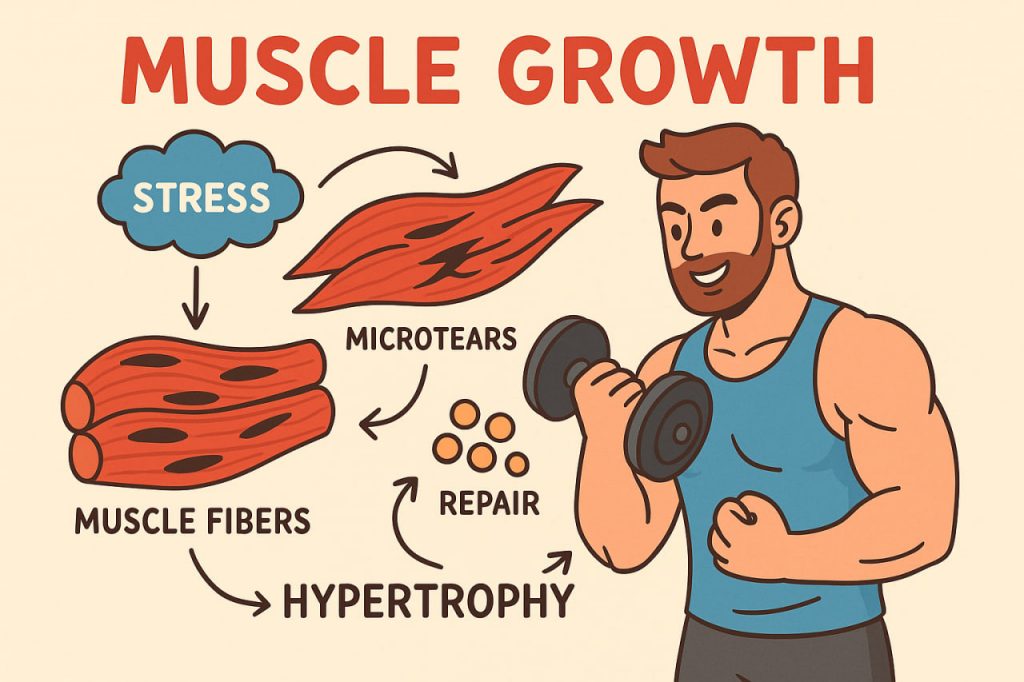
Muscle growth, also known as muscle hypertrophy, is a biological process in which muscle fibers increase in size in response to physical stress, nutrition, and recovery. While the concept seems straightforward — lift weights and muscles grow — the underlying mechanisms are complex and deeply coordinated by cellular signaling, hormones, and metabolic processes. Understanding how muscles truly grow helps explain why consistency, proper form, rest, and balanced nutrition are essential for long-term strength development without harming health.
When muscles encounter resistance — such as weightlifting, bodyweight training, or high-intensity activities — they experience microscopic damage. This damage is not harmful; it is a necessary trigger that stimulates the body to repair the fibers and make them stronger and thicker. Over time, repeated cycles of stress and repair produce visible growth.
The Three Main Mechanisms of Muscle Growth
Scientists identify three key stimuli responsible for hypertrophy:
1. Mechanical Tension
When muscles contract under load, they experience tension that activates cellular sensors.
This tension signals the body to strengthen the muscle fibers.
2. Muscle Damage
Small tears in the muscle fibers occur during training.
The repair process recruits satellite cells, which fuse with existing fibers, increasing their size.
3. Metabolic Stress
Sensations like burning, swelling, or fatigue result from metabolic byproducts.
This stress triggers hormonal and cellular responses that support growth.
According to exercise physiologist Dr. Megan Howard:
“Muscle hypertrophy is the body’s adaptive response to stress —
the more strategic the stress, the more effective the growth.”
This highlights the importance of controlled training rather than random overload.
Cellular Process: How Muscles Actually Get Bigger
At the microscopic level, several steps occur:
- Training creates tension and micro-damage.
- The immune system responds with inflammation that begins the repair process.
- Satellite cells activate and attach to damaged fibers.
- These cells donate their nuclei to muscle fibers.
- More nuclei allow fibers to synthesize more protein.
- The fiber thickens — this is hypertrophy.
The key takeaway: muscles grow during recovery, not during training.
Role of Protein and Nutrition
Protein provides amino acids required for repairing and building muscle tissues.
Muscle growth depends on:
- adequate protein intake
- balanced calories
- essential micronutrients
- proper hydration
Without proper nutrition, hypertrophy is limited regardless of training intensity.
The Importance of Rest and Sleep
Rest is as important as training itself.
During sleep:
- growth hormone increases
- tissues repair more efficiently
- inflammation decreases
- energy reserves rebuild
Lack of rest may halt progress or increase injury risk.
Hormones Influencing Muscle Growth
Several hormones contribute to hypertrophy:
- growth hormone (GH)
- testosterone
- insulin-like growth factor (IGF-1)
- insulin
These hormones regulate protein synthesis and cell repair, but healthy muscle growth relies on natural processes — not external supplementation.
Types of Muscle Hypertrophy
There are two forms:
1. Myofibrillar Hypertrophy
Increase in contractile proteins → greater strength.
2. Sarcoplasmic Hypertrophy
Increase in muscle fluid and energy stores → greater muscle size.
Both occur during training but in different proportions depending on workout style.
Why Muscles Stop Growing (Plateaus)
Common reasons include:
- insufficient recovery
- inadequate nutrition
- repetitive training without progression
- excessive stress or overtraining
- poor technique
Adjusting training or recovery strategies helps overcome plateaus safely.
Interesting Facts
- Muscles begin adapting within hours after training, but visible growth takes weeks.
- A single muscle fiber can contain thousands of nuclei supporting protein synthesis.
- Muscle mass naturally declines after age 30 unless regularly trained.
- Muscles burn more calories at rest than fat, improving metabolism.
- You cannot turn fat into muscle — they are completely different tissues.
Glossary
- Hypertrophy — an increase in muscle fiber size.
- Satellite Cells — stem-like cells that repair and grow muscle tissue.
- Mechanical Tension — force applied to muscles during contraction.
- Protein Synthesis — the process of building new proteins in cells.
- Metabolic Stress — biochemical changes in muscles during intense activity.