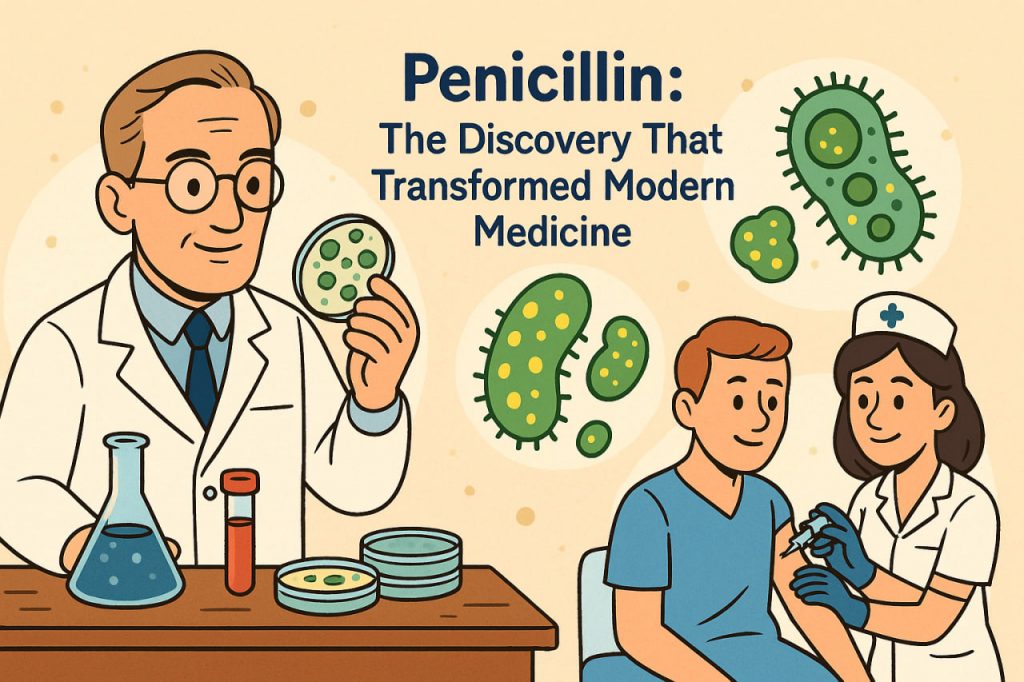
Penicillin is one of the most important medical discoveries in human history. As the first true antibiotic, it revolutionized the treatment of bacterial infections and dramatically reduced global mortality. Before penicillin, even minor wounds, sore throats, and common infections could become life-threatening. Surgeries were dangerous, childbirth carried high risks, and epidemics spread quickly due to the lack of effective treatments. Penicillin changed all of this by providing a safe and powerful drug capable of killing bacteria without harming human cells. Its discovery marked the beginning of the antibiotic era and paved the way for modern infection control, surgery, and public health.
The story of penicillin is both scientific and accidental. Scottish biologist Alexander Fleming discovered it in 1928 when he noticed that a mold growing in one of his Petri dishes had prevented bacteria from multiplying. Although Fleming recognized its potential, the compound was unstable and difficult to extract. Years later, a team of scientists from Oxford — Howard Florey, Ernst Chain, and Norman Heatley — developed methods to isolate, purify, and mass-produce penicillin. This collaborative breakthrough changed medicine forever.
How Penicillin Works
Penicillin belongs to a group of antibiotics known as beta-lactams. These drugs interfere with bacterial cell wall synthesis, causing bacteria to weaken and burst. Because human cells do not have cell walls, penicillin targets bacteria selectively, making it extremely effective and relatively safe.
Penicillin is especially powerful against:
- streptococcal infections
- staphylococcal infections
- pneumonia
- meningitis
- syphilis
- skin and wound infections
According to medical historian Dr. Laura Bennett:
“Penicillin didn’t just cure infections —
it changed the entire trajectory of modern medicine.”
Its discovery allowed doctors to attempt complex surgeries, treat battlefield injuries, and save millions of lives.
The Impact of Penicillin on the World
Following its mass production during World War II, penicillin quickly became known as a miracle drug. It dramatically lowered death rates from infected wounds, pneumonia, and childbirth complications. It also:
- made organ transplants and chemotherapy possible
- reduced fatalities from infectious diseases
- helped control epidemics
- enabled safer medical procedures
Penicillin’s success opened the door to the development of dozens of other antibiotics that continue to protect human health today.
Challenges: Antibiotic Resistance
Despite its success, penicillin faces a significant modern challenge — antibiotic resistance. Some bacteria have evolved mechanisms that make them immune to penicillin’s effects. Overuse and misuse of antibiotics accelerate this process.
Resistant infections are now a major global health concern. While penicillin is still effective for many diseases, doctors must prescribe antibiotics carefully, and patients must follow medical guidance to avoid contributing to resistance.
Modern Uses of Penicillin
Although newer antibiotics are now available, penicillin remains widely used. It is effective for:
- throat infections
- skin infections
- respiratory infections
- dental infections
- certain sexually transmitted infections
Different forms of penicillin are used depending on the type and severity of infection.
How Penicillin Is Made Today
Penicillin is now produced using industrial fermentation. The mold Penicillium chrysogenum is grown in large bioreactors, where it produces penicillin under carefully controlled conditions. After fermentation, the antibiotic is extracted, purified, and processed into different medical formulations.
Interesting Facts
- Penicillin was discovered by accident when mold contaminated Fleming’s experiment.
- The first major patient saved by penicillin was a policeman with a severe infection in 1941.
- Penicillin’s development required collaboration across three countries during World War II.
- It remains one of the most widely used antibiotics in the world.
- Excessive antibiotic use contributes to global resistance, one of the biggest medical challenges today.
Glossary
- Antibiotic — a substance that kills or prevents the growth of bacteria.
- Beta-Lactam — a class of antibiotics including penicillin, which disrupt bacterial cell walls.
- Resistance — when bacteria evolve the ability to survive antibiotic treatment.
- Fermentation — biological process used to mass-produce penicillin.
- Pathogen — a microorganism that can cause disease.