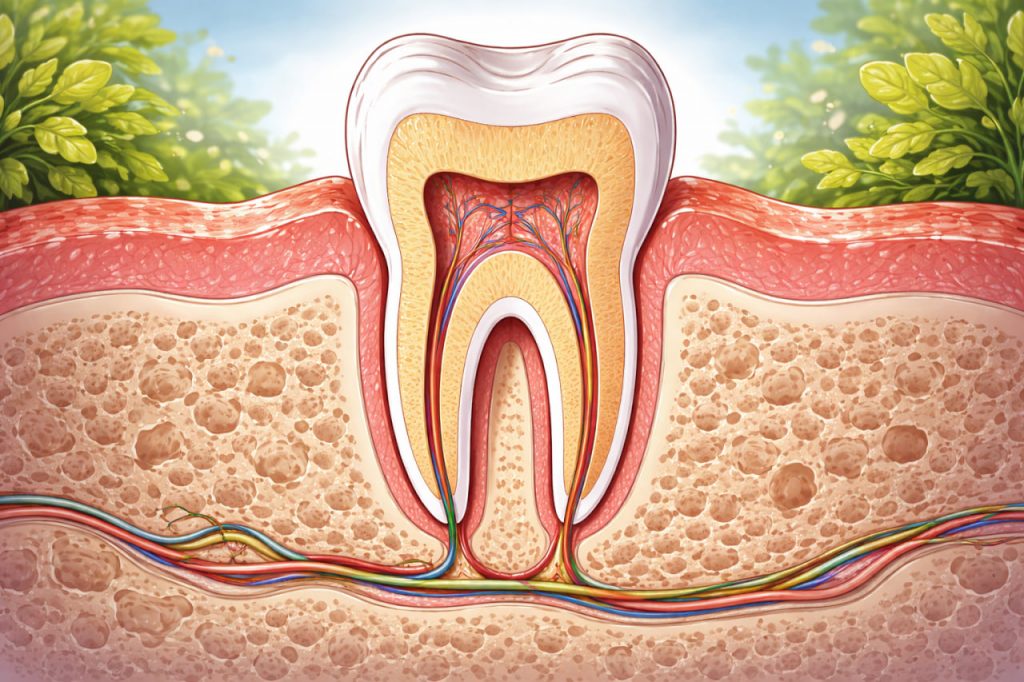
Human teeth are complex biological structures designed to withstand constant mechanical stress while performing precise functions. They are not simple solid objects, but layered systems where each component plays a specific role. Teeth allow us to bite, chew, speak clearly, and maintain the shape of the face. Their structure balances hardness and sensitivity, strength and responsiveness. Understanding how teeth are built helps explain why proper care is essential and why damage to different parts leads to different problems.
The Main Parts of a Tooth
Each tooth consists of two main visible and hidden sections: the crown and the root. The crown is the part above the gum line that interacts directly with food. The root anchors the tooth inside the jawbone, providing stability during chewing. Although the crown appears solid, it contains multiple layers with distinct properties. The root is equally complex, interacting with bone and surrounding tissues to absorb pressure.
Enamel: The Protective Outer Layer
The outermost layer of the crown is enamel, the hardest substance in the human body. Enamel protects the tooth from mechanical damage, temperature changes, and chemical exposure. Despite its strength, enamel cannot regenerate once damaged. Acidic foods, bacteria, and grinding can gradually weaken it. Because enamel lacks living cells, protecting it through hygiene and diet is critical.
Dentin: The Supportive Core
Beneath the enamel lies dentin, a slightly softer but more flexible material. Dentin forms the bulk of the tooth and supports the enamel above it. It contains microscopic channels that transmit sensations such as heat, cold, and pressure. When enamel wears away, dentin becomes exposed, increasing sensitivity. This layer explains why tooth damage often leads to discomfort even without visible cavities.
Pulp: The Living Center
At the center of each tooth is the pulp chamber, which contains nerves, blood vessels, and connective tissue. The pulp supplies nutrients to the tooth and enables sensation. Pain from tooth decay usually originates here when bacteria reach this inner area. Because the pulp is sensitive and vital, protecting outer layers is essential to avoid infection. Damage to the pulp often requires specialized treatment.
The Root and Jaw Connection
The root of the tooth is covered by a thin layer called cementum, which helps attach it to the surrounding bone. Tiny fibers connect the root to the jawbone, forming a flexible yet strong suspension system. This structure allows teeth to absorb chewing forces without cracking the bone. Healthy roots and supporting tissues are just as important as healthy crowns. Problems in this area can lead to tooth mobility or loss.
Gums and Supporting Structures
Teeth do not function alone; they rely on gums and bone for protection and stability. Gums form a protective seal around the tooth, blocking bacteria from reaching deeper tissues. The jawbone supports roots and adapts to chewing forces over time. Together, these structures form the foundation of oral health. When gums or bone are damaged, even healthy teeth are at risk.
Why Tooth Structure Matters
Each layer of the tooth has a unique role, and damage to one layer affects the others. Early decay begins at the enamel but can progress inward if untreated. Understanding tooth structure explains why preventive care is so effective. Protecting teeth means protecting an entire system, not just a visible surface. This knowledge highlights the importance of regular care and early intervention.
Interesting Facts
- Tooth enamel is harder than bone.
- Dentin contains thousands of microscopic channels.
- Teeth can sense pressure but cannot regenerate enamel.
- Roots are longer than the visible part of most teeth.
- Gums act as a biological barrier against bacteria.
Glossary
- Enamel — the hard outer layer protecting the tooth crown.
- Dentin — the inner layer that supports enamel and transmits sensation.
- Pulp — the living center containing nerves and blood vessels.
- Root — the part of the tooth anchored in the jawbone.
- Cementum — the tissue covering the root and attaching it to bone.