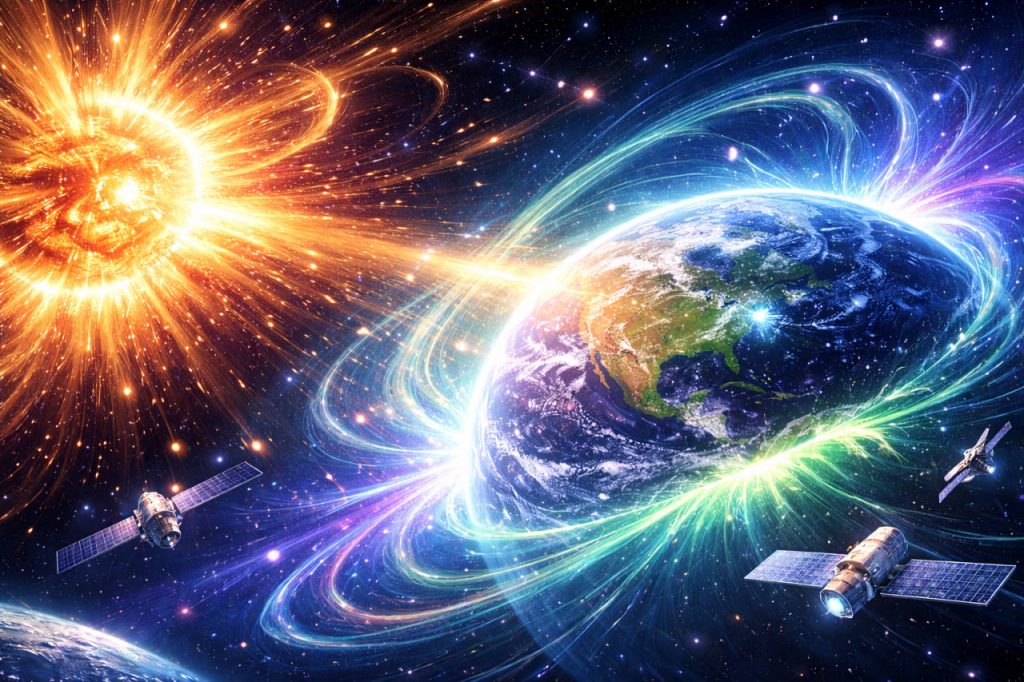
A radiation storm is a powerful space-weather event caused by intense bursts of energetic particles released by the Sun. Unlike hurricanes or lightning storms, radiation storms are invisible to the human eye, yet their effects can extend across the entire planet. These storms occur when solar eruptions accelerate protons and other charged particles to near-light speeds, sending them racing through the solar system. When Earth lies in their path, the planet’s magnetic field and atmosphere absorb much of the impact, but not without consequences. Radiation storms can disrupt satellites, endanger astronauts, and interfere with communication and navigation systems. Understanding how these storms form and affect Earth is essential in an age increasingly dependent on space-based technology.
How Radiation Storms Form
Radiation storms originate from solar flares and coronal mass ejections, both of which release enormous amounts of energy from the Sun’s surface. During these events, magnetic fields suddenly reorganize and fling charged particles into space. When the particles are sufficiently energetic, they can penetrate deep into Earth’s magnetosphere. The fastest particles may arrive within minutes, leaving little time for warning. According to space physicist Dr. Laura Bennett:
“Radiation storms are the Sun’s fastest messengers,
carrying energy across space in a matter of minutes.”
Their speed and intensity make them among the most dangerous forms of space weather.
Interaction with Earth’s Magnetic Shield
Earth is protected by a powerful magnetosphere, which deflects many incoming charged particles. However, during strong radiation storms, some particles spiral along magnetic field lines toward the polar regions. There, they collide with atmospheric molecules, triggering enhanced auroras and increased radiation levels at high altitudes. While the surface remains mostly shielded, aircraft flying near the poles and satellites in orbit can be exposed to elevated radiation. This interaction shows that Earth’s magnetic field is not an impenetrable barrier, but a dynamic shield that can be stressed during extreme solar activity.
Effects on Technology and Infrastructure
Radiation storms pose a serious risk to modern technology. High-energy particles can damage satellite electronics, corrupt data, and shorten the lifespan of space hardware. Navigation systems, including GPS, may become less accurate or temporarily unavailable. Radio communication, especially at high frequencies, can be disrupted as charged particles alter the ionosphere. In extreme cases, radiation storms contribute to broader space-weather events that induce electrical currents in power grids, increasing the risk of equipment damage. As reliance on satellites grows, so does the importance of monitoring and forecasting radiation storms.
Risks to Humans in Space and Aviation
For astronauts, radiation storms represent one of the greatest hazards of space travel. Outside Earth’s atmosphere, exposure to energetic particles increases the risk of radiation sickness and long-term health effects. Space agencies closely monitor solar activity and design spacecraft with protective shielding and safe zones. High-altitude and polar aviation routes are also affected, as increased radiation levels can raise exposure for flight crews and passengers. During strong storms, airlines may reroute flights to lower latitudes to reduce risk. These precautions highlight how space weather directly influences human activity far beyond Earth’s surface.
Monitoring and Forecasting Radiation Storms
Scientists use a network of space-based observatories and ground stations to monitor solar activity in real time. By tracking solar flares, particle flux, and magnetic field changes, researchers can issue warnings before the most intense particles arrive. While forecasting has improved significantly, predicting the exact strength and impact of radiation storms remains challenging. Ongoing research aims to refine models and extend warning times, helping societies better prepare for extreme solar events. Radiation storms serve as a reminder that Earth is deeply connected to processes occurring far beyond its atmosphere.
Interesting Facts
- Radiation storms can reach Earth within minutes of a powerful solar eruption.
- The strongest storms are most dangerous to satellites and astronauts, not people on the ground.
- Enhanced auroras during radiation storms can be visible far from the polar regions.
- Solar activity follows an approximately 11-year cycle of rising and falling intensity.
- Some radiation storms have been detected as far away as Mars and Jupiter.
Glossary
- Radiation Storm — a surge of high-energy charged particles originating from the Sun.
- Solar Flare — a sudden release of energy from the Sun’s atmosphere.
- Coronal Mass Ejection — a massive cloud of solar plasma ejected into space.
- Magnetosphere — the region around Earth dominated by its magnetic field.
- Ionosphere — an upper layer of Earth’s atmosphere affected by charged particles.