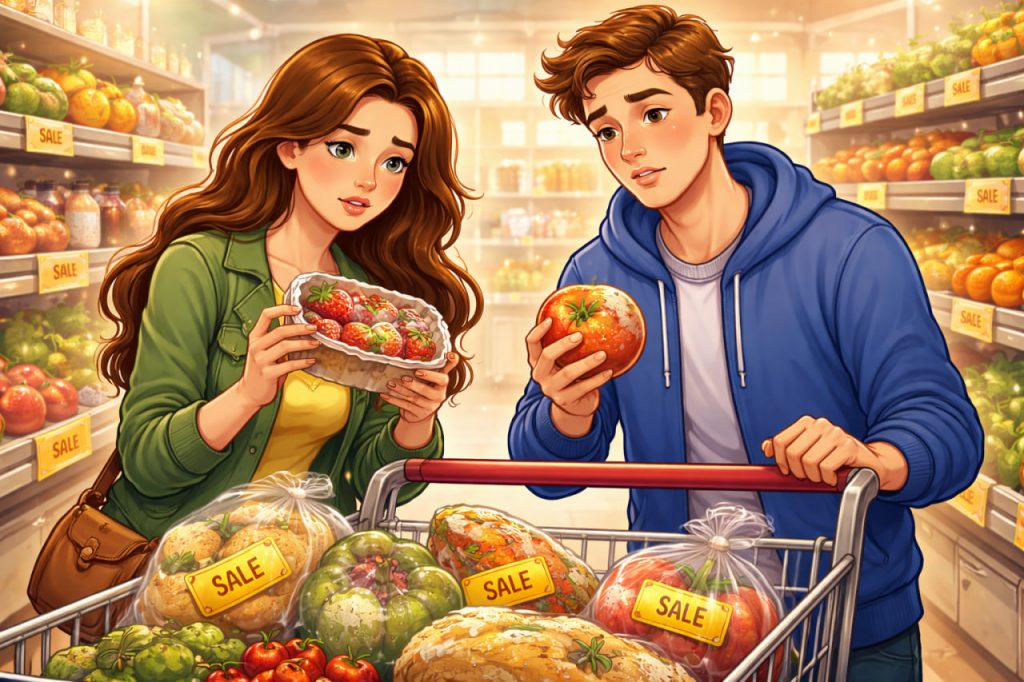
Discounted food products with visible signs of spoilage often raise an important question: can they still be safely consumed if only part of the product appears damaged? Many people encounter fruits, vegetables, bread, or cheese sold at reduced prices due to minor defects or early spoilage. While such products may seem economical and environmentally friendly, food safety experts urge caution. Spoilage is not always limited to what the eye can see, and microorganisms responsible for decay may spread beyond visibly affected areas. Understanding how rot develops and how it differs between food types is essential for making informed decisions and protecting health.
What Causes Rot and Spoilage in Food
Rot is primarily caused by microorganisms such as bacteria, molds, and yeasts that break down organic matter. These organisms thrive in moist, nutrient-rich environments and can spread quickly within food products. While surface damage may look localized, microscopic growth often extends deeper into the product. Some molds produce mycotoxins, which are invisible, heat-stable compounds that can remain even after cutting away spoiled sections. Food safety researcher Dr. Helen Moore explains:
“Visible rot is often only the surface signal of a much larger microbial network
already present inside the food.”
This is why appearance alone is not a reliable indicator of safety.
Foods Where Trimming May Be Acceptable
In certain cases, removing the affected portion of a food product may significantly reduce risk. Hard vegetables such as carrots, cabbage, or bell peppers have dense structures that limit the spread of microorganisms. If spoilage is minimal and clearly localized, cutting away a generous margin around the damaged area may remove most of the contamination. Similarly, hard cheeses can sometimes be salvaged by removing at least 2–3 centimeters around mold growth. These foods have lower moisture content, which slows microbial penetration and toxin spread.
Foods That Should Not Be Consumed
Many foods are unsafe to eat once any sign of rot appears. Soft fruits like berries, peaches, or tomatoes allow mold and bacteria to spread rapidly throughout the flesh. Bread, soft cheeses, cooked foods, and processed products should also be discarded if mold or rot is visible. In these cases, microorganisms can infiltrate the entire product even if only one spot appears spoiled. According to food safety specialist Dr. Marcus Allen:
“If a food is soft or moist, visible rot usually means the whole product is compromised,
even if most of it looks normal.”
Consuming such foods increases the risk of gastrointestinal distress and toxin exposure.
Health Risks and Hidden Dangers
The primary concern with eating partially spoiled food is exposure to harmful bacteria or toxins that are not destroyed by cooking or freezing. Some mycotoxins are associated with long-term health risks when consumed repeatedly, even in small amounts. Vulnerable populations, including children, elderly individuals, and those with weakened immune systems, face higher risks. While occasional exposure does not guarantee illness, food safety authorities consistently emphasize prevention rather than risk-taking. Choosing safety over savings is often the wiser long-term decision.
Economic and Environmental Considerations
Discounted foods are often marketed as a way to reduce food waste, which is an important environmental goal. However, reducing waste should not come at the expense of health. Many experts recommend prioritizing cosmetically imperfect but fresh products rather than items showing actual spoilage. Proper storage, timely consumption, and informed purchasing decisions help balance sustainability with safety. Being selective about discounted products ensures that cost savings do not lead to unintended consequences.
Interesting Facts
- Some molds produce toxins that cannot be removed by cooking or freezing.
- Hard cheeses and dense vegetables slow microbial spread due to low moisture content.
- Food spoilage often begins internally before becoming visible on the surface.
- Discounted food programs significantly reduce waste but rely on consumer awareness.
- Not all bad smells indicate danger, but visible rot is a strong warning sign.
Glossary
- Microorganisms — microscopic bacteria, molds, and yeasts that cause food spoilage.
- Mycotoxins — toxic compounds produced by certain molds.
- Food Spoilage — the process of food deterioration due to microbial activity.
- Cross-Contamination — the spread of harmful microorganisms from one area to another.
- Moisture Content — the amount of water in food that affects microbial growth.