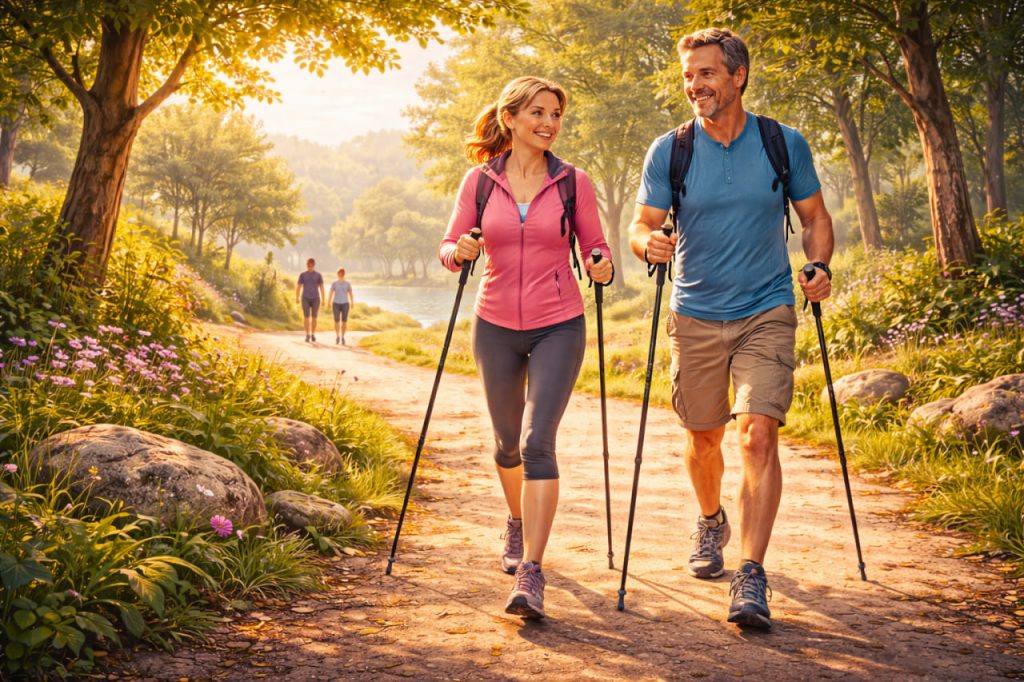
Nordic walking is a form of physical activity that originated in Northern Europe and has gained global popularity for its simplicity and effectiveness. At first glance, it looks like ordinary walking with poles, but biomechanically it is a full-body movement engaging far more muscles than regular walking. Nordic walking combines cardiovascular exercise with coordination and strength elements, making it suitable for a wide range of people. It is widely used in fitness, rehabilitation, and outdoor recreation. Understanding how Nordic walking works explains why it is often underestimated. This activity demonstrates how small changes in movement technique can significantly alter physical load.
What Nordic Walking Actually Is
Nordic walking involves walking with specially designed poles while using a specific movement pattern. The poles are not for balance support, but for active propulsion, engaging the arms, shoulders, and upper body. Proper technique includes coordinated arm swing, pole planting, and posture control. This creates a diagonal movement pattern similar to cross-country skiing. According to sports scientist Dr. Henrik Larsen:
“Nordic walking transforms walking into a whole-body exercise
by redistributing effort across both upper and lower muscles.”
This distinction separates Nordic walking from casual hiking with sticks.
Muscle Engagement and Energy Use
One of the key benefits of Nordic walking is increased muscle activation. In addition to legs and hips, muscles of the arms, chest, back, and core are actively involved. This broader engagement increases energy expenditure compared to normal walking at the same speed. The workload is distributed more evenly across the body, reducing excessive strain on individual joints. As a result, Nordic walking can feel easier while being more physically demanding at the same time.
Joint Load and Movement Safety
Nordic walking is often praised for its low-impact nature. The use of poles helps redistribute forces and reduce load on knees, hips, and lower back. This makes it suitable for people seeking joint-friendly activity or gradual return to movement. Proper technique is essential to achieve these benefits. When done correctly, Nordic walking supports natural gait mechanics rather than altering them unnaturally.
Cardiovascular and Coordination Benefits
From a cardiovascular perspective, Nordic walking elevates heart rate more effectively than regular walking. At the same time, the rhythmic coordination between arms and legs improves motor control and balance. Outdoor practice adds additional benefits related to mental well-being and environmental stimulation. These combined effects explain why Nordic walking is commonly used in structured physical activity programs.
Why Nordic Walking Is Widely Used
Nordic walking is accessible, adaptable, and scalable. It requires minimal equipment and can be practiced on various terrains. Intensity can be easily adjusted by speed, pole technique, and terrain choice. These qualities make it popular among different age groups and fitness levels. Nordic walking illustrates how thoughtful movement design can support sustainable physical activity.
Interesting Facts
- Nordic walking engages up to 90% of body muscles.
- It originated as off-season training for cross-country skiers.
- Energy expenditure can be 20–40% higher than regular walking.
- Proper pole technique is more important than walking speed.
- Nordic walking is widely used in rehabilitation programs.
Glossary
- Nordic Walking — a walking technique using poles for active propulsion.
- Diagonal Gait — coordinated movement of opposite arm and leg.
- Muscle Activation — engagement of muscles during movement.
- Low-Impact Exercise — activity that minimizes joint stress.
- Propulsion — forward movement generated by applied force.