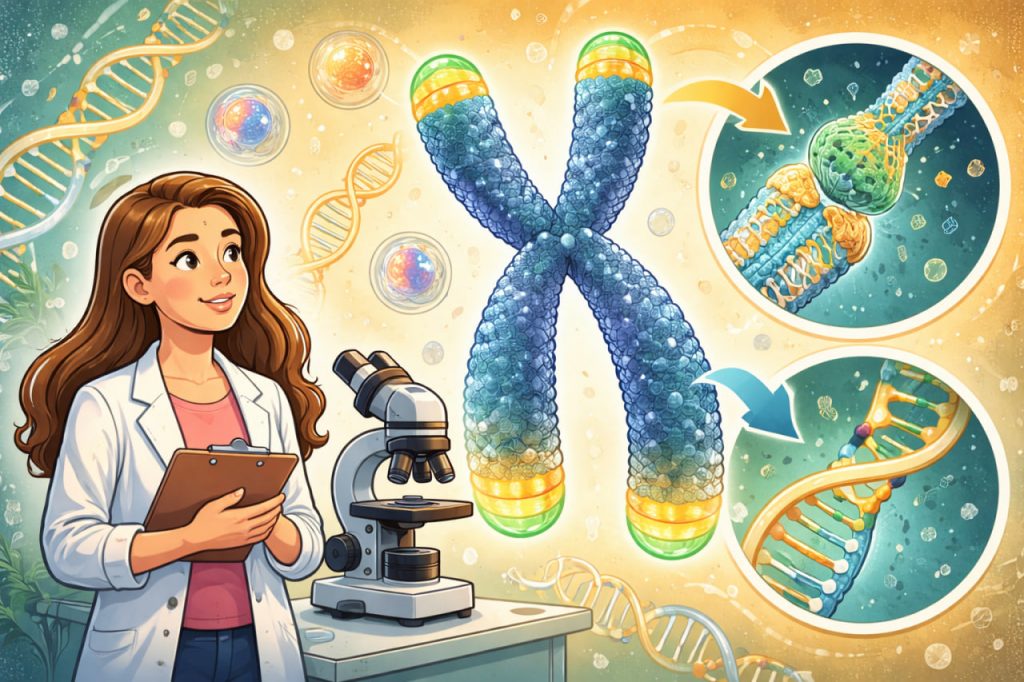
Telomeres and telomerase play a central role in how cells age, divide, and maintain genetic stability over time. Every time a cell divides, it must copy its DNA, a process that is remarkably accurate but not perfect at the very ends of chromosomes. Telomeres act as protective caps that preserve essential genetic information during these divisions. As cells continue to divide throughout life, telomeres gradually shorten, influencing cellular lifespan and function. Telomerase, a specialized enzyme, can rebuild these protective ends under specific conditions. Understanding this system provides key insights into aging, cellular health, and the limits of biological renewal.
What Are Telomeres
Telomeres are repetitive DNA sequences located at the ends of chromosomes, functioning much like the plastic tips on shoelaces that prevent fraying. Their primary role is to protect chromosomes from damage and from being mistaken for broken DNA. Without telomeres, vital genetic information could be lost during cell division. Each division slightly shortens telomeres because the DNA replication machinery cannot fully copy chromosome ends. Over time, this shortening acts as a biological counter, limiting how many times a cell can divide safely. According to molecular biologist Dr. Rebecca Moore:
“Telomeres are not passive structures.
They actively determine how long a cell can function properly.”
This makes telomeres a key factor in cellular aging.
Telomerase and Cellular Maintenance
Telomerase is an enzyme that can extend telomeres by adding new DNA repeats to chromosome ends. It is highly active in early development, stem cells, and certain immune cells, where frequent division is necessary. In most adult somatic cells, telomerase activity is very low or absent, allowing telomeres to shorten gradually. This balance helps protect the body from uncontrolled cell division. Telomerase does not make cells immortal in a normal biological context; instead, it supports controlled renewal in specific tissues. Its precise regulation is critical for maintaining cellular integrity.
Telomeres, Aging, and Cellular Senescence
As telomeres become critically short, cells enter a state known as cellular senescence, where they stop dividing but remain metabolically active. Senescence acts as a protective mechanism, preventing damaged cells from proliferating. However, the accumulation of senescent cells over time is associated with tissue aging and reduced regenerative capacity. Telomere shortening is therefore considered one of the biological hallmarks of aging. Scientists emphasize that aging is multifactorial, and telomeres represent one important piece of a much larger puzzle.
Telomerase and Cancer Biology
Telomerase plays a complex role in cancer biology. Many cancer cells reactivate telomerase, allowing them to divide indefinitely without telomere shortening. This ability contributes to uncontrolled growth, one of cancer’s defining features. However, telomerase alone does not cause cancer; it works alongside genetic mutations and environmental factors. According to cancer researcher Dr. Daniel Hughes:
“Telomerase does not create cancer by itself,
but it enables cancer cells to escape normal biological limits.”
This dual role makes telomerase both a subject of intense research and careful regulation.
Why Telomeres Matter for Science
Telomeres and telomerase have reshaped how scientists think about cell lifespan, regeneration, and biological limits. Research in this field influences studies on aging, immune function, and genetic stability. Telomere length is also explored as a biomarker for cellular stress and long-term health trends, though interpretation requires caution. Importantly, telomere biology highlights the balance between renewal and restraint that defines living systems. Rather than offering simple solutions, this field underscores the complexity of biological aging.
Interesting Facts
- Human telomeres shorten by roughly 50–200 DNA bases with each cell division.
- Telomerase was discovered in the 1980s, reshaping modern cell biology.
- Stem cells maintain longer telomeres to support tissue regeneration.
- Telomere shortening acts as a natural barrier against uncontrolled cell division.
- Different species have vastly different telomere lengths and aging patterns.
Glossary
- Telomeres — protective DNA sequences at the ends of chromosomes.
- Telomerase — an enzyme that extends telomeres by adding DNA repeats.
- Cellular Senescence — a state in which cells stop dividing permanently.
- Chromosome — a DNA structure containing genetic information.
- Somatic Cells — all body cells except reproductive cells.