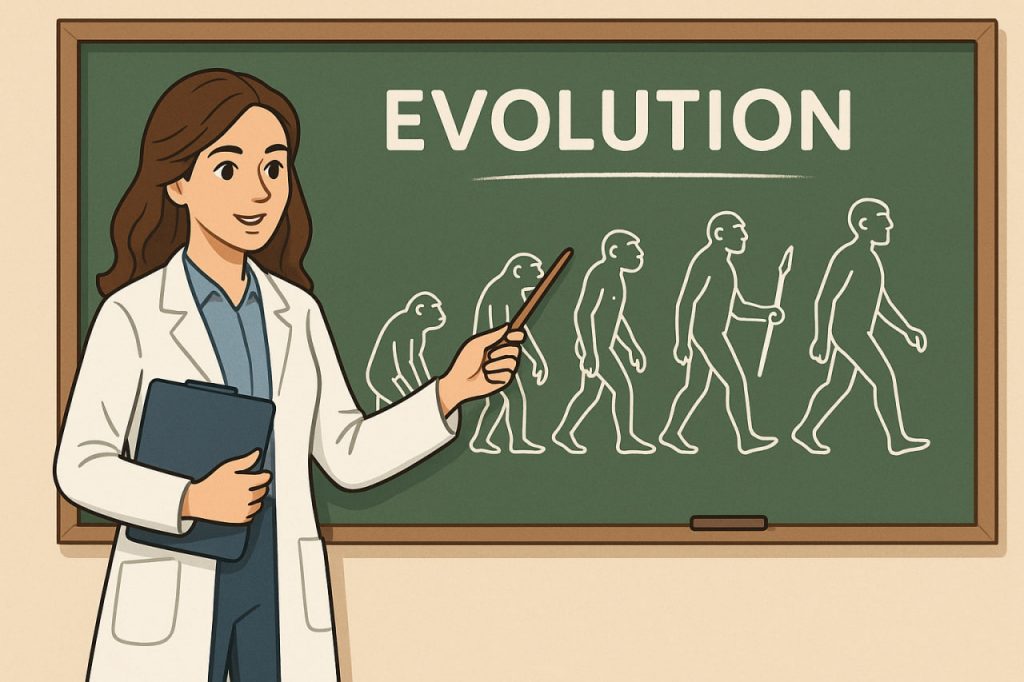
The question of who appeared first — a man or a woman — has been asked in many cultures throughout history, often appearing in myths, religious stories, and philosophical discussions. However, from a scientific standpoint, the answer is far more complex and cannot be reduced to a simple sequence. Human beings evolved through millions of years of biological development, during which early populations gradually acquired characteristics that define modern males and females. Sex is not created suddenly in evolution; instead, it is inherited from earlier species, each carrying genetic systems that eventually shaped the human male and female forms. Because evolution acts on populations rather than individuals, it is scientifically inaccurate to suggest that either a “first man” or a “first woman” appeared in isolation. Instead, both sexes co-evolved as part of long, connected lineages.
In evolutionary biology, the existence of two sexes predates humans by hundreds of millions of years. Early vertebrates — ancient fish and amphibian-like creatures — already had genetic mechanisms resembling those found in humans today. Over time, these systems became more specialized, leading to distinct reproductive roles. This means that male and female traits emerged long before humans existed, and early human ancestors inherited these traits from earlier species, not through the sudden appearance of a fully formed man or woman. According to evolutionary anthropologist Dr. William Harper:
“Evolution does not create a first man or a first woman —
it shapes populations where male and female characteristics gradually become what we define today.”
This understanding helps explain why the question has no simple answer in scientific terms.
Genetic Evidence and the Role of Ancestral Lineages
Modern genetics reveals two important concepts often discussed in relation to human origins: Mitochondrial Eve and Y-chromosomal Adam. These terms refer to the most recent individuals from whom all humans today inherit specific genetic lines — maternal and paternal, respectively. However, these individuals did not live at the same time, nor were they the only humans of their era. Mitochondrial Eve lived roughly 150,000–200,000 years ago, while Y-chromosomal Adam may have lived tens of thousands of years earlier or later, depending on genetic variation. These figures represent lineage bottlenecks, not the first man or woman. They help scientists understand human ancestry but do not imply that humanity began with a single pair.
How Early Human Populations Evolved
Human evolution involved entire groups of early hominins — such as Homo habilis, Homo erectus, and later Homo sapiens. These populations consisted of both males and females who reproduced, migrated, and gradually adapted to environments. Over generations, natural selection shaped physical and behavioral differences, producing the diversity seen today. The idea of one sex appearing before the other does not match evolutionary processes, which rely on reproduction and therefore require both sexes to exist simultaneously in a population.
Why the Question Persists Across Cultures
The question “Who came first?” remains culturally significant because it touches on identity, origin stories, and human curiosity. Many traditional narratives provide symbolic answers that reflect cultural beliefs rather than scientific evidence. These stories often explore themes of balance, creation, responsibility, and the relationship between genders. While science approaches the question through genetics and fossils, cultural interpretations enrich our understanding of how societies imagine human beginnings.
What Science Ultimately Concludes
From an evolutionary viewpoint, neither man nor woman appeared first. Instead, both sexes are the result of a shared evolutionary pathway that stretches back through countless generations. Humans emerged as populations of early hominins, not as isolated individuals. The question becomes less about sequence and more about understanding the continuity of life on Earth. As evolutionary biologist Dr. Elena Marquez notes:
“The origin of humans is a story of populations evolving together —
not one sex emerging before the other, but both forming parts of the same evolutionary whole.”
This perspective highlights the interconnectedness of male and female evolution throughout natural history.
Interesting Facts
- The genes determining male and female development evolved over 300 million years ago in early vertebrates.
- All humans inherit mitochondria exclusively from their mothers, which helps identify maternal ancestry.
- Fossil evidence shows early hominin populations, not individual “first humans,” living in Africa over 2 million years ago.
- Many animals, including some fish and plants, can change sex — highlighting how flexible biological sex can be in nature.
- Mitochondrial Eve and Y-chromosomal Adam were not a couple, nor did they live at the same time.
Glossary
- Mitochondrial Eve — the most recent woman whose mitochondrial DNA is shared by all living humans.
- Y-chromosomal Adam — the most recent man whose Y-chromosome is shared by all living male humans.
- Hominins — species in the human evolutionary lineage.
- Sex Determination — biological processes that shape male and female characteristics.
- Lineage Bottleneck — a reduction in genetic diversity that causes certain ancestral lines to dominate future generations.