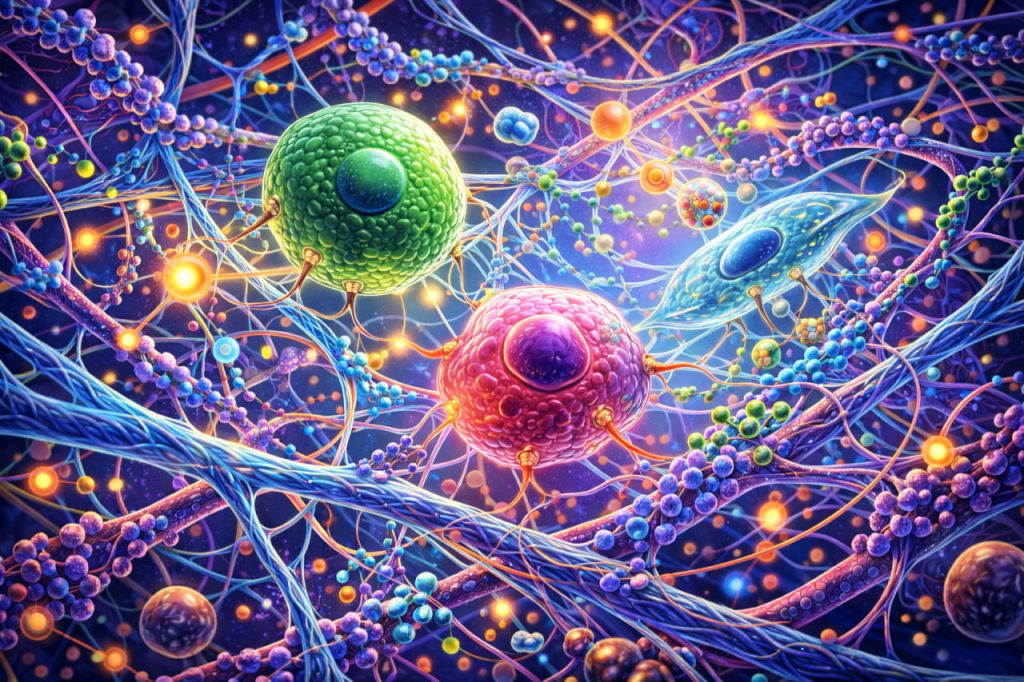
The extracellular matrix is no longer viewed as a passive scaffold that merely holds cells in place. Modern research reveals it as a dynamic, information-rich system that actively regulates how cells grow, move, communicate, and adapt to their environment. Composed of proteins, sugars, and signaling molecules, the extracellular matrix shapes tissue structure while simultaneously influencing cellular behavior. Advances in imaging, molecular biology, and computational modeling have transformed our understanding of how this matrix functions across different organs. Scientists now describe it as a key interface between mechanical forces and biological responses. Exploring the latest research on the extracellular matrix helps explain how tissues maintain stability, respond to stress, and change over time.
Structure and Core Components
The extracellular matrix is a complex network built primarily from collagen fibers, elastin, proteoglycans, and glycoproteins. Each component contributes specific physical and biochemical properties, such as strength, elasticity, and hydration. Collagen provides tensile stability, while elastin allows tissues to stretch and recoil. Proteoglycans attract water, creating cushioning and enabling nutrient diffusion. Importantly, the precise composition of the matrix varies between tissues, allowing bone, skin, cartilage, and brain tissue to function in very different ways. According to cell biologist Dr. Laura Stein:
“The extracellular matrix is not uniform —
it is customized at the molecular level for each tissue’s function.”
This specialization is central to how organs maintain their unique properties.
The Matrix as a Signaling Platform
Recent studies emphasize that the extracellular matrix acts as a biological signaling hub, not just a structural framework. Cells interact with the matrix through surface receptors that sense stiffness, composition, and spatial organization. These interactions influence gene expression, cell differentiation, and migration. Mechanical signals transmitted through the matrix can alter cellular behavior without changing chemical signals. This process, known as mechanotransduction, explains how physical forces shape biological outcomes. The matrix therefore participates directly in communication between cells and their environment.
Dynamic Remodeling and Adaptation
One of the most important discoveries in recent research is that the extracellular matrix is constantly remodeled. Cells produce enzymes that break down matrix components while simultaneously synthesizing new ones. This continuous turnover allows tissues to adapt to growth, injury, and changing mechanical demands. Remodeling plays a role in development, aging, and tissue maintenance. However, excessive or disorganized remodeling can disrupt normal tissue structure. Understanding how balance is maintained within this system is a major focus of current research.
Extracellular Matrix and Tissue Microenvironments
Modern research increasingly focuses on the concept of microenvironments, small-scale regions where cells experience unique matrix conditions. Variations in stiffness, fiber alignment, and molecular composition create localized signals that guide cell behavior. These microenvironments help explain why identical cells behave differently depending on their location within a tissue. Advanced imaging techniques now allow scientists to map matrix organization at extremely high resolution. These findings are reshaping how researchers interpret tissue complexity and cellular diversity.
Technological Advances Driving New Discoveries
Progress in extracellular matrix research has been accelerated by new technologies. High-resolution microscopy, three-dimensional cell culture systems, and bioengineered matrices allow scientists to study matrix–cell interactions in controlled environments. Computational models help predict how changes in matrix structure affect tissue behavior. These tools move research beyond static observation toward dynamic, system-level understanding. As technology advances, the extracellular matrix is increasingly seen as an active regulator rather than a background structure.
Future Directions in Matrix Research
Looking ahead, researchers aim to integrate extracellular matrix studies with systems biology and biomechanics. Understanding how matrix properties change over time may clarify processes such as development and aging. Scientists are also investigating how matrix patterns differ across species, offering evolutionary insights. While many questions remain unanswered, the extracellular matrix has emerged as a central theme in modern biology. Its study continues to redefine how scientists understand tissue organization and cellular behavior.
Interesting Facts
- The extracellular matrix can transmit mechanical signals faster than chemical signals.
- Matrix composition differs dramatically between tissues, even within the same organ.
- Cells can sense stiffness changes at scales smaller than a single micron.
- Matrix remodeling occurs continuously throughout life.
- Advanced imaging can now visualize matrix fibers in three dimensions.
Glossary
- Extracellular Matrix — a network of molecules surrounding cells that provides structural and signaling support.
- Collagen — a protein responsible for tensile strength in tissues.
- Proteoglycan — a molecule that binds water and supports tissue hydration.
- Mechanotransduction — the process by which cells convert mechanical signals into biological responses.
- Microenvironment — a localized region with specific physical and biochemical conditions.