
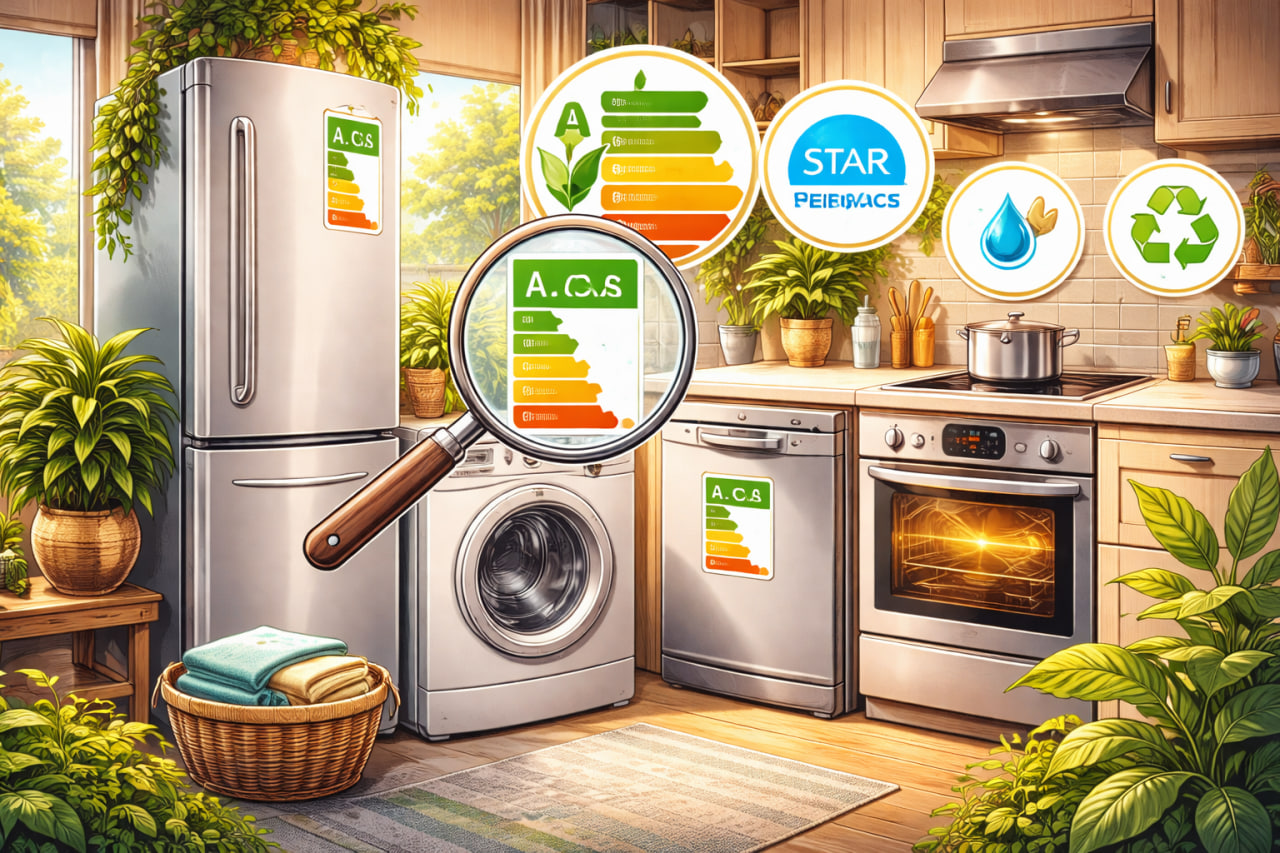
Choosing eco-friendly home appliances is not just about saving electricity—it’s about reducing long-term environmental impact while maintaining everyday comfort. Modern appliances vary widely in efficiency, materials, and lifecycle footprint, and marketing claims can be misleading. Labels and classes exist to help consumers make informed choices, but only when they are understood correctly. Energy efficiency, water use, durability, and recyclability all matter. Learning how to read certifications and compare real indicators allows buyers to choose appliances that are genuinely better for the planet and for household budgets.
Energy Efficiency Classes: What They Really Mean
Energy efficiency classes provide a standardized way to compare how much energy appliances consume. In the EU, rescaled labels for product groups such as refrigerators, washing machines, and dishwashers run from A (most efficient) to G (least efficient), replacing older scales that included “A+++”. The class reflects energy use under standardized test conditions, allowing fair comparison between similar models. Importantly, two appliances with the same class can still differ in absolute consumption if their sizes or capacities differ. Always compare efficiency classes within the same category and size range to get meaningful results.
Understanding Energy Labels
Energy labels summarize key performance data at a glance. The units depend on the product: EU refrigerator labels show kilowatt-hours per year, while EU washing machine and dishwasher labels show kilowatt-hours per 100 eco-programme cycles and litres of water per cycle. Labels may also show noise levels and capacity. In Europe, the standardized energy label provides transparent, comparable information across brands. In other markets, certifications like Energy Star indicate that a product meets strict efficiency criteria. For EU energy labels, suppliers declare the values using prescribed methods, and market surveillance authorities can check them. ENERGY STAR, by contrast, requires third-party certification. Reading the full label helps identify trade-offs between performance and efficiency.
Water Efficiency and Resource Use
For appliances such as washing machines and dishwashers, water efficiency is just as important as electricity use. Efficient models reduce water consumption per cycle without compromising cleaning performance. Some labels include water usage per operation, allowing comparison between models. Using less water can also save energy if less water needs to be heated to the same temperature. Choosing appliances that optimize both resources significantly reduces environmental footprint over time.
Durability and Repairability
An often overlooked aspect of eco-friendliness is product lifespan. Appliances that last longer and can be repaired create less waste and reduce the need for new resource extraction. Some manufacturers now publish repairability scores or provide extended spare-parts availability. A slightly less efficient appliance that lasts twice as long may be more sustainable than a highly efficient model with a short lifespan. Longevity is a key element of true environmental responsibility.
Materials and End-of-Life Considerations
Eco-friendly appliances also consider what happens at the end of their life cycle. Models designed with recyclable materials and modular components are easier to disassemble and recycle. Some brands participate in take-back or recycling programs to reduce landfill waste. Avoiding excessive mixed plastics and prioritizing metal components improves recyclability. These factors are rarely visible at first glance, but they strongly influence environmental impact.
Avoiding Greenwashing
Not all “green” claims are meaningful. A broad claim such as “environmentally friendly” is not itself a certification. In the EU, however, “eco 40-60” on washing machines and “eco” on dishwashers identify programmes specified by ecodesign rules and used to determine label values. Reliable indicators include official energy labels, third-party certifications, and transparent technical specifications. Comparing standardized metrics is more trustworthy than relying on branding language. True eco-friendly appliances demonstrate measurable performance improvements, not vague promises.
Making a Balanced Decision
The most sustainable choice balances efficiency, durability, and suitability for real household needs. Oversized appliances waste energy, while underpowered ones may require repeated use. Selecting the right capacity, using eco-modes properly, and maintaining appliances extends their benefits. Eco-friendly choices work best when combined with responsible usage habits. Informed selection empowers consumers to reduce environmental impact without sacrificing quality of life.
Interesting Facts
- Updated energy labels removed “A+++” to improve clarity and comparison.
- Water efficiency often reduces energy use indirectly.
- Durable appliances generate less waste over time.
- EU energy label values are declared by suppliers and can be checked by market surveillance authorities.
- Proper sizing is as important as efficiency class.
Glossary
- Energy Efficiency Class — a rating based on product-specific efficiency criteria, not a measure of absolute energy use.
- Energy Label — an official label showing key performance indicators.
- Water Efficiency — how much water is needed to perform a given task, such as washing a specified load to the same standard.
- Repairability — how easily a product can be maintained and fixed.
- Greenwashing — misleading claims about environmental benefits.