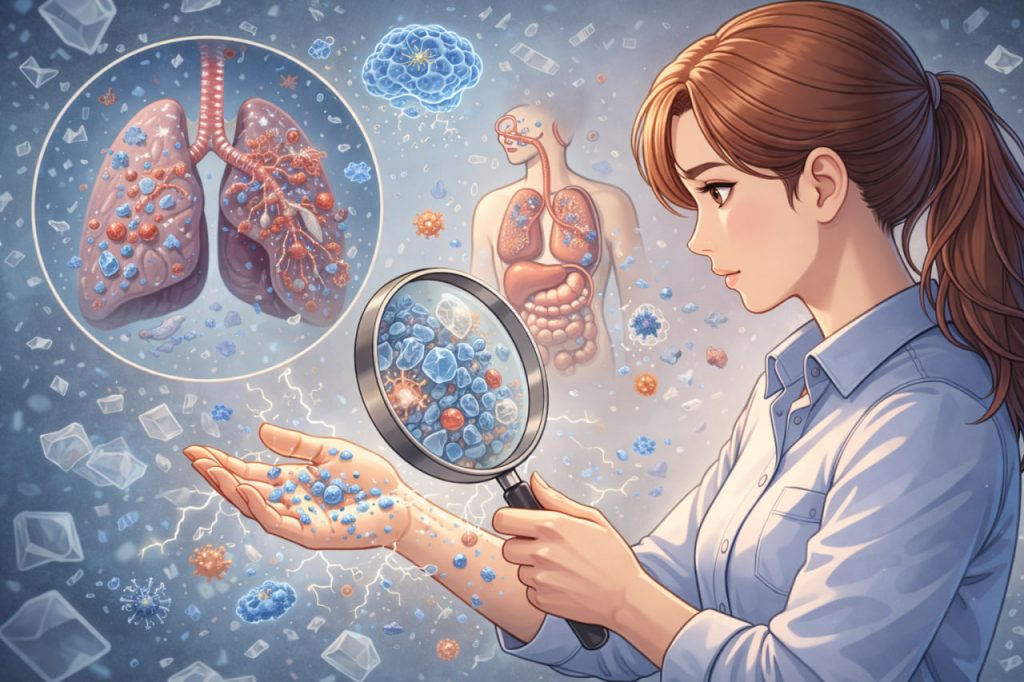
Plastic is no longer just an external material surrounding humans—it has become an internal environmental factor. Microplastics and nanoplastics are now detected in human blood, lungs, intestines, and even the placenta. One of the key but rarely discussed mechanisms behind their behavior is electrostatic charge. Static electricity does not simply cause plastic to cling or crackle; it fundamentally alters how plastic particles interact with air, chemicals, cells, and biological tissues. Understanding this interaction is essential for assessing real health risks in the modern world.
Electrostatic Charge as a Key Property of Plastic
Plastic is an electrical insulator, meaning it easily accumulates and retains excess electrons. When plastic fragments—especially microscopic ones—are exposed to friction, airflow, or contact with other materials, they become electrostatically charged. Unlike larger objects, micro- and nanoplastic particles have an extremely high surface-to-volume ratio, which allows them to hold charge more efficiently and for longer periods. This charge directly influences how they move, what they attract, and where they end up in the human body.
Microplastics, Nanoplastics, and Static Attraction
Microplastics (particles smaller than 5 mm) and nanoplastics (often smaller than 1 micrometer) behave differently from visible plastic. When electrostatically charged, these particles act as mobile collectors of pollutants. They attract heavy metals, airborne toxins, bacteria, and chemical residues far more effectively than neutral particles. This means plastic fragments are not just foreign bodies—they often carry concentrated chemical cargo into the human organism.
Electrostatic Charge and Entry Into the Human Body
Electrostatically charged micro- and nanoplastics are more likely to remain suspended in the air and adhere to surfaces, skin, and respiratory pathways. Charged particles penetrate deeper into the lungs and are less easily expelled by natural defense mechanisms. In the digestive system, electrostatic interactions may increase adhesion to intestinal walls, prolonging contact with tissues. This increases the likelihood of translocation—the movement of particles from the gut or lungs into the bloodstream.
Plastic Particles Inside the Human Body
Recent studies have confirmed the presence of microplastics in human blood, lungs, liver, and reproductive tissues. While research is ongoing, electrostatic charge is considered a factor that influences how long particles remain in tissues and how they interact with cells. Charged nanoplastics may interfere with cell membranes, disrupt signaling processes, and increase inflammatory responses. Their electrical properties may also affect protein binding and immune recognition.
Interaction With the Nervous and Immune Systems
Nanoplastics are small enough to cross biological barriers, including the blood–brain barrier in some experimental models. Electrostatic charge may enhance this process by facilitating interaction with charged biological molecules. The immune system may recognize these particles as foreign but struggle to eliminate them, leading to chronic low-grade inflammation. While definitive long-term outcomes are still being studied, the combination of size, persistence, and electrical charge raises legitimate concern.
Why This Is a Modern Problem
Historically, humans were not exposed to electrically charged synthetic particles at this scale. The rapid increase in plastic production over the past 70 years has created a novel environmental condition. Indoor environments rich in synthetic materials, low humidity, and constant friction amplify electrostatic effects. As plastic degrades into smaller fragments, electrostatic behavior becomes more relevant—not less.
What Science Currently Knows—and What It Doesn’t
Current scientific consensus does not yet classify microplastics as acutely toxic in the traditional sense. However, researchers increasingly describe them as biologically active carriers rather than inert debris. Electrostatic charge is recognized as a mechanism that enhances particle persistence, mobility, and chemical binding. Long-term, low-dose exposure effects are still under investigation, but uncertainty does not equal safety.
Reducing Exposure and Electrostatic Effects
Practical steps can reduce electrostatic accumulation and plastic particle exposure. Maintaining adequate indoor humidity helps neutralize static charge. Regular wet cleaning reduces resuspension of charged particles. Ventilation lowers indoor particle concentration. Choosing natural materials when possible reduces sources of charged synthetic debris. These measures do not eliminate exposure, but they significantly reduce cumulative load.
Interesting Facts
- Nanoplastics can be smaller than viruses.
- Electrostatic charge increases particle adhesion to biological tissues.
- Microplastics have been detected in human blood and organs.
- Charged particles remain airborne longer than neutral ones.
- Indoor environments amplify electrostatic plastic behavior.
Glossary
- Microplastics — plastic particles smaller than 5 millimeters.
- Nanoplastics — plastic particles at the nanometer scale.
- Electrostatic Charge — accumulation of electrical charge on a surface.
- Translocation — movement of particles across biological barriers.
- Inflammatory Response — immune reaction to foreign materials.